

When I first started paying closer attention to Falcon Finance, it stood out for a reason that has nothing to do with hype. Falcon doesn’t shout. It builds. In a market crowded with bold promises and fast narratives, Falcon has taken a quieter, more deliberate path — one focused on solving a very real DeFi problem: how to turn idle assets into productive, usable liquidity without forcing users to sell what they believe in.
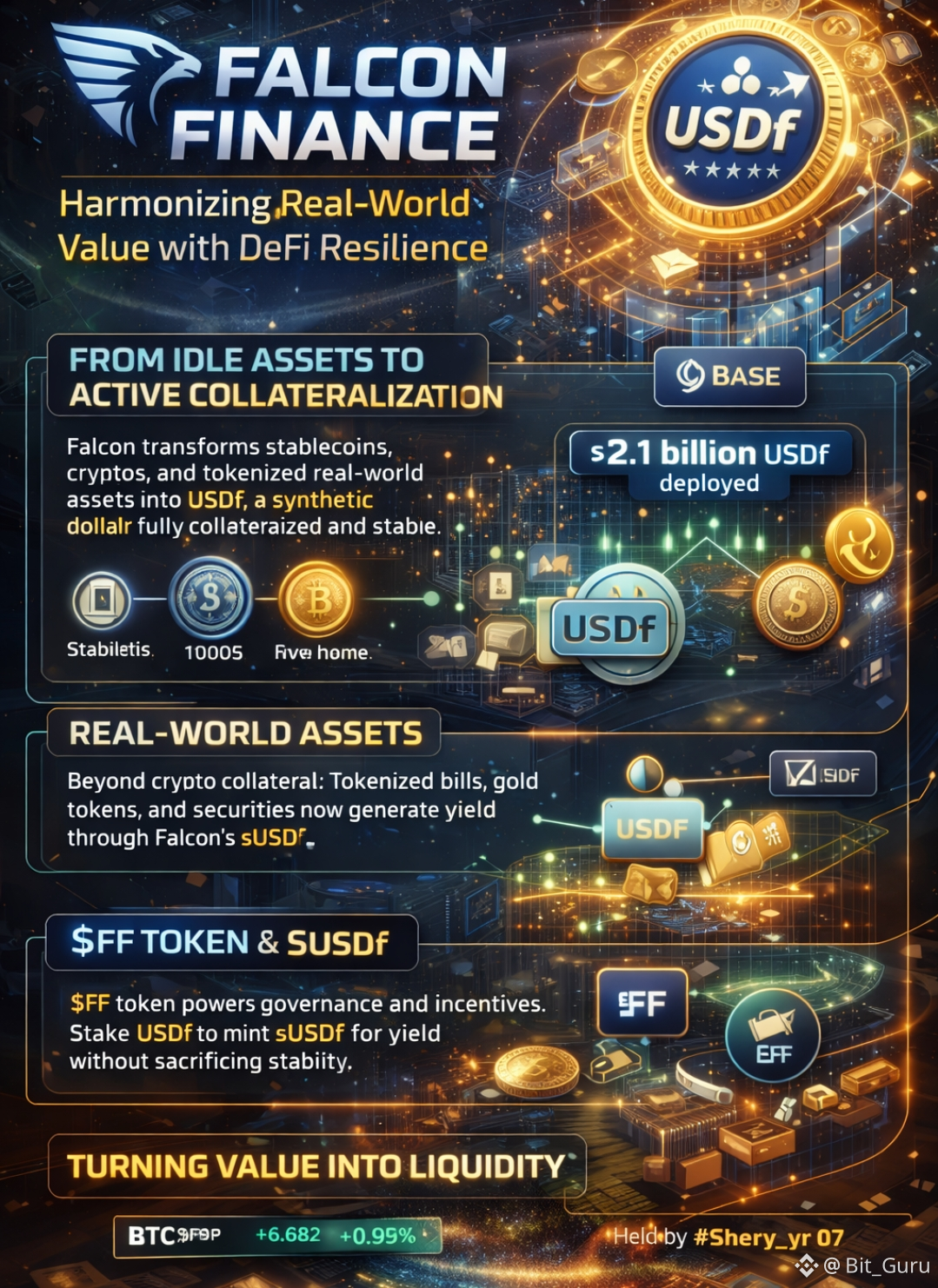
At its core, Falcon Finance is designing a universal collateralization layer. Instead of limiting users to a short list of approved crypto assets, Falcon opens the door to stablecoins, blue-chip cryptocurrencies, and tokenized real-world assets. These deposits back USDf, Falcon’s over-collateralized synthetic dollar, built to maintain stability while remaining fully on-chain. This approach allows users to unlock liquidity while preserving exposure — a powerful alternative to the traditional “hold or sell” dilemma.
What makes this more than theory is traction. On the Base network, Falcon has already deployed over $2.1 billion worth of USDf, signaling real demand from traders, institutions, and advanced DeFi participants. Stablecoins are the backbone of on-chain finance, and Falcon’s model expands how that backbone is supported. By linking diverse collateral types into a single unit of account, it deepens liquidity across the ecosystem while giving asset holders flexibility that previously didn’t exist.
Falcon’s growing focus on tokenized real-world assets (RWAs) is especially important. Beyond crypto collateral, the protocol now supports assets like government bills, gold-backed tokens, and tokenized securities. These assets can be deposited into Falcon vaults to mint USDf and even earn yield through sUSDf, the protocol’s yield-bearing stable asset. This structure reflects lessons learned from earlier stablecoin failures: conservative over-collateralization, transparent reserves, and diversified risk.
The launch of the $FF token adds another layer, enabling governance participation and long-term ecosystem alignment. Rather than concentrating control, Falcon’s distribution emphasizes community incentives and institutional involvement, signaling an ambition to scale responsibly.
Falcon Finance is not without challenges — regulatory uncertainty and token volatility remain realities. But its progress is driven by substance, not speculation. With billions in active liquidity, multi-asset collateral support, and a clear bridge between traditional finance and DeFi, Falcon is quietly shaping what resilient, real-world-ready decentralized finance can look like.
This is not a promise of overnight disruption. It’s something more credible — a system being built to last.
$FF @Falcon Finance #FalconFinacne