

@APRO Oracle When people hear “blockchain” or “smart contracts,” they think about tokens, wallets, and DeFi. But the most important thing under all of it is data.Smart contracts don’t have senses. They sit inside a blockchain and do exactly what they’re told, and nothing more. If you want them to react to the outside world like a price change, a shipment arriving, or a legal document being signed you need a way to bring that information in. That’s where oracles come in, and APRO is one of the newest takes on this problem.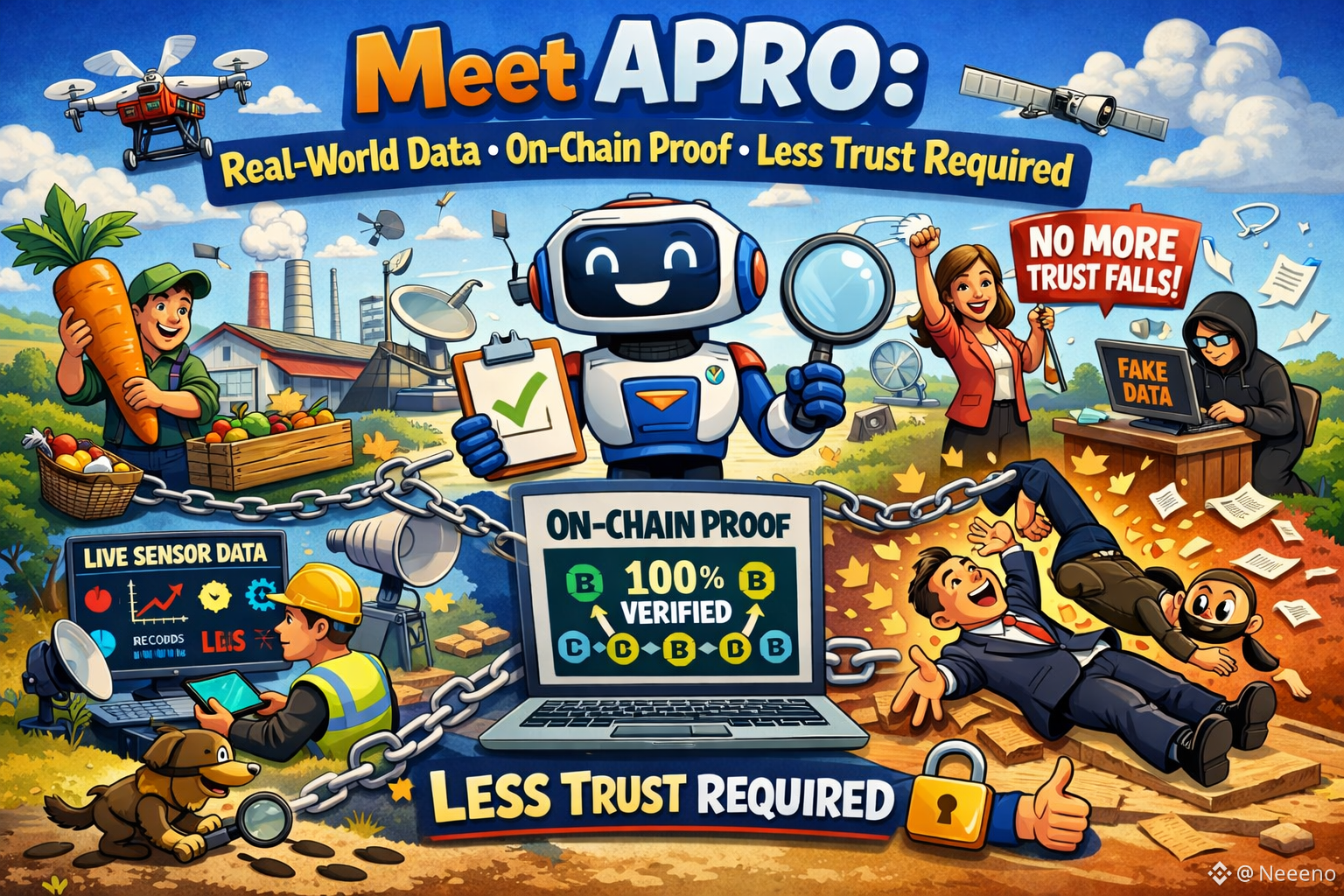
At its heart, APRO is a decentralized oracle network—a piece of software infrastructure that connects off-chain, real-world information with on-chain applications. That part isn’t new. Projects like Chainlink have been doing oracle work for years. What makes APRO feel like a fresh chapter is the way it tries to push beyond just simple price feeds into a broader, more nuanced idea of verified reality on the blockchain.
Traditionally, an oracle’s job has been to fetch a number—say the price of an asset—and deliver it to a smart contract. That’s useful, but it’s also a limited view of what smart contracts might need if they’re going to drive real economic activity. APRO aims to go deeper by bringing more complex, real-world signals—reserve statements, shipment logs, documents, audit reports—into a format that can be verified and used on-chain. It does this with a combination of machine learning, cross-source reconciliation, and cryptographic proofs so that the data isn’t just delivered, it’s trusted.
APRO is designed so users don’t have to rely on one central party. That makes its approach feel especially relevant right now.. Five years ago, most Web3 applications were about swapping tokens or minting NFTs. Today, builders are talking about tokenized real-world assets, autonomous AI agents that manage money without human intervention, or DeFi protocols that settle contracts based on off-chain events. In all of those use cases, the difference between success and disaster isn’t some clever smart contract trick—it’s the quality of the data feeding it.
I was struck by how the project doesn’t just lean on older oracle patterns but tries to layer in intelligence and context to the data it provides. There are layers for collection, for validation, and ultimately for on-chain finalization. Nodes stake tokens, are rewarded for honest work, and can be slashed for misbehavior. Multiple data sources are compared. Anomalies get flagged. In practice, that means there are economic incentives aligned to encourage accuracy rather than speed or convenience alone. That design feels like a response to countless examples in crypto where shaky data has caused cascading failures.
Another interesting dimension is the project’s stance on machine learning and AI. It doesn’t use these terms as buzzwords. Instead, APRO employs models that sift through unstructured inputs—documents, reports, other messy data forms—that traditional oracles can’t handle well. It tries to turn this messiness into structured facts that a smart contract can act on. You can read that and feel the tension between the promise and the pitfalls: training models on real-world data isn’t easy, and the question of who certifies the certification still lingers. But there’s something earnest in the ambition, especially because this is exactly the kind of boundary where blockchain infrastructure is now being tested.
It’s also notable how quickly the ecosystem around APRO has grown. The network supports data feeds across dozens of blockchains and thousands of sources, and it’s backed by names that include institutional firms as well as crypto-native investors. That kind of cross-sector involvement hints at why this project matters now: companies and builders outside of pure token speculation are starting to look at blockchain not as a toy, but as a layer for real business logic—if the data layer is robust enough. That shift in mindset is real, and APRO’s approach feels tuned to it.
Of course, nothing about this is without risk.
There are lots of oracle projects, and verifying real-world data is hard. The token has been unstable early on, and decentralization vs. usability is still being argued. These are typical growing pains for infrastructure. In a way, watching APRO navigate them feels like watching a new kind of plumbing get installed in a city that’s suddenly trying to support skyscrapers. You don’t notice pipes until the water stops flowing; oracles are a lot like that.
What makes APRO worth paying attention to right now is that it sits at the intersection of several trends that are converging: the rise of AI agents that act autonomously on financial data, the tokenization of real assets that require trustworthy documentation, and the growing demand for blockchains to interact meaningfully with the outside world. It’s easy to fall into hype cycles in crypto, but when you strip that away, you’re left with a simple idea: if we want smart contracts to be more than code that moves tokens around, we have to figure out how to feed them truth. APRO is trying to do that, and that’s a conversation worth having

