

If you only glance at @Falcon Finance , it’s easy to file it away as “another stablecoin” or “another yield token.” The marketing around DeFi tends to push everything into those bins. But USDf feels like a different kind of bet. The real question isn’t whether it can hold a peg on a quiet day, or whether sUSDf can quote an attractive rate. The question is whether people will actually choose to use USDf as their working dollar unit when they already have USDC, USDT, and a growing list of synthetic dollars.
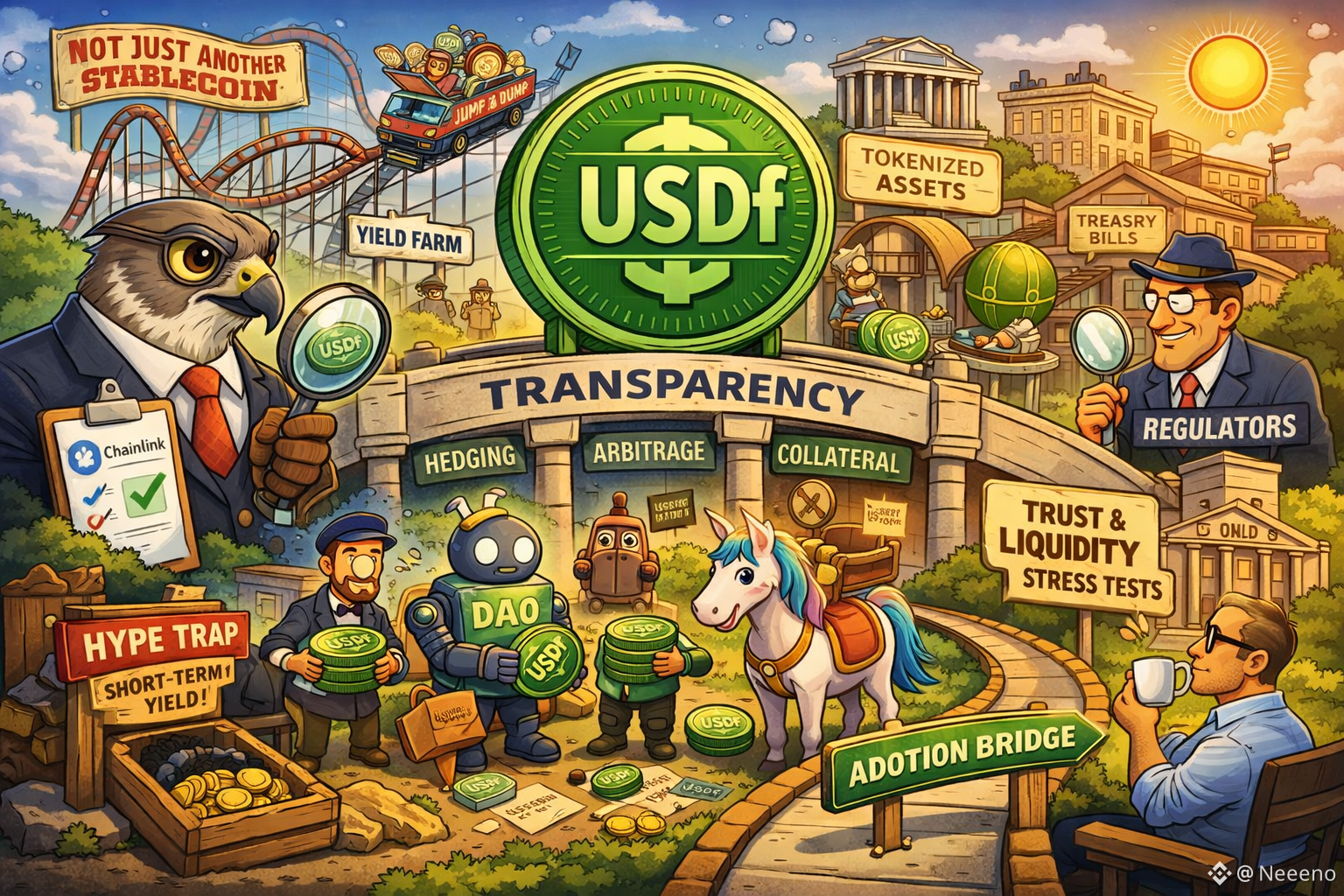
That shift in framing matters because the hardest part of any dollar-like asset onchain is not engineering. It’s habit. People reach for what’s already accepted, liquid, and easy to unwind at 2 a.m. during a market wobble. Falcon’s own documentation describes USDf as an overcollateralized synthetic dollar whose stability leans on hedging and arbitrage rather than simple cash reserves. That’s a meaningful design choice, but it doesn’t automatically translate into everyday usage. Mechanisms can be sound and still fail the “will people adopt it” test.
The reason this topic is showing up now is that the market has become unusually picky about what a “dollar” means. Over the last couple of years, we’ve watched projects like Ethena’s USDe prove there’s demand for synthetic dollars, while also showing how fragile sentiment can be when market conditions change. Meanwhile, regulators are closing in on stablecoin definitions, and institutions are exploring tokenized cash and government debt.
It’s a mix of trust, yield, and regulation, and Falcon wants to sit right in the middle. The big standout: Falcon puts a lot of effort into showing its work (transparency).Public materials emphasize real-time collateral validation using Chainlink tooling like price feeds and proof-of-reserve mechanisms. The point is to make the system checkable onchain, not dependent on reputation or opaque audits. That’s not the same as guaranteeing safety, but it fits the cultural mood of 2025: people want receipts. In crypto, especially after so many collapses and unverified claims, “show me, don’t tell me” has become more than a slogan—it’s the baseline expectation.
Distribution is another quiet but crucial factor. Falcon has rolled out USDf on networks like Base, where DeFi activity has been climbing fast. Availability doesn’t guarantee adoption, but it sets the stage for it. When a new asset appears in the same pools, lending markets, and trading venues where users already move capital, it becomes part of the furniture. Adoption in crypto doesn’t happen with a single moment of hype—it’s a slow process of convenience, trust, and repetition.
That’s why calling Falcon a “yield play” misses the point. Yield is a short-term magnet. It brings in capital, but that capital is fickle. Once rates compress, the only thing that remains is whether people actually want to hold the underlying token. For USDf, the real test isn’t how much sUSDf earns this week—it’s whether USDf becomes part of the default mental model of “dollars” onchain. If traders start quoting prices in USDf, if DAOs hold it as treasury cash, if protocols use it as collateral without being paid to, that’s real adoption.
The collateral story is where Falcon’s broader ambition shows. Traditional stablecoins are backed by cash equivalents, which keeps them simple but narrow. Falcon’s “universal collateralization” idea flips the question around: if you already hold valuable assets, why shouldn’t you be able to mint liquidity against them safely? It’s a bridge between asset management and money creation, hinting at a future where onchain portfolios can act more like balance sheets than wallets. And as tokenized real-world assets—like treasury bills and commercial debt—enter DeFi, Falcon’s model starts to feel less experimental and more like a glimpse of where things are going.
Of course, that makes the stakes higher too. If USDf relies on hedging and arbitrage to stay stable, it depends on deep, efficient markets. Liquidity isn’t a side issue—it’s the backbone. There have already been a few brief moments of stress when USDf slipped a bit off peg before recovering. Those aren’t necessarily red flags, but they do remind everyone that stability is built from behavior over time. People don’t just look at whitepapers; they look at how a token behaves when things go wrong. Trust in a digital dollar grows through memory, not marketing.
When I look at Falcon Finance, I see something trying to answer a harder question than most projects dare to ask: can a synthetic dollar become ordinary? Not glamorous, not a novelty, just the kind of thing people reach for without thinking twice. That’s the quiet ambition underneath all the design details. If USDf finds that rhythm—used across networks, accepted without incentives, seen as dependable when volatility spikes—it could become one of the few stable-value systems that actually earns its place.
And if it doesn’t? That’s worth watching too. Every attempt to build a better onchain dollar teaches the market something about trust, collateral, and design under pressure. The story of USDf is less about promising safety or high returns and more about testing whether crypto can build its own reliable foundation—one people will use not because they have to, but because it works.
@Falcon Finance #FalconFinance $FF

