

@APRO Oracle Not long ago, “sports data on blockchain” sounded like a side quest. Plenty of people could name a novelty prediction market or an NFT that moved with a player’s stats, but it was hard to argue the plumbing was ready for serious use. In late 2025, the conversation feels different, and the reason is oddly straightforward: more money is starting to sit on top of these outcomes, in more places, under more scrutiny. MarketWatch captured the shift by pointing to how much of Kalshi’s momentum has been tied to sports, with NFL trading repeatedly highlighted as a major driver. And when sports becomes the growth engine, the weakest link stops being user acquisition or on-chain settlement logic and becomes something less glamorous: getting the result right, fast, and defensibly.
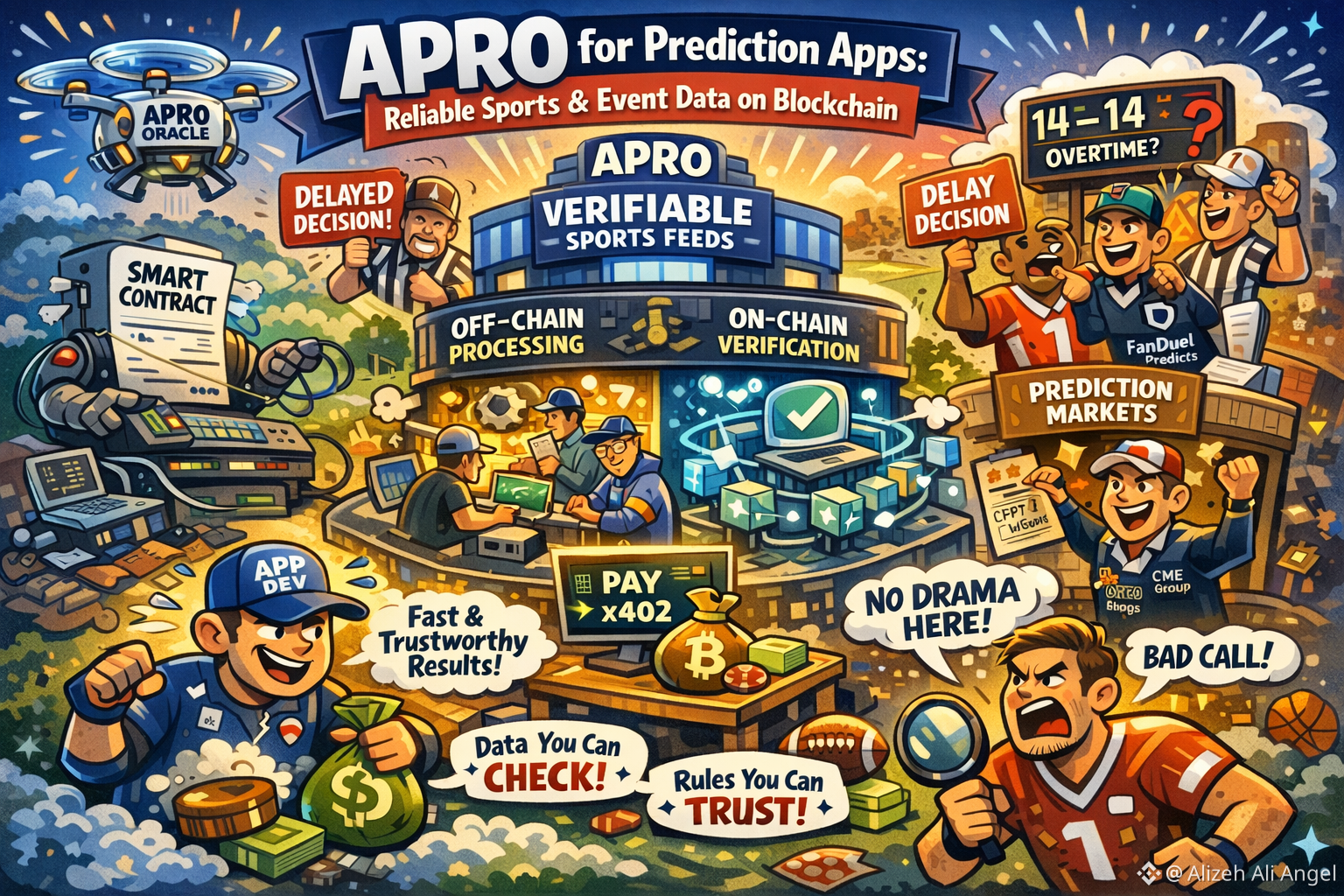
That’s where APRO becomes more than “another oracle.” If prediction apps are going to feel legitimate—whether they’re fully crypto-native or wrapped in regulated event-contract framing—they need a consistent way to answer one question: what is the outcome we’re settling against, and why should anyone trust it? APRO’s relevance is that it’s explicitly positioning itself around verifiable data delivery, not just “data delivery,” and it’s doing it with a design that tries to balance speed with accountability: off-chain processing for the heavy lifting, paired with on-chain verification so the final output isn’t just a vendor’s word.
If you build anything that pays out based on “who won,” you eventually learn that the hard part is not the payout logic. It’s agreeing on the truth quickly, and agreeing in a way people accept when they’re upset. Sports outcomes feel obvious until they aren’t. A match can be abandoned. A league can correct statistical hours later. An overtime format can change. Even the words “final” and “official” can mean different things depending on the sport, the country, and the data vendor. Prediction apps don’t just need an answer; they need a process for when the answer changes, or when the answer is temporarily unknowable.
The “smart but stuck in a box” version
Smart contracts are great at following rules, but they’re basically offline—they can’t look up real-world stuff on their own. So you need an oracle as the messenger that brings outside information on-chain. The simplest setup is: one source, one messenger, one update. The grown-up version looks more like financial market plumbing: redundancy, monitoring, and explicit failure modes. APRO’s documentation leans into that grown-up framing by describing “secure off-chain & on-chain” design—basically, do the collection and computation off-chain, but verify and expose results on-chain. ZetaChain’s APRO overview gets even more specific about how it can be consumed: a “push” model where operators publish updates on thresholds or time intervals, and a “pull” model for on-demand, higher-frequency access. That matters for sports because different markets have different tolerance for latency. A season-long futures contract can survive slower updates; an in-game market or a fast-closing player-prop style contract cannot.
The part that makes APRO feel especially relevant to prediction apps right now is that it’s not only talking about the oracle abstraction—it’s shipping sports feeds as a product line aimed directly at prediction markets. Multiple industry updates in late December 2025 reported APRO launching verifiable, near real-time sports data feeds and packaging access as an Oracle-as-a-Service subscription, with early coverage across several sports and the NFL named as an initial major league integration. Whether you love the “Oaks” label or roll your eyes at it, the packaging choice tells you who the buyer is supposed to be: teams building apps that don’t want to negotiate bespoke data plumbing every time they add a new league or market type.
This lands at the exact moment the market is getting crowded with serious entrants. DraftKings announced a standalone prediction markets app and framed it as trading event contracts under CFTC oversight, available broadly across the U.S., including sports event contracts in certain states. FanDuel and CME Group launched “FanDuel Predicts” in five states with phased expansion planned into early 2026, and Reuters noted sports-related event contracts as part of what the platform intends to offer. The wider implication is simple: if regulated brands treat “sports outcome contracts” as a legitimate format, then settlement integrity becomes a product feature, not back-office plumbing. Users may not care how the oracle works, but they absolutely care when a market resolves wrong or late.
There’s also an economics problem hiding under the technical one. Near real-time data is expensive: servers, node operators, monitoring, plus the messy work of edge cases. Here again, APRO is relevant because it’s pairing its sports feeds with a payment mechanism that fits how developers actually consume data. Those same reports about APRO’s sports launch pointed to support for x402. Coinbase describes x402 as a way to charge for digital access over plain HTTP by reviving the “402 Payment Required” response so clients can programmatically pay for an API request without traditional account and session overhead. If prediction apps are seasonal—and they are—metered access can be more realistic than a big fixed integration cost. It also makes it easier to experiment: try a niche league, see if users bite, and scale spend only if the market activity shows up.
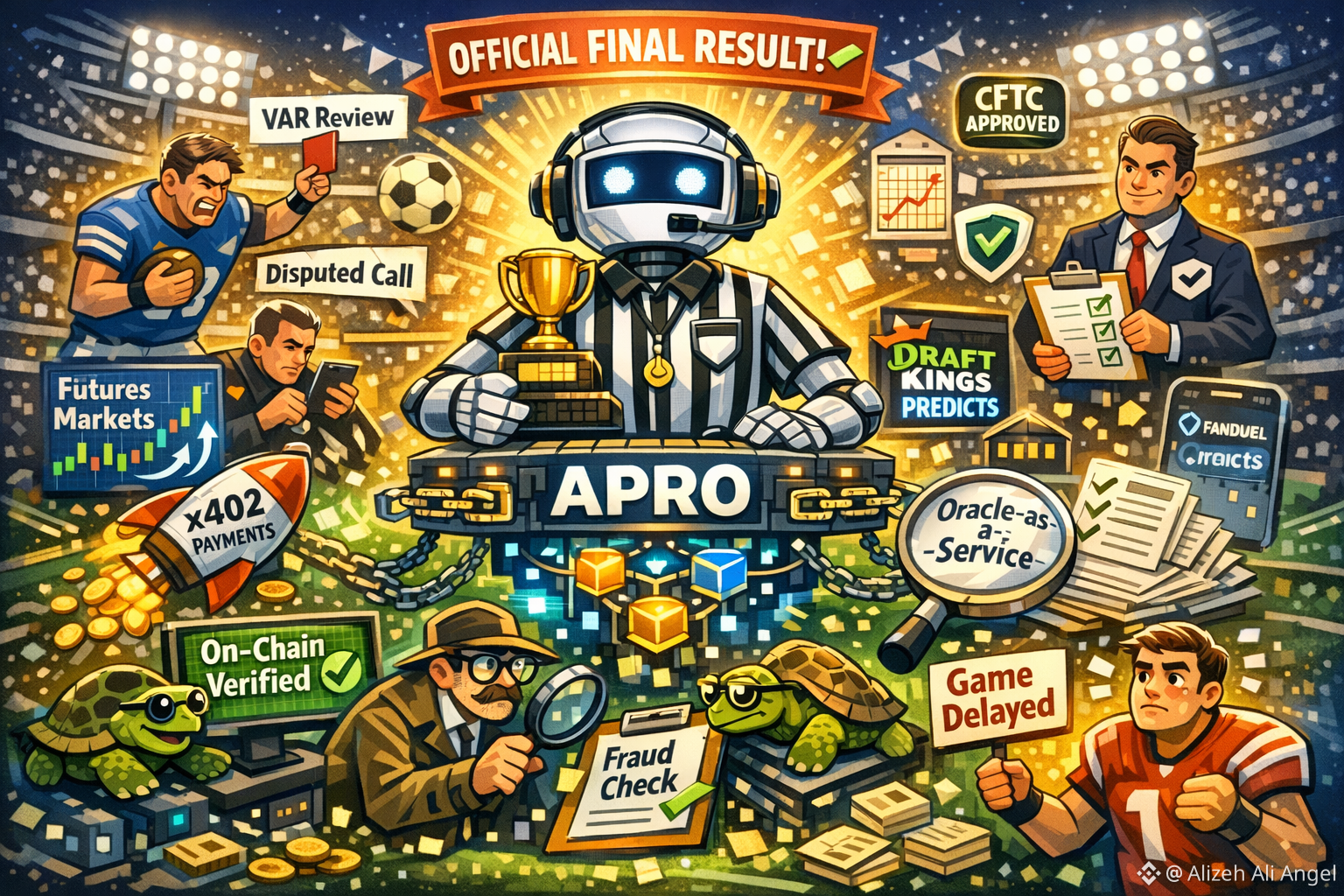
Where #APRO can matter most, though, is not the speed story. It’s the dispute story. “Verifiable” can mean different things: a provider signature, agreement across independent nodes, an audit trail, or a backstop that can challenge bad updates. APRO’s own FAQ describes a two-tier structure where an off-chain network handles oracle messaging and aggregation, with a second-tier backstop for fraud validation. The details matter less than the intent: build a system that assumes conflict will happen. Sports guarantees it. If a governing body delays an official decision, or reverses one, a responsible oracle stack needs published rules for how markets pause, resume, or re-resolve—because “just push the latest score” is how you turn a prediction app into a trust problem.
Then there’s the rights reality. “Official data” is a business, and not every app can afford it or negotiate it. This is one reason APRO’s hybrid framing is practically relevant. When data comes from multiple sources—some licensed, some public, some aggregated—the system has to show its work. Off-chain processing can clean and reconcile, while on-chain verification can at least make the output and its update history inspectable. That doesn’t solve licensing by itself, but it does help with the other quiet requirement: if you’re going to let people trade on outcomes, you need to reduce the chance that a single party can quietly rewrite history after users have taken risk.
The healthiest sign, honestly, is how unromantic the work has become. The next tests won’t be about grand narratives. They’ll be about uptime during peak games, about whether feed updates behave predictably across chains, and about what happens when a league dispute drags on for days. In that world, APRO’s “strong relevance” is simple and concrete: it’s aiming to be the settlement-grade bridge between messy real-world events and the strict finality that smart contracts demand, and it’s doing it at the moment prediction apps are being forced—by scale and by regulation—to take data quality personally.

