

Most traders don’t get burned because they can’t read a chart. They get burned because they don’t understand what they’re holding. AT, the ecosystem token of APRO, is one of those assets that looks simple on the surface, but its real value depends almost entirely on whether the network actually gets used. If you’re thinking about trading it short term or holding it long term, the smartest first step is to understand what AT is meant to do, what demand drivers it has, and what could quietly go wrong.
APRO positions itself as a decentralized oracle network. In plain words, it’s a system that brings real world and external data onto blockchains so apps can use it. That includes crypto prices, market feeds, and real world assets data. APRO also emphasizes an “AI enhanced” approach for handling data quality and complex feeds, and it supports multiple blockchains using different delivery methods, including data push and pull models.
So where does AT fit in?
AT is the token used inside this system as the fuel and the incentive layer. According to multiple sources describing APRO’s design, AT is used to pay for oracle requests and data services, to stake for network security (especially for node operators), to participate in governance, and to reward data providers and ecosystem participants. In other words, AT is meant to be demanded when APRO’s data is demanded.
This connection between token demand and real usage is the first thing investors should keep in mind. Some tokens exist mostly for marketing. AT is at least structured to be “spent” or “locked” for real network activity. That’s a good sign in theory, but theory only matters if builders and applications actually choose APRO over other oracle options. If APRO becomes a widely used data layer, AT gets natural demand. If adoption stays limited, AT demand may rely too heavily on speculation.
Now let’s talk numbers, because data matters.
Most market trackers list AT with a maximum supply of 1,000,000,000 tokens, and circulating supply around 250,000,000. That means only about a quarter of the supply is currently in circulation, which matters for future dilution. CoinMarketCap lists a circulating supply of 250 million AT out of a 1 billion max supply, with market cap sitting around the low tens of millions depending on the day.
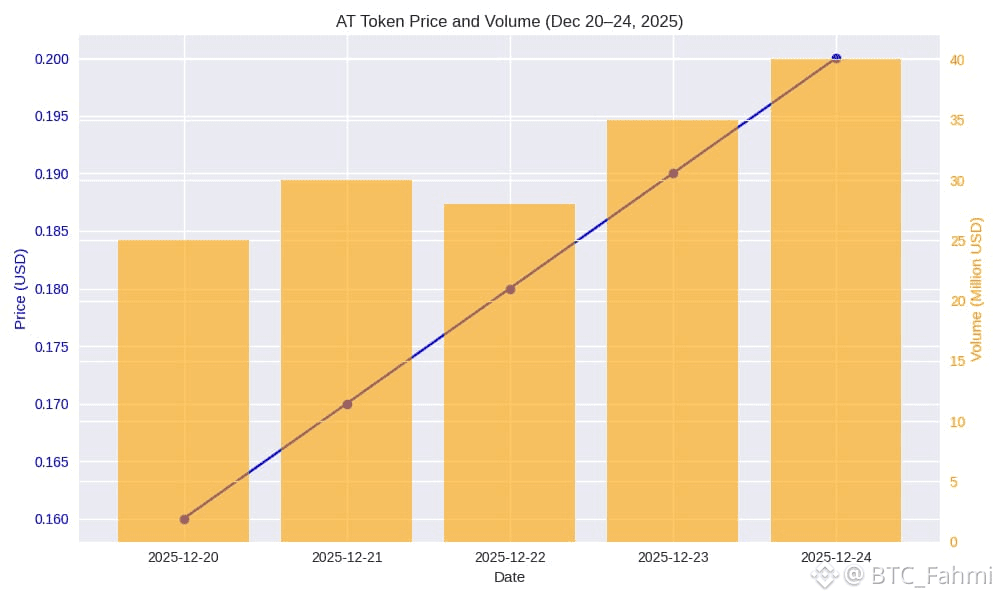
Price and volume recently have shown heavy activity. CoinMarketCap reported AT around the $0.16 to $0.19 range with very large 24 hour volume compared to its market cap, and CoinGecko also showed AT near $0.20 at the time of crawling. When you see volume that high relative to market cap, it usually means one thing: the token is being actively traded, and volatility is part of the package.
From a trader’s perspective, that volatility can be opportunity. From an investor’s perspective, it’s a warning label. A token can move fast in both directions, and even solid projects can see aggressive sell offs when early allocations unlock or market attention shifts.
One important timeline detail is that AT’s token generation event has been described as happening on October 24, 2025. That makes AT a relatively fresh asset in the market, and newer tokens often go through unstable discovery phases where price action is driven more by positioning than fundamentals.
If you’re evaluating AT for long term involvement, focus on the ecosystem reality, not the narrative. The strongest long term case for AT is straightforward: APRO becomes widely used infrastructure for DeFi, RWA apps, and cross chain systems needing reliable data feeds, and AT becomes the token that people must hold and spend to access those services and secure the network. Sources describing APRO emphasize multi chain oracle delivery, incentives for data providers, and staking based security as core pillars.
But every good story has pressure points, and APRO has a few that are worth saying out loud.
First, oracle networks live and die on trust. If data quality fails even once in a big way, adoption can stall. Second, oracle systems are complex, which increases the surface area for smart contract risk and operational failures. Third, integrating real world assets data is not only technical, it’s also about sourcing reliable feeds and convincing users those feeds are credible. One recent overview of APRO’s risks highlights technical complexity, oracle accuracy, security vulnerabilities, and adoption barriers as major challenges.
My personal take, in a completely non financial advice way, is this: AT looks like the kind of token that can reward patient holders only if APRO proves real traction with developers and protocols. It’s not the kind of asset where “belief” alone can carry it forever. As a trader, I’d treat it like a high activity market with sentiment swings. As an investor, I’d treat it like a business bet: adoption first, token second.
If you keep that mindset, AT becomes much easier to evaluate. Watch real usage, ecosystem integrations, and token supply changes over time. If those improve steadily, AT’s long term case strengthens. If they don’t, the token may remain mostly a vehicle for short term speculation, and that’s a very different game.

