
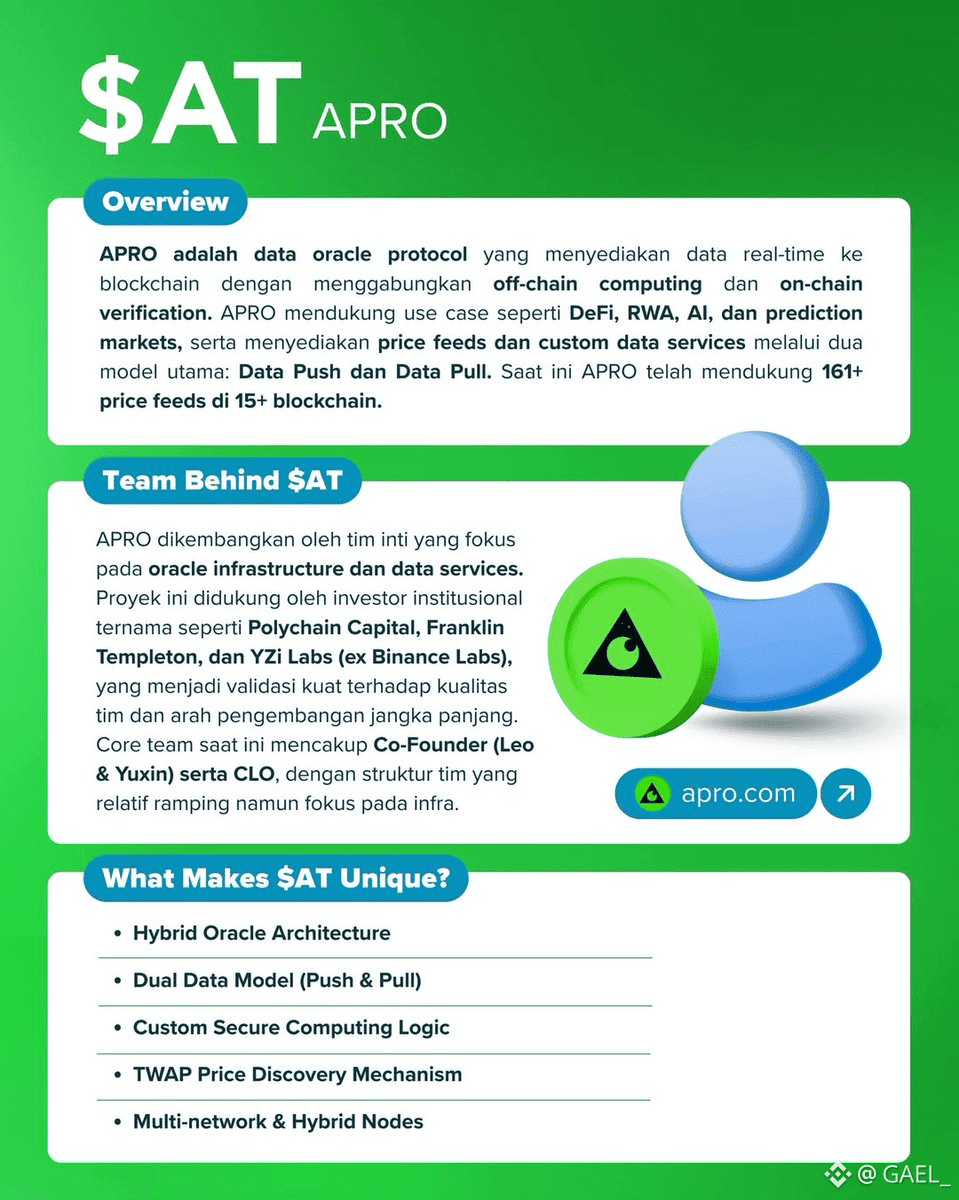
BUT FIRST! WHAT IS APRO ORACLE?
BACK TO THE ARTICLE ON DEFI:
There was a time when I could feel the pace of this space in my body. The constant checking. The restless scrolling. Every update felt urgent. Every new protocol arrived wrapped in volume and certainty. I did not question it then. I thought that was what progress sounded like.
Over time that noise stopped feeling like movement. It began to feel like friction. I noticed how quickly attention jumped from one place to another and how little stayed behind once it moved on. The louder something arrived, the faster it seemed to fade. What remained was a quiet sense that something important was being missed.
I started paying attention to what did not ask for me. The systems that did not demand a reaction. The tools that worked even when nobody was watching. In a space built on visibility, the most resilient pieces often sat in the background, unnoticed until they were absent.
That is when the idea of signal began to separate itself from noise for me. Signal was not louder. It was steadier. It did not need explanation every week. It showed up the same way regardless of the mood of the market or the attention of the crowd.
DeFi has matured in strange ways. We have more protocols than ever, more dashboards, more language to describe ourselves. Yet the core problems remain familiar. Trust in inputs. Coordination across systems. Decisions that depend on something outside the chain behaving honestly. These are not flashy problems. They are structural ones.
When I first noticed APRO, it was not through an announcement or a campaign. It appeared indirectly, through how other systems leaned on it. Builders referenced it casually, without emphasis. Integrations felt intentional rather than opportunistic. That subtlety stood out to me more than any headline could have.
The design philosophy felt restrained. Not minimal for aesthetics, but minimal for survival. There was no sense of trying to redefine everything at once. Instead, there was patience. A willingness to become reliable before becoming visible. In a culture that rewards speed, that choice felt almost out of place.
What I kept noticing was how data was treated. Not as a product to be marketed, but as a responsibility to be handled carefully. There is a difference between feeding applications information and shaping their behavior. When predictions turn into actions, the cost of being wrong grows heavier. That weight seemed acknowledged here.
I have watched many systems promise intelligence. Most confuse complexity with depth. True intelligence in decentralized systems feels quieter. It reduces assumptions rather than expanding them. It narrows uncertainty instead of performing confidence. That is closer to what I sensed here.
The ecosystem around it reflected the same tone. Conversations were slower. Builders spoke more about constraints than ambitions. Partnerships felt less like endorsements and more like alignment. These are subtle signals, but they accumulate. Over time they form a pattern that is hard to fake.
What interested me most was how adoption appeared. It was not celebrated loudly. It was noticed in behavior. Features being relied on without ceremony. Dependencies forming naturally. When a protocol becomes part of someone else’s critical path, it stops being an idea and starts becoming infrastructure.
I often think about endurance now more than innovation. The early years trained us to chase novelty. But novelty ages quickly. Endurance requires humility. It requires accepting that your work will disappear into other people’s systems. That success may look like invisibility.
There is a quiet confidence in building for that outcome. It suggests a belief that value compounds through reliability, not attention. That trust is earned slowly, often through uneventful days where nothing breaks and nothing trends.
The contrast with noise becomes clearer the longer I stay. Noise wants reaction. Signal waits. Noise measures itself constantly. Signal is measured by others, indirectly, through dependence. One exhausts quickly. The other settles in.
I do not think this approach is better in a moral sense. It is simply better suited for the stage DeFi has reached. As systems grow more interconnected, fragility hides in the smallest assumptions. Data feeds. Oracles. Decision layers. These are not places where drama helps.
Watching APRO grow into this role has reminded me why I entered this space in the first place. Not for spectacle, but for systems that could outlast moods. Systems that respect time as a design constraint rather than an enemy.
There is still noise everywhere. It is part of the environment now. I no longer feel the need to fight it. I just listen differently. I pay attention to what remains consistent when the volume drops.
Some protocols ask to be believed. Others ask to be used. The difference matters more to me than it used to.
When I step back, the signal is not a moment. It is a pattern. Quiet. Repeating. Unimpressed with itself. That is the kind of infrastructure that stays when everything else moves on.
$AT | #APRO | #DeFi | @APRO Oracle

