
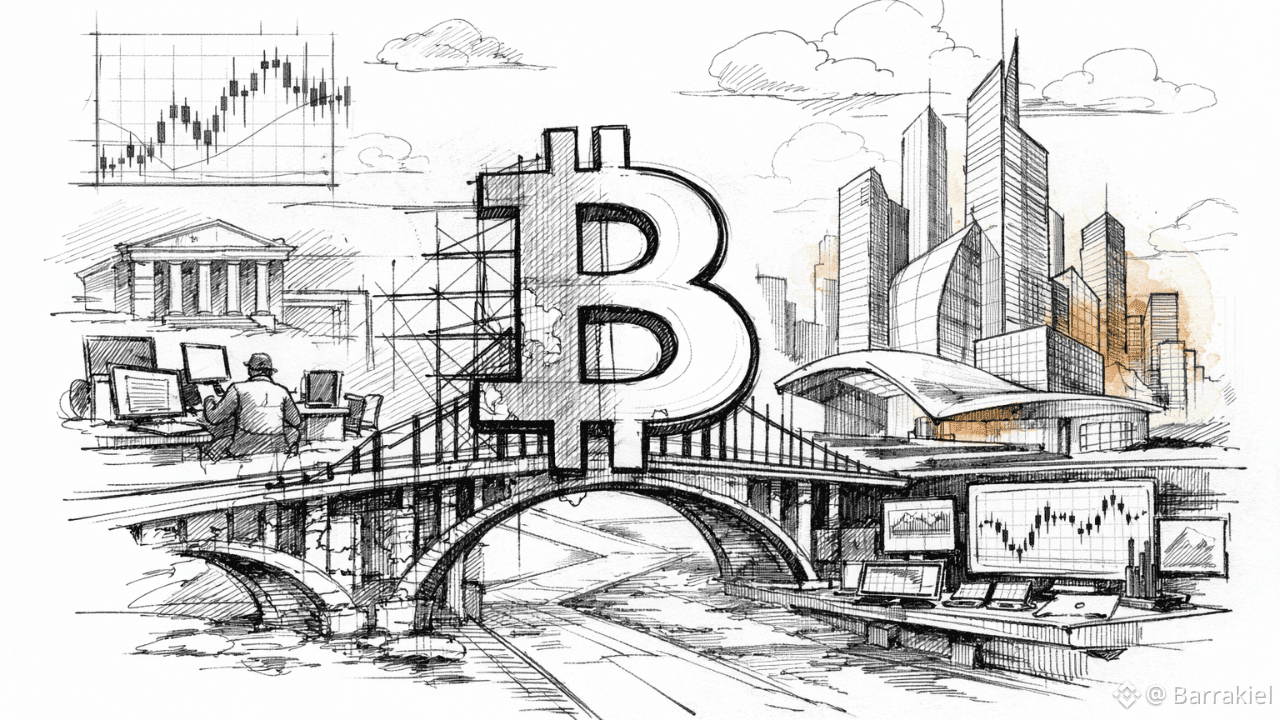
What does this mean for investors in 2026?
In the first two parts, we went through structural changes
cryptocurrency market and delved into the mechanisms that really drive it
price movements. We have seen the market transform from a retail
experiment on the institutional ecosystem and how derivatives, funding rates and
liquidation cascades create an invisible layer that determines where
price moves. Now it's time to ask the fundamental question: what is all this
does it mean for you as an investor or trader in 2026?
The answer is not simple, because there is no universal strategy,
that would work for everyone. But there are principles and mental models that
that will help you navigate an environment where old practices
stop working and where success requires a deeper understanding of how
the market really works.
Why context-free DCA can fail
Dollar Cost Averaging, i.e. regular purchases of a fixed amount without
regardless of price, is often presented as a safe strategy for
long-term investors. And in many cases it actually works. The problem is,
that DCA assumes that the market is moving up in the long term and that the short term
fluctuations are just noise that can be ignored.
In an environment where the market has undergone structural change and where institutions are managing
capital flows according to macroeconomic conditions, it can be purely
mechanical DCA suboptimal. If you buy during a period when funding
rates are extremely high, open interest is growing to unsustainable levels
and stablecoin supply is stagnant, you are probably buying close to the local
top.
This doesn't mean you should abandon regular investing. It does mean
that you should add context. Track the metrics we talked about
talked about in previous parts. When you see healthy fundamentals, increase
pace of purchases. When you see an overheated market, be more conservative. DCA with
Context is a much more powerful tool than blindly following a plan.
How to read the market without predicting the price
The biggest mistake most traders make is trying to predict exactly where
price will go. They draw lines on charts, look for formations and believe they have found
the key to the future. The reality is that the market is too complex to
was predictable in the short term. But that doesn't mean you can't
to have an advantage.
Instead of predicting the price, focus on reading the market structure. Ask yourself:
Who is under pressure? Where is the imbalance? What are the capital flows? How
do different groups of market participants behave?
When you see ETFs seeing consistent inflows, stablecoin
supply is growing, funding rates are neutral and open interest is growing
together with the price, you know that the market is in a healthy growth mode. You don't have to
know if bitcoin will reach 80 thousand or 100 thousand dollars. You just know,
that structure supports growth and that being in a position makes sense.
Conversely, when you see ETF outflows, declining stablecoin supply,
extreme funding rates and growing open interest with a stagnant price,
you know the market is vulnerable. Again, you don't have to predict the exact top.
Just know that the risk outweighs the potential reward.
This approach requires patience and a willingness to accept that you will not have
position at any given moment. But it greatly increases the likelihood that when
position you have, it will be on the right side of the market.
When is retail welcome and when is liquidity exit?
One of the hardest lessons for a retail trader to learn is the realization that
is not always welcome in the market. There are phases when retail capital is the fuel
for growth, and a phase where it is only liquidity for the exit of large players.
In the early stages of a bull run, when institutions are building positions and the market is
undervalued, retail capital is welcome. Every purchase helps push the price
up and creates a positive feedback loop. At this stage, everyone is on
same side.
But as the bull run progresses and the price reaches extreme levels,
The dynamics are changing. Institutions are starting to distribute their positions and need
buyers. Aggressive marketing campaigns appear at this stage,
influencers are screaming about new all-time highs and everywhere you hear "now or
never". This is the moment when retail often enters the market massively, right
when he should be most cautious.
How to tell the difference? Watch the behavior of smart money. When you see that
institutional flows slow or reverse, while retail FOMO
reaches its maximum, you are probably in the distribution phase. When you see the opposite
– institutions are buying and retail is apathetic or skeptical – you are
probably in the accumulation phase.
On Binance you can track top trader positions and long/short ratios,
which give you an idea of how retail is positioned versus
professionals. The great divergence between these groups is often
a signal that one of them is right and the other is wrong.
Mental models instead of price targets
Price targets are tempting because they give the illusion of control and certainty.
But in reality, they are often counterproductive. When you set
target at $100,000 for bitcoin, you are creating a mental anchor,
which influences your decision making. If the price reaches 95 thousand and turns
you will hold the position in the hope that it will reach your target, even if
The market structure is already signaling a turnaround.
Instead of price targets, use mental models based on market structure. For example:
Liquidity model: I hold the position as long as I see healthy capital flows and
increasing liquidity. When these conditions disappear, I close the position regardless
for the price.
Imbalance Model: I enter a position when I see a significant
imbalance between supply and demand. I close when the market returns to
balance.
Risk Model: My position size is determined by the market structure, not mine
opinion. When the structure is healthy, I increase exposure. When it is vulnerable,
I am reducing.
These models allow you to be flexible and respond to changing conditions, instead of being tied to arbitrary numbers.
Why patience is not passivity
In a cryptocurrency environment where the price can change by ten percent in
hour, it's easy to mistake patience for passivity. But those are two completely different things.
different things.
Passivity means doing nothing and hoping that things will turn out well.
Patience means actively watching the market, understanding its structure, and waiting.
at the moment when you have a real advantage. A patient trader makes fewer trades,
but each trade has a better probability of success.
In 2025, when the market is more sophisticated than ever before, it is
patience is a competitive advantage. While most traders react to every
movement and tries to seize every opportunity, a patient trader waits for
a situation where the market structure is clearly on his side.
This requires discipline and a willingness to accept that sometimes the best deal is
no trade. But in the long run this approach significantly increases
probability of success.
A practical framework for 2026
If you want to apply everything we've talked about into a practical strategy, here's a simple framework:
Spend time analyzing market structure every week. Track ETF flows,
stablecoin supply, open interest, funding rates a on-chain metriky.
Create a simple checklist that will tell you if the market is in
healthy or vulnerable state.
Divide your capital into three categories. Long-term holdings for assets,
that you believe in regardless of short-term fluctuations. Tactical allocation for
a situation where the market structure clearly supports a certain direction. Cash or
stablecoins for periods when there is no clear opportunity.
Use positioning as a risk management tool. When the structure is
If the market is healthy, increase exposure. If it is vulnerable, decrease. Size
The position should reflect your confidence in the structure, not your opinion of the price.
Keep a journal of your purchases and decisions. Don't just write down what you bought.
and sold, but why. What was the market structure? What metrics did you
monitored? What worked and what didn't? This diary is the most valuable tool for
long-term improvement.
Accept that you will only be right 50 to 60 percent of the time.
Success is not about always being right, but about being right when you are wrong.
If you are wrong, you lose little, and if you are right, you gain a lot.
Closing balance sheet
The cryptocurrency market in 2026 will not be the same as in 2017 or 2021.
It will be more sophisticated, more institutionalized, and more complex. Old strategies
based on simple rules and technical analysis cease to exist
work. And we need to look for new ones. Let's realize that in trading, someone always makes money and someone always loses. So this year I wish all of you to be on the right side and leave the wrong side to those nameless "them". :D