

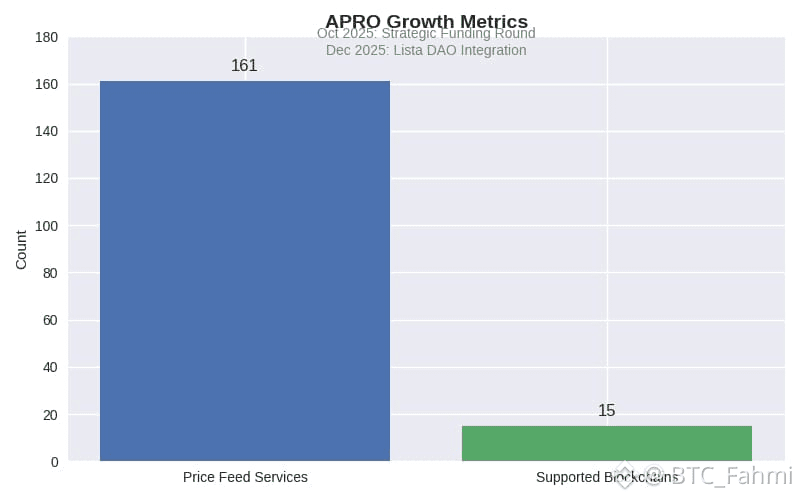
The first time I saw a trading system break because of a bad data feed, it wasn’t a dramatic hack or a market crash. It was something quieter and more frustrating: a price moved a few seconds late, a liquidation engine reacted to the wrong number, and traders paid for it. That experience sticks with you, because it teaches a simple truth that’s easy to ignore when markets are moving fast: most “smart” strategies are only as good as the data they consume. That’s why oracle networks matter, and why APRO’s growth journey is worth studying if you trade, invest, or simply care about how on-chain markets are becoming more dependable.APRO’s story is basically a scaling story, but not the usual kind where growth is measured only by headlines. The more interesting part is the way APRO has tried to scale the hard things: speed, reliability, and the ability to support data types that don’t fit neatly into a standard price-feed template. APRO positions itself as an AI-enhanced decentralized oracle network, built to move beyond “just prices” and toward broader real-world information that applications can verify on-chain. That includes structured feeds like asset prices, but also unstructured inputs such as documents, web pages, and even media content, which APRO describes as part of its approach to real-world assets and “proof” style data services. From a trader’s perspective, the first scaling lesson is that adoption is usually pulled by demand, not pushed by technology. Oracles don’t grow because they look elegant on paper. They grow when apps need them, and when the oracle’s failure becomes too expensive to tolerate. APRO’s documentation frames its product in two practical delivery models, Data Push and Data Pull, which is basically a recognition that different applications want data in different ways. Some need regular updates sent to them, others need to request data on demand. According to a developer guide connected to APRO’s ecosystem, the network supports 161 price feed services across 15 major blockchain networks, which is the kind of number that matters because it signals operational breadth rather than a single-chain experiment. The second scaling lesson is that “oracle scaling” is not only about adding more feeds. It’s about making sure the whole system holds up when usage becomes routine and boring. That sounds funny, but boredom is the goal. Traders want feeds to be so reliable that nobody talks about them. APRO’s ecosystem listings emphasize fast response times, customizable oracle solutions, and network stability as part of its pitch to DeFi applications. If you’ve ever built or used strategies that rely on frequent updates, you know that speed without consistency is a trap. A fast feed that occasionally fails is worse than a slightly slower feed that is predictably stable, because the failure cases are where losses hide.APRO’s recent growth also shows a common infrastructure pattern: once you reach a certain baseline of working product and integrations, funding becomes less about “starting” and more about “expanding.” In October 2025, APRO announced a strategic funding round aimed at pushing next-generation oracles for prediction markets and related use cases. Funding announcements don’t automatically make a project strong, but they can be useful signals for investors because they often coincide with scaling phases: more chains supported, more decentralization of nodes, and more work on security and uptime.There’s also evidence of the “integration flywheel” starting to turn. For example, in December 2025, Lista DAO reported integrating APRO into a multi-oracle framework to improve pricing accuracy and reliability. This kind of integration matters because multi-oracle setups are usually chosen by teams that have already learned the hard way that relying on a single data provider is risky. If APRO is being added as an additional independent signal, it suggests the network is reaching the credibility stage where it’s not just a new option, but a redundancy option.One of APRO’s more distinctive growth angles is its push toward AI-assisted or AI-native oracle services. In plain terms, this is an attempt to make oracles useful for data that isn’t clean and structured. APRO’s RWA oracle materials describe a two-layer system designed to turn messy real-world inputs into verifiable on-chain facts. That’s ambitious, and it’s also where the clearest trade-offs appear for investors. The opportunity is big: if RWAs and proof-style data become standard building blocks, oracle networks that can verify more than just prices could see long-term demand. The risk is equally real: unstructured data is harder to validate, easier to dispute, and can introduce new attack surfaces. If you’re investing, it’s worth asking not only “Can they do it?” but “Can they do it reliably under adversarial conditions?”Another risk traders should think about is dependence risk. As APRO expands across chains and adds more feeds, the cost of an outage grows. In oracle networks, scaling can create a strange paradox: growth increases trust, but it also increases the damage if something goes wrong. That’s why investors should pay attention to practical details like how a network decentralizes its nodes, how it verifies sources, and what kinds of fallback mechanisms integrations use. APRO’s own materials repeatedly emphasize off-chain processing combined with on-chain verification, which is basically an attempt to balance flexibility with security. If you want a simple way to frame APRO’s growth journey, think of it like this: the project is trying to scale the “data layer” of on-chain markets in the same way exchanges and liquidity protocols scaled execution. That doesn’t mean it will win, and it doesn’t mean the token will automatically perform, but it does mean APRO is playing in a category where long-term involvement is possible because oracles aren’t seasonal products. If they become embedded into applications, they tend to stay there, because switching costs are high and reliability becomes part of a protocol’s identity.My personal takeaway, looking at APRO’s growth path, is that the most valuable infrastructure projects are rarely the loudest. They’re the ones that quietly get integrated, quietly expand coverage, and quietly become part of how markets function. If APRO continues adding credible integrations, expanding feed coverage, and proving that its AI-focused approach can handle real-world complexity without weakening security, its growth journey could become a useful blueprint for how oracle networks scale in the next phase of on-chain finance.

