

@APRO Oracle There’s a quiet but unmistakable shift happening at the intersection of traditional finance and decentralized technology, one that doesn’t always show up in headlines but is already reshaping how value flows through markets. For years, the blockchain world promised that assets from real estate to fine art, from bonds to commodity futures could be represented on a ledger the same way a Bitcoin transaction is. Yet, bringing that promise into reality has always confronted a persistent problem: how do you reliably and trustworthily connect the messy, analog world of contracts and pricing and legal titles to the rigid, deterministic world of smart contracts? For all the talk about tokenization and real-world assets (RWAs), this “real world to digital world” bridge is the thing that actually matters.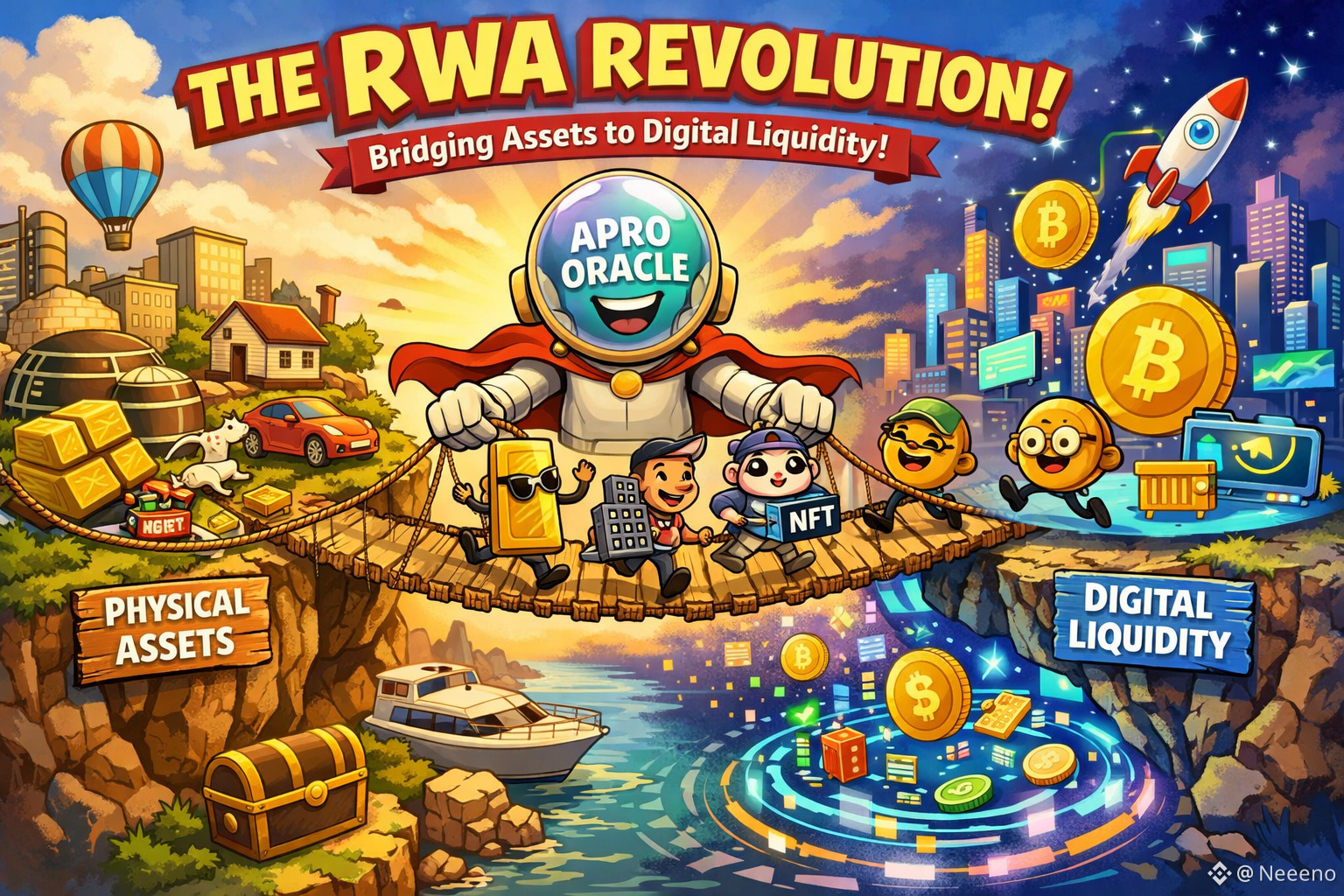
Enter @APRO Oracle , a project that has quietly been building not another yield machine or NFT fad, but a kind of connective tissue for finance’s next chapter. APRO’s stated mission isn’t just to supply another price feed for DeFi, or to prop up simple token exchanges. Instead, it aims to re-architect the fundamental pathway by which off-chain, physical asset information becomes usable on a blockchain with a degree of fidelity, context, and verifiability that hasn’t been typical until now. At its best, this could mark a meaningful step toward making real-world asset tokenization not just a theoretical opportunity, but a robust, scalable infrastructure.
What’s being attempted here feels slightly ironic when you step back and unpack the term “oracle.” In computer science, an oracle is a source of truth — something external that tells a system what’s happening outside its own walls. Blockchains, by design, are closed systems. That’s what makes them secure: no external inputs are trusted by default. But it also creates the very gap that projects like APRO are trying to bridge — how does a smart contract know that a mortgage payment was made on time, or that a piece of fine art sitting in a vault in Zurich actually exists and holds a certain appraisal value? Or, more pressingly, how does the system do that without relying on a single point of failure — a lone private company or data feed that could fail, lie, or be manipulated?
Traditional oracle services have focused on delivering simple structured data — asset prices, exchange rates, that sort of thing. But physical assets involve messy, high-variance data: legal documents, valuation reports, audit trails, proof of reserve statements, regulatory filings, and more. APRO’s approach layers artificial intelligence (in the form of large language models and multimodal processing tools) atop decentralized oracle networks so the system can interpret complex inputs — documents, images, unstructured sources — and turn them into structured data smart contracts can trust. That’s not a small technical trick; it’s a way of putting a translator between the analog narratives of the real world and the binary logic of blockchains.
Why does this matter now? The conversation around RWAs isn’t new — tokenization has been discussed in academic and industry circles for years — but the narrative has matured.
A lot of real-world assets—worth tens of billions—have already been tokenized, and big investors have shown more interest in 2025 and into 2026. Major finance companies are realizing this could help make traditionally illiquid assets easier to trade, including commercial real estate, private equity, fine art, and inventory financing.. The core barrier is trust — accurate, timely, provable information — and that’s exactly the problem a more sophisticated oracle layer aims to solve
Walking this tightrope between physical and digital isn’t academic. Anyone who’s ever stood in front of a bank trying to get a loan against a commercial property — suffering through months of due diligence, title searches, and risk assessments — can attest to how painfully opaque and slow traditional finance often is. Now imagine breaking that process down into smart contracts that can verify ownership, compliance status, valuation data, and payment history in real-time. That’s the sort of future APRO’s work is trying to make possible. It doesn’t instantly solve legal complexity or regulatory ambiguity, but it does create a layer where those complex inputs are translated into trusted, standardized on-chain signals.
There’s an emotional texture to this shift, too — it’s both exciting and unnerving. On the one hand, finally seeing real-world assets trade with the liquidity and efficiency we’ve seen in digital native markets feels like a genuine advance. On the other, we’ve seen enough hype cycles in crypto to be wary of grand claims that a single protocol will upend centuries of financial infrastructure overnight. Wisdom in this space often comes not from hype but from observing slow, imperfect adoption and incremental improvements. APRO’s focus on foundational data infrastructure — not flashy applications — suggests an awareness of this reality.
Yet, there are legitimate questions. Can an oracle network truly parse the rich nuance of legal and financial documentation with sufficient accuracy to meet institutional standards?
Every country has different compliance requirements. How can a system meet them all, and how can you persuade issuers, custodians, and auditors to rely on algorithm-based checks to confirm accuracy?WThese aren’t trivial concerns. They’re the very same challenges that have slowed RWA projects for years. But they also underscore why this work is worth paying attention to: because if the bridge itself can be made reliable and transparent, everything that relies on it becomes easier to build.
Ultimately, the “RWA revolution” isn’t just about making assets tradable on chain. It’s about democratizing access to value that’s been locked behind narrow financial gates for decades. If tokenized assets are going to meaningfully live alongside equities, bonds, and commodities in diversified portfolios, the plumbing that connects them to real-world valuation, reporting, and compliance has to be rock solid. Projects like APRO Oracle aren’t flashy. They don’t promise instant wealth or speculative gains. What they do is bet on a more durable future where the data linking physical reality to digital ledgers is trusted, verifiable, and universally accessible.
That’s why this trend is gaining traction now — because the missing piece of the RWA puzzle wasn’t the idea of tokenization itself, but the dependable, intelligent layer that can translate messy human reality into digital truth. How quickly that promise becomes commonplace is still unfolding, but the early work being done on oracle infrastructure suggests this could be the kind of quiet revolution that ultimately matters most.

