
I am 32 years old this year, settled in Shanghai, and I own two houses — one for my family and one for myself. It may be hard for some to believe, but all of this was earned through 7 years of struggling in the cryptocurrency space.$WOO
When I first entered the market, I only invested over 30,000 in capital. During the worst part of the market, I had just over 9,000 left in my account. That period was quite tough, but I didn't follow the crowd blindly; I stuck to my own 'foolish method' and slowly persevered. In the end, I managed to roll my funds up to tens of millions. One of the most impressive times was when my bottom position increased 400 times in just 4 months, earning me 10 million at once. Looking back now, I even feel like it sounds like a 'joke', but this is a real experience.$DUSK
Anyone who has traded knows that prices often follow a strong market trend after a gap breakthrough—however, many people also get caught in false gaps, entering just to be stopped out when the gap is filled. Today, I've thoroughly analyzed the trading logic of gaps: from what gaps are, how to identify them, to the practical uses of four types of gaps, teaching you how to avoid traps and accurately profit, allowing even beginners to apply directly.
First, understand:
What is a gap? How to unify the judgment standards?
Simply put, a gap is the 'blank interval' on the K-line chart—this interval has no trading traces. The core reason is: The opening price of the next K-line is significantly higher or lower than the closing price of the previous K-line (due to major news outside of trading hours).
But there is a key point: Different traders have different judgment standards for gaps
Some people look at the 'difference between closing price and opening price';
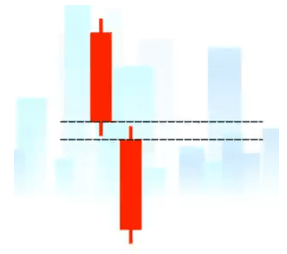
Some people look at the 'difference between upper and lower shadows'.
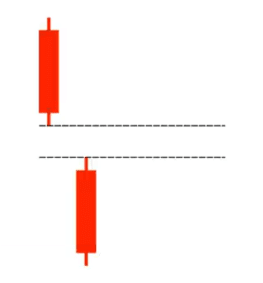
I tell you, we must unify standards, otherwise the analysis will become chaotic! I have always used the space between shadows as a judgment basis for gaps—only if the lowest point of the next K-line is higher than the highest point of the previous K-line (upward gap), or if the highest point of the next K-line is lower than the lowest point of the previous K-line (downward gap), is it considered an effective gap. This can filter out a lot of noise and leave only high-quality signals.
Additionally, a little knowledge: The frequency of gaps varies significantly between different markets:
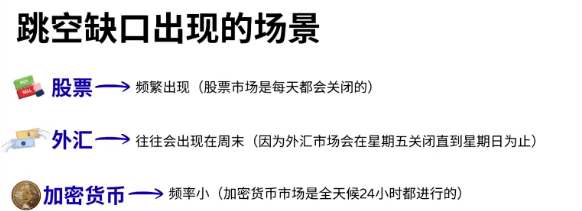
Four types of practical uses for gaps:
Distinguishing types is key to avoiding pitfalls
Not all gaps can be traded; different types of gaps have completely different signal meanings and operational logic. Below is a sorting by 'practical value', explaining each one in detail:
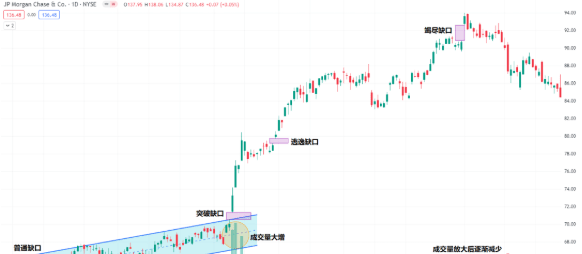
One, Breakthrough Gaps: The most worthwhile 'trend initiation signal'
Breakthrough gaps are the most valuable gaps, bar none—they appear when prices break through sideways ranges and K-line patterns (like head and shoulders bottom, double tops), and are a strong signal for the initiation of a new trend.
Core Identification Signal:
Gap Position: Right above the resistance level (bullish) or below the support level (bearish);
Trading Volume: When the gap forms, trading volume increases significantly (capital acknowledges the breakthrough, not a false move);
Subsequent Performance: After a breakthrough, the gap is unlikely to be filled, and prices will accelerate upward/downward directly.
Practical Case Analysis:
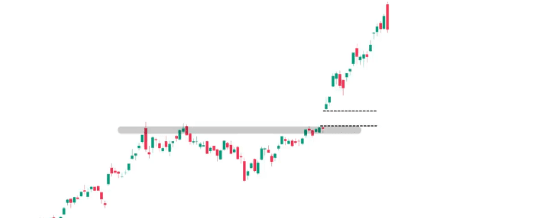
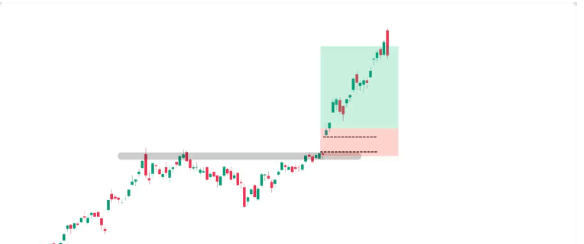
For example, in this chart, the price has been fluctuating below a resistance level for a long time, repeatedly attempting to break through (which can also be seen as the neckline of a 'head and shoulders bottom' pattern). Suddenly, one day, the price jumps high and breaks through the resistance level, while trading volume surges—this is a standard breakthrough gap.
Trading Strategy:
Entry Timing: Wait for the large bullish candle of the breakout day to fully form before entering long (avoiding chasing halfway up the hill, confirming the breakout is effective);
Stop-Loss Setting: Place it below the gap (if prices fill the gap, it indicates the breakthrough has failed, exit in a timely manner);
Profit-Taking Method: Either follow a fixed profit-loss ratio (like 3:1), or use passive profit-taking (like trailing stop-loss) to maximize profits.
Looking at another example:
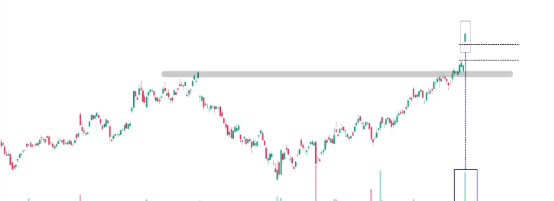
Prices repeatedly face pressure at resistance, then break through with a gap, and trading volume increases simultaneously. The entry and stop-loss logic is the same as above, and subsequent prices directly lead to a significant market movement—this is the charm of breakthrough gaps; once captured, it leads to high win rates and high profit-loss ratios.
Two, Continuation Gaps: The 'adding position signal' for trend acceleration
Continuation gaps appearing in the middle of a trend are signals that 'the trend is still accelerating, not at the top/bottom'—indicating that market sentiment is high, more capital is entering, driving prices to jump forward.
Core Identification Signal:
Gap Position: In the middle of an upward/downward trend, not at a critical price point;
Trading Volume: It may not be as large as the breakthrough gap, but it should maintain a moderate increase overall;
Subsequent Performance: It may slightly fill the gap, but will quickly continue along the trend.
Practical Case Analysis:
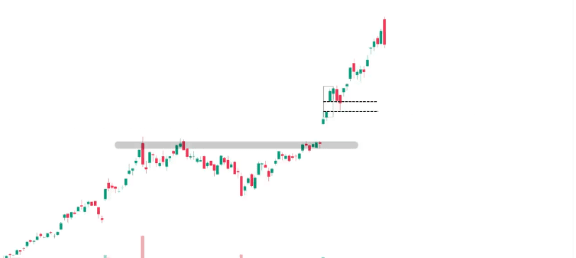
For example, in an upward trend, if the price has risen significantly and then suddenly opens high to form a gap—this is a continuation gap, indicating that the bullish momentum is still strong. Even if subsequent prices fill the gap, it is merely a short-term pullback; the trend will continue.
Trading Strategy:
Entry Timing: Enter after the large bullish candle is fully formed, or when the gap is filled, look for bullish K-lines (like a hammer) to add positions;
Stop-Loss Setting: Place it below the gap (if the gap is completely filled and prices continue to drop, it indicates a possible trend reversal, exit with a stop-loss);
Profit-Taking Method: Follow the trend, use trailing stop-loss to lock in profits, and do not exit too early.
Three, Common Gaps: The 'trap signal' that should be avoided the most
Common gaps are the most frequent and least valuable gaps, appearing in sideways trading ranges, with small gaps usually formed by normal order imbalances, unrelated to major news.
Core Identification Signal:
Gap Position: Within a sideways range, not near critical price levels;
Trading Volume: Trading volume is very low when the gap forms;
Subsequent Performance: It is likely to quickly fill the gap, and prices will oscillate back within the range.
Trading Strategy:
Core Principle: Do not trade! This type of gap has no trend significance, just noise within the range; forcing a trade will only lead to being stopped out when the gap is filled;
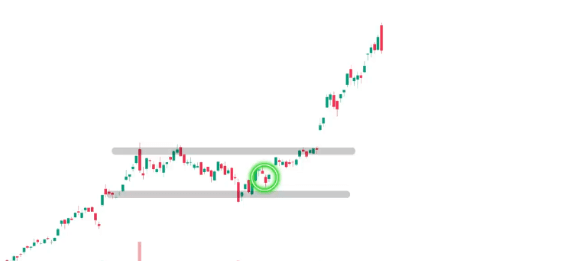
A little trick: If common gaps appear near support/resistance levels, the probability of filling the gap will be higher—this can be used to trade ranges near the gap (but not recommended for beginners).
Here's another reminder: If you use 'closing price and opening price' as the standard for gaps, you will find gaps everywhere within the range, which can easily mislead trading. This is why I emphasize 'using the space between shadows' as the standard—to filter out low-quality gaps and focus on valuable trades.
Four, Exhaustion Gap: The 'Profit-Taking Signal' of trend termination
Exhaustion gap is a warning signal that 'the trend is coming to an end', appearing at the end of a trend, indicating a loss of momentum.
Core Identification Signal:
Gap Position: Near key resistance/support levels, the trend has already progressed for a long time;
Trading Volume: Trading volume is low when the gap forms (no capital follow-up);
Subsequent Performance: Gaps are quickly filled, accompanied by a reversal K-line pattern (like bullish engulfing, bearish engulfing).
Practical Case Analysis:
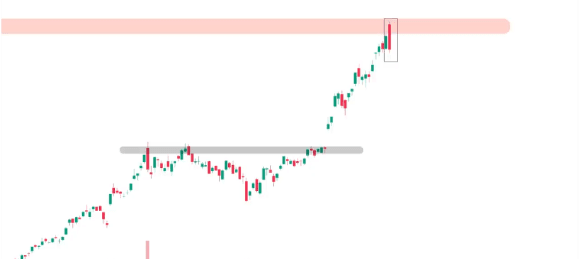
Prices at the end of an upward trend, with a gap high opening but very low trading volume. Subsequently, prices quickly drop to fill the gap and form a bearish engulfing K-line—this is an exhaustion gap, indicating that the bulls have lost their strength, and the trend is about to reverse.
Trading Strategy:
Core Principle: Do not enter against the trend! Even if a reversal K-line appears, do not easily short (trading against the trend has a low win rate and small profit potential);
Correct Approach: If you have long positions in this trend, take the opportunity to lock in profits and exit with this signal;
Aggressive Trading (not recommended for beginners): If the reversal K-line pattern is particularly strong, and prices continue to drop after filling the gap, you can try shorting with a small position, but strict stop-loss must be set.
Final Summary:
The 3 Core Principles of Gap Trading
First identify the type, then decide whether to trade: Breakthrough gaps and continuation gaps are worth trading, while common gaps and exhaustion gaps should be avoided;
Do not look at gaps in isolation; consider other signals: trading volume, key price levels, K-line patterns, and confirm through multiple confirmations before entering;
Risk control is always the top priority: Stop-loss must be placed below/above the gap; once the gap is filled, it indicates that the signal is invalid, exit decisively.
The core logic of trading gaps is 'capturing trends driven by capital'—gaps are just surface signals; the underlying trading volume, position, and trend are key. Remember: Not all gaps can make money; only by distinguishing types and finding the right rhythm can one profit consistently in gap trading.
Crypto trading is about repeating simple tasks over time; consistently using one method until you master it, trading cryptocurrencies can be like any other industry, practice makes perfect, allowing you to make each decision effortlessly.
This is also my seventh year trading cryptocurrencies; starting with 10,000, now supporting my family with crypto trading! I can say that I have used 80% of the methods and techniques in the market. If you want to treat crypto trading as a second profession to support your family, sometimes listening more and observing more will help you discover things outside of your current understanding, at least allowing you to avoid five years of detours!
Follow me@慢慢赢_实盘带单

