
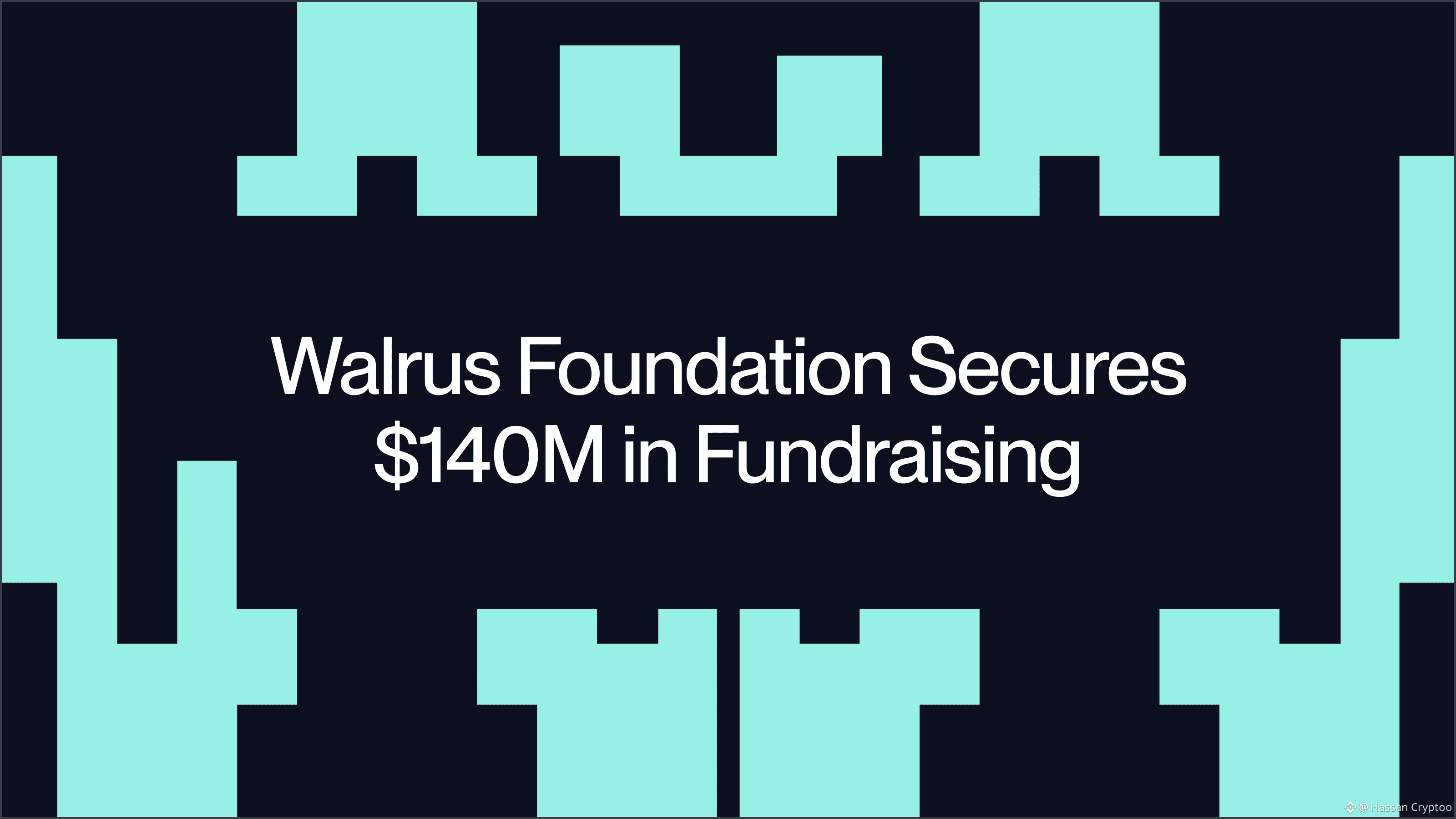
I have, in fact, run through enough tokenomics models to know that the real test is not the Pie chart on day one, but the economic logic that has to hold for years. When the $WAL | Walrus protocol unveiled its long awaited tokenomics and a staggering $140 million in funding in March of 2025, it was not just announcing numbers. It was actually laying down a deliberate economic blueprint for a decentralized storage network that has to compete in a real world of costs and incentives. After spending time with their technical documentation and the announcements from that period, what became clear to me is that WAL is engineered less as a speculative asset and more as a functional kernel for a new type of data market. The key components are not isolated features but are interlocking parts of a system designed to balance growth, security, and long term stability from the outset.
The foundation, as detailed on their token page, is utility. WAL is not an abstract governance token bolted on as an afterthought. It is the designated payment token for storage on the Walrus network. But the clever bit, the part that particularly caught my attention, is the payment mechanism's design to keep user costs stable "in Fiat terms" This is, in fact, a direct and practical acknowledgment of the volatility problem that plagues utility tokens. A user pays WAL upfront to store data for a fixed period, and that token payment is then distributed over time to the storage nodes and stakers who provide the service. This creates a predictable fee stream for operators and a predictable cost for users, attempting to decouple the utility of the network from the token's market price. It is indeed a simple idea that addresses a complex, real world adoption hurdle.
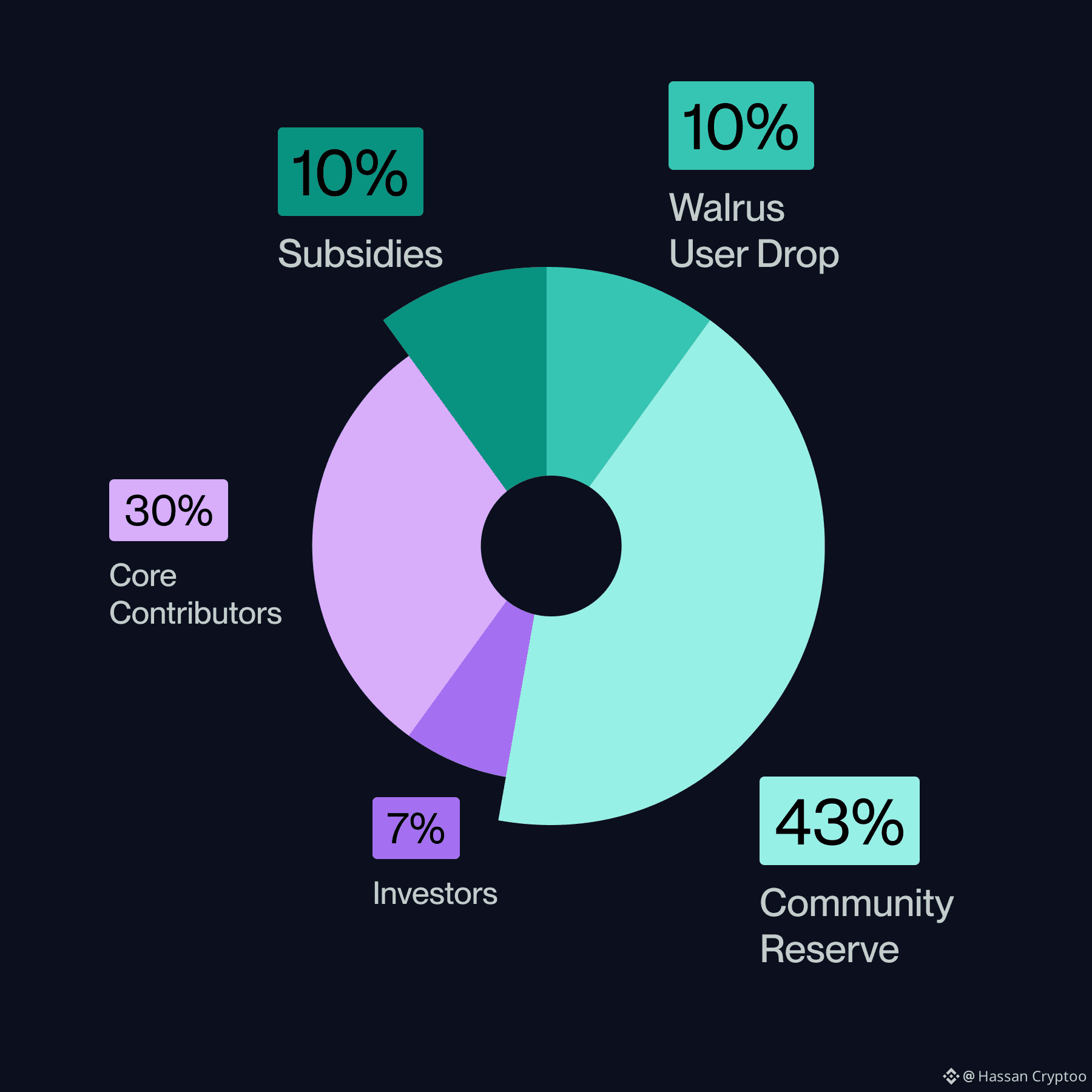
This utility is indeed powered by a distribution model that makes a pronounced statement about priorities. In their March 2025 announcement, Walrus specifically emphasized that over 60% of the total 5 Billion WAL tokens are dedicated to the community. This is not merely vague marketing. It is a specific allocation, 43% to a Community Reserve for grants and ecosystem development, 10% for a User Drop to early adopters, and another 10% for Subsidies to support node operators in the early days. When you compare this to the 30% for core contributors and 7% for investors, the weighting is quite obvious. The protocol is allocating resources to bootstrap the two sided marketplace it needs to survive, users who need storage and nodes that provide it. The 10% subsidy pool, in particular, is a tactical war chest.It is designed to reduce the cost for early users while makes sure, node operators can build practical models before the organic fee market matures. This is not just fair launch but a calculated go-to-market strategy funded by the token treasury itself.Of course, a network that stores precious data needs security, and here the tokenomics effectively integrate staking in a way that directly impacts network health. Walrus employs a delegated staking model. This means that any token holder, not just node operators, can indeed stake their WAL to a specific storage node. This stake acts as a vote of confidence and a source of security. Nodes compete to attract this stake because it governs how data is assigned to them. In return, nodes and their stakers earn rewards. The whitepaper and website of the project point to a future where "slashing" is enabled, meaning poor performance or malicious action by a node could lead to a portion of the staked tokens being penalized. This aims to fully align the financial interests of token holders with the reliability of the network operators they choose to back. It turns passive token holding into an active, though risk managed, participation in network security.
Perhaps the most technically intriguing component I found is actually the planned deflationary mechanism. The WAL token is designed to be deflationary, and the system introduces two specific burning mechanisms tied directly to network performance. The first burns tokens from penalty fees levied on short term stake shifts. The logic here is economic. If a staker rapidly moves their tokens between nodes, it forces the network to wastefully move data around.The fee disincentivizes this noise, and the burn removes that tokens from circulation supply of the token.The second mechanism burns a portion of tokens slashed from staking with persistently low performing nodes. This is not inflation for the sake of rewards but deflation for the sake of health. It actively removes tokens from circulation as a consequence of behavior that harms network efficiency or security. Over time, if the network is busy and well staked, this could create meaningful deflationary pressure, theoretically benefiting long term holders who contribute to network stability.
All these components, the fiat pegged utility, the community heavy distribution, the security aligned staking, and the behavior driven burns, do not exist in a vacuum. Indeed, they are the economic engine for the technical innovation described in the April 2025 whitepaper, which details Walrus's "Red Stuff" encoding protocol designed for efficiency. They are also backed by the substantial $140 million in funding announced in March, capital that provides a multi year runway to transition from subsidized growth to a sustainable fee based economy. What stands out to me, after piecing this together, is the conscious attempt to build a circular economy. Actually, the token pays for services, staking secures those services, and poor staking behavior is taxed or penalized and burned to strengthen the system. It is a model that keeps the protocol must be economically maintainable for nodes, affordable for users, and secure for data. Whether it works in practice is a question for the coming years, but the March 2025 announcement presented a structure that tries to answer those hard questions from day one.
by Hassan Cryptoo
@Walrus 🦭/acc | #walrus | $WAL

