


Observations and personal views from Nothing Research Partner 0x_Todd — the following content does not constitute any investment advice.
Recently, one question I've been frequently asked by friends is how I view Ethereum's narrative?
Certainly, Ethereum focused on ICO and the world computer in 2017, and then DeFi and the financial settlement layer in 2021. However, in this round leading up to 2025, there seems to be a lack of new narratives that can match the previous ones in significance.
Perhaps ETFs and Staking ETFs count as half, but these are not within Ethereum developers' control. If there's another half, it can only be ZK.
Ethereum is undoubtedly the blockchain in the entire crypto world that has bet the most on ZK.
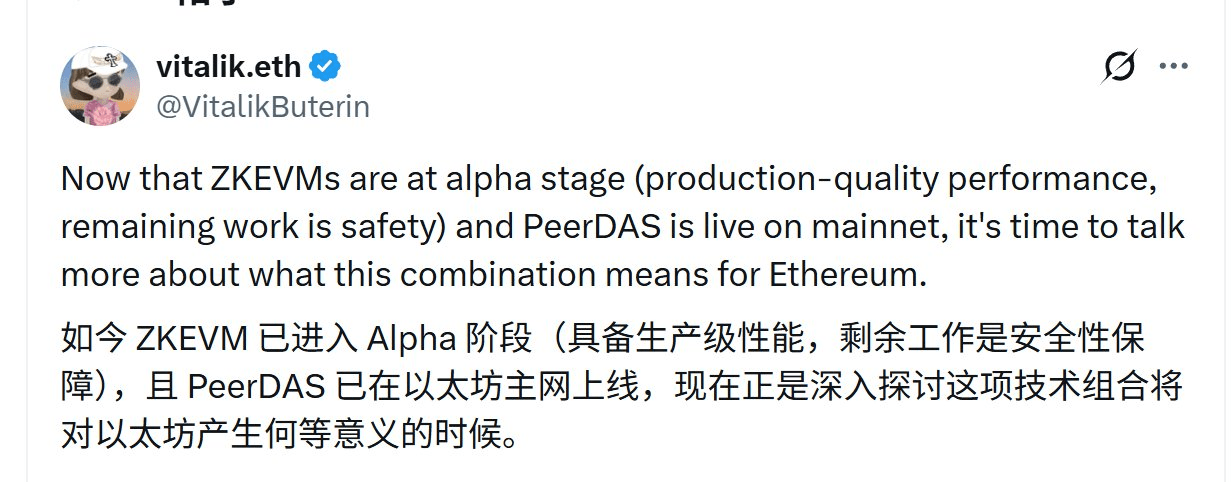
Recently, Vitalik was very excited—he officially announced on Twitter that ZKEVM has now entered the Alpha phase.
Why is Ethereum so obsessed with ZK?
Actually, Ethereum’s TPS is already quite high, with theoretical peak performance now exceeding 200 TPS—largely due to multiple increases in the Gas limit.
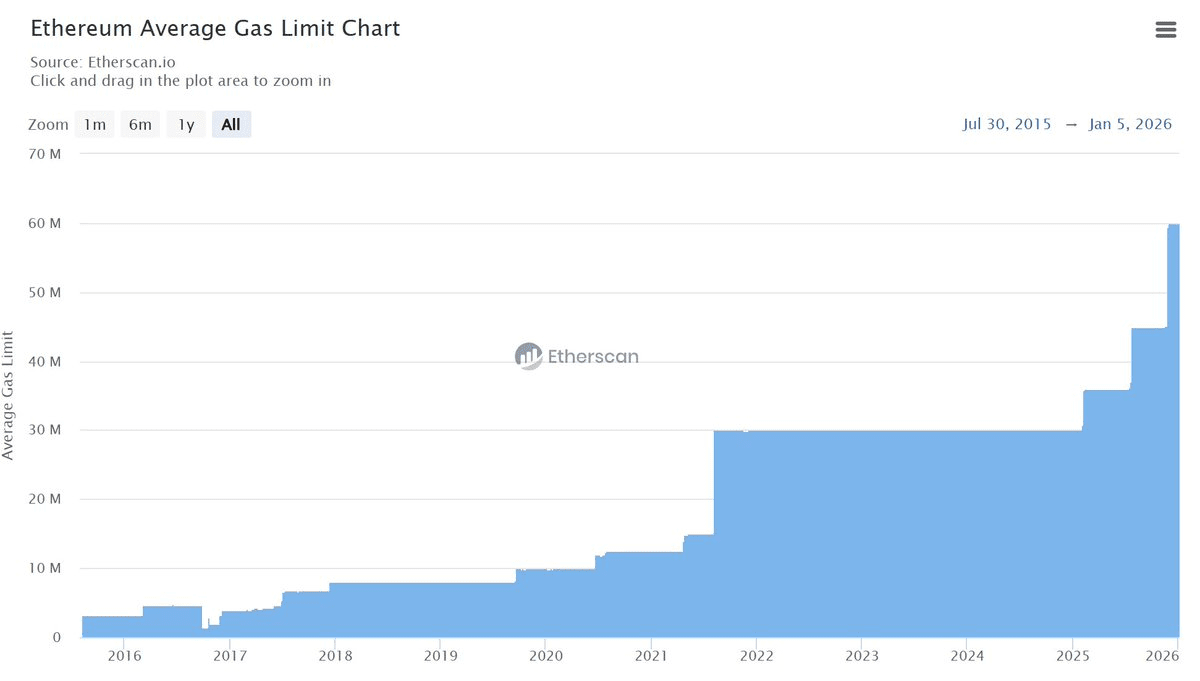
However, increasing the Gas limit comes at a cost and cannot be done indefinitely. The cost is that nodes need more expensive servers to run.
Yet Ethereum wants to preserve its proud high degree of decentralization, so it cannot push node server performance too high (for reference, a Solana node server is roughly 5–10 times more expensive than an ETH node server).
Therefore, mainnet ZKization is essential. Note that this isn’t just about creating a few ZK L2s—it’s about full ZKization of the L1 mainnet.
So what’s the benefit after ZKization?
ETH nodes can simply verify ZK proofs, without having to manually and painstakingly validate each transaction as they did before.
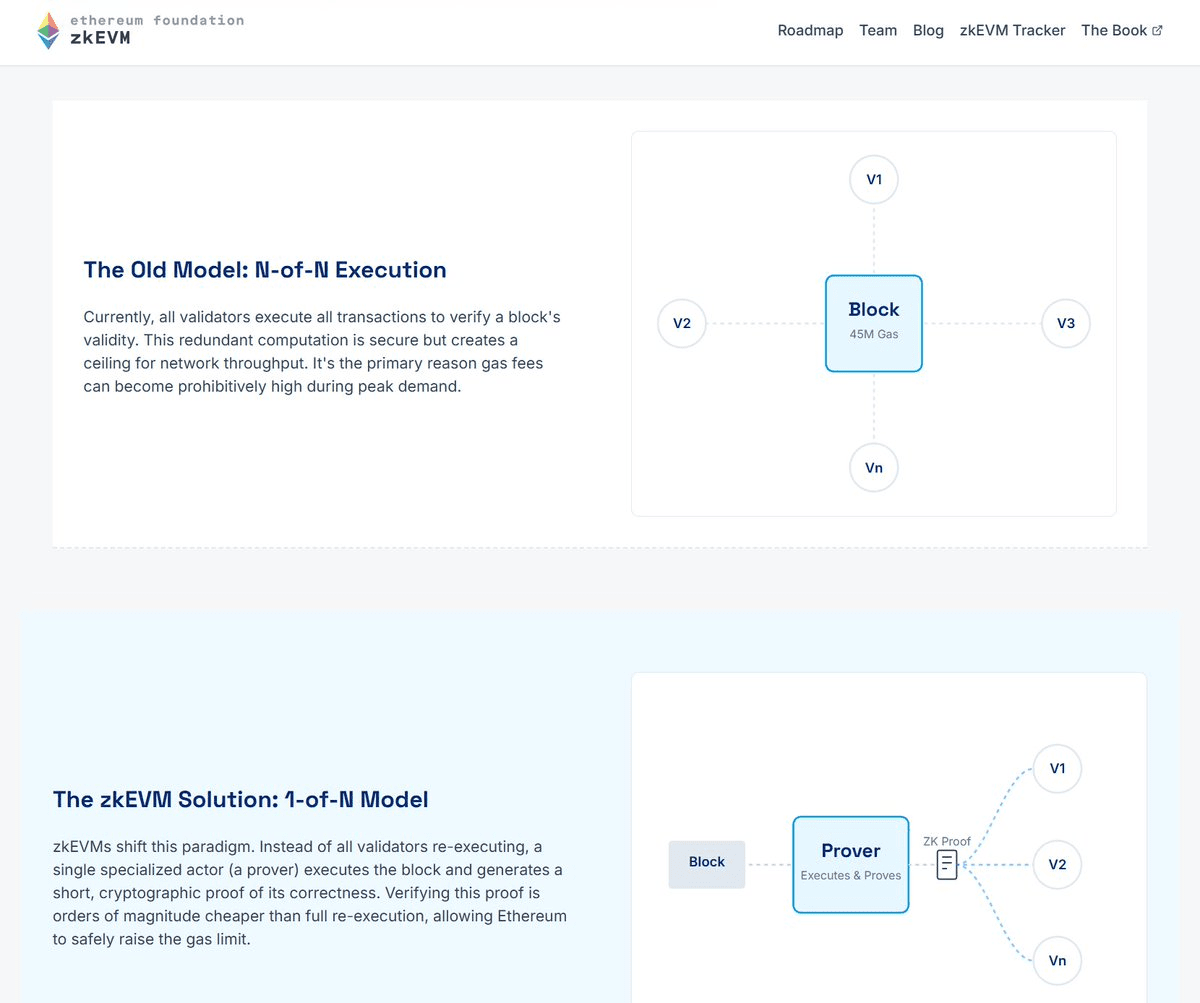
Let’s use an analogy: imagine you’re a teacher grading exams (nodes), and the transactions are students’ answer sheets.
Grading manually used to be very slow. But since the invention of marking answer sheets with bubbles (ZKization), machines can instantly calculate total scores. As a teacher, wouldn’t you be greatly relieved?
You’re relieved—previously, one person could only grade 50 papers, but now they can grade 1,000. The person is still the same, but efficiency has skyrocketed.
Therefore, Ethereum must first ZKize its mainnet before it can significantly increase the Gas limit.
ZKization itself doesn’t directly increase TPS—it’s a prerequisite. Performance gains still come from raising the Gas limit. But after ZKization, nodes don’t need to spend much more on server costs, making the cost extremely low.
And after the recent Fusaka upgrade (especially the PeerDAS upgrade), Ethereum has performed well, bringing it one step closer to mainnet ZKization—hence Vitalik’s excitement.
Imagine a mainnet with TPS exceeding 1,000—this would indeed be a strong narrative for Ethereum.
Someone raised a question: if Ethereum itself were to implement ZK-EVM for its mainnet, would other ZK teams still be meaningful?
First, the conclusion: they still are meaningful.
Why is that?
First of all, ZK engineering is one of the most difficult development tasks across the entire network, on par with FHE. It requires a large number of cryptography experts.
ETH Foundation likely has some reserves in this area, but as an open-source community, Ethereum’s philosophy is that collective effort makes the fire burn brighter. It relies on numerous third-party ZK teams to experiment and innovate. In return, Ethereum offers substantial support.
Second, there are four types of ZK-EVM, from Type 1 to Type 4. Teams like Polygon, Scroll, ZKsync, and Taiko are essentially each taking on a different task, working independently to implement one of these types.
Additionally, there are ZK-VMs, such as Brevis.
In fact, ZK-VMs hold an even more stable position compared to ZK-EVMs.
The reason is that the four major types of ZK-EVMs will likely eventually converge on one cost-effective solution, which will become part of Ethereum’s official mainnet ZK-EVM. In that case, the other three may be affected.
But ZK-VMs are not EVM-compatible by nature, so they will inevitably remain a part of Ethereum’s diversity.
Moreover, since VMs aren’t constrained by EVM limitations, they can achieve much higher performance. Ethereum’s ZK-EVM poses no threat to them; on the contrary, the official Ethereum team will continue to encourage their development.
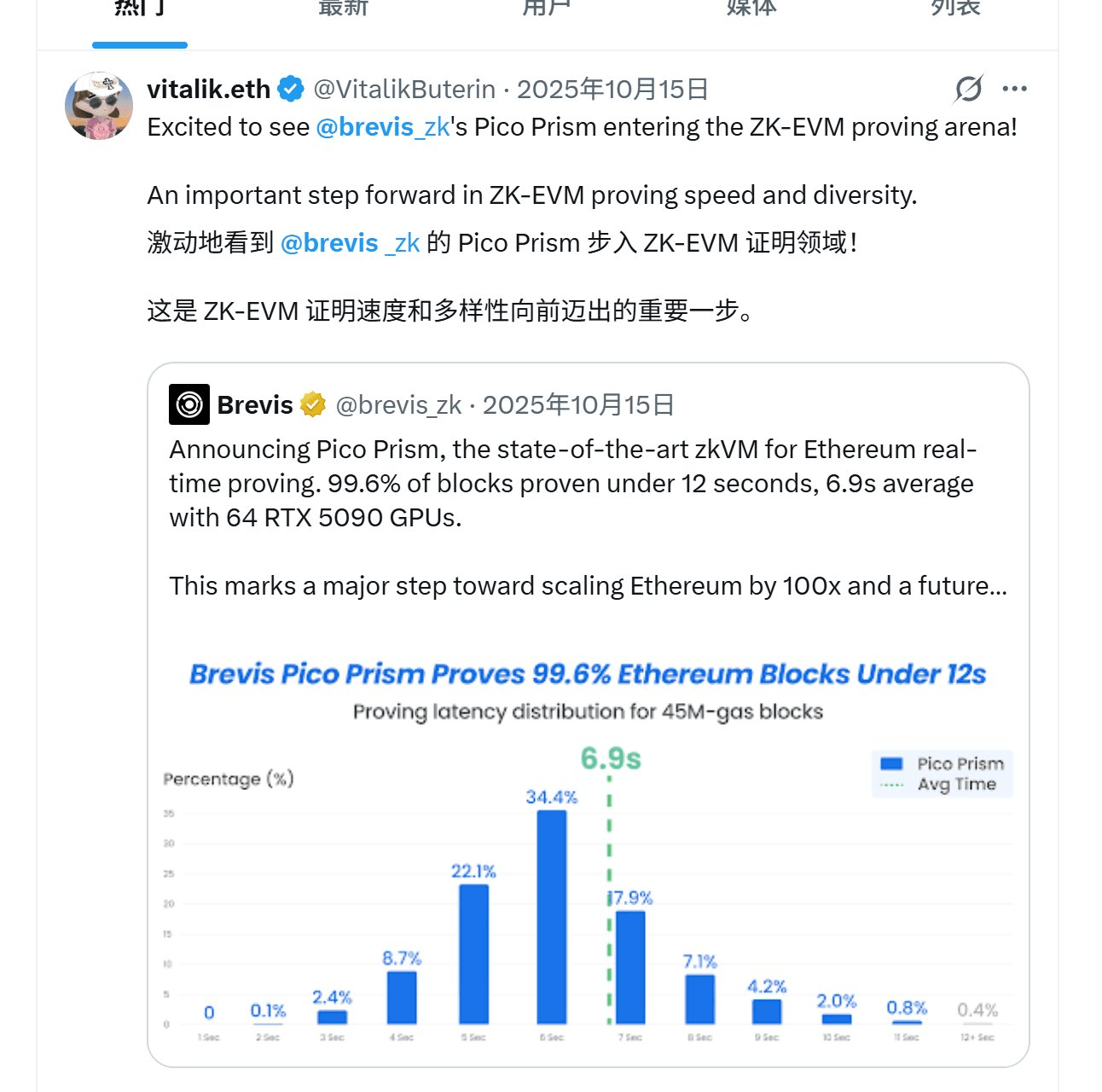
For example, Vitalik recently specifically mentioned Brevis’ ZK-VM performance and expressed anticipation for them to enter the ZK-EVM space.
For L2s, it might have some impact, but still relatively small.
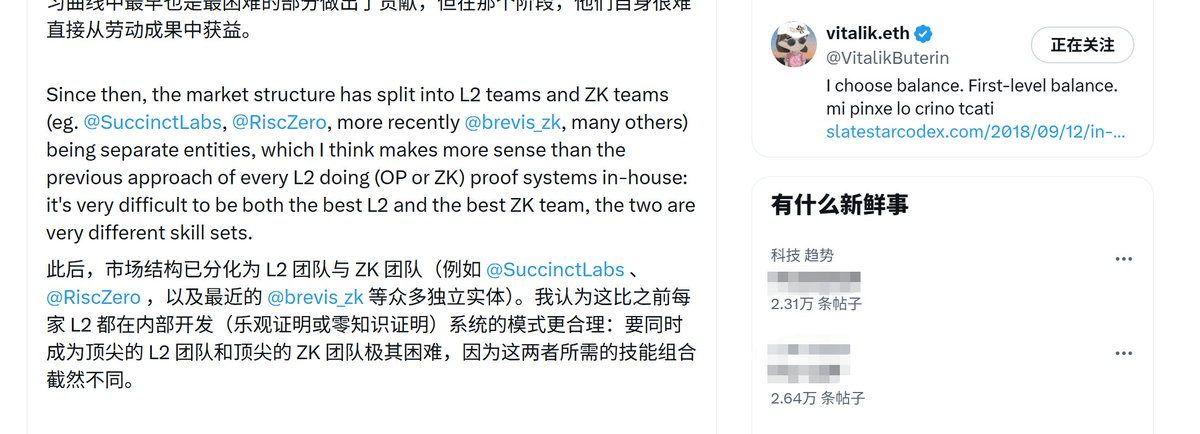
Vitalik once said when discussing Polygon that ZK and L2 should be kept separate.
After ZKization of the L1, it will inevitably attract some users back from ZK L2s, especially if L1 becomes cheap enough that fewer users will need to go to L2.
But think about it the other way: imagine L1 is the foundation, and L2 is a skyscraper. The foundation must be as solid as possible. So if the L1 mainnet is ZKized, L2s will also benefit from lower fees.
Moreover, in that same tweet, Vitalik specifically mentioned Brevis, the team working on ZK-VMs. The reason is that Brevis’ work in ZK goes beyond L2—what he calls 'separating ZK research from L2 research'.
For example, they have a ZK computing power market, helping Uniswap’s hooks with ZK-based reward distribution—essentially application-driven.
In summary, Ethereum has been around for 10 years, and the call for ZKization has been around for over five years. After years of persistent effort, ZKization has now entered its Alpha phase—thanks to continuous investment from Ethereum and numerous third-party ZK teams, including Brevis and Polygon.