

The winds of the融市场 seem to have undergone a fundamental shift. Wall Street giants, once cautious and even hostile towards cryptocurrency, are now racing towards this emerging field with an unprecedented posture. This is no longer a tentative layout, but a structural, all-encompassing strategic advance. From Morgan Stanley's 'blitzkrieg' to Bank of America's explicit endorsement, and the collective 'FOMO' (fear of missing out) within the entire banking industry, a clear signal is emerging: U.S. capital is transforming cryptocurrency from a marginal alternative investment into a priority for its core business. So, what exactly has happened behind this?
Weather Vane
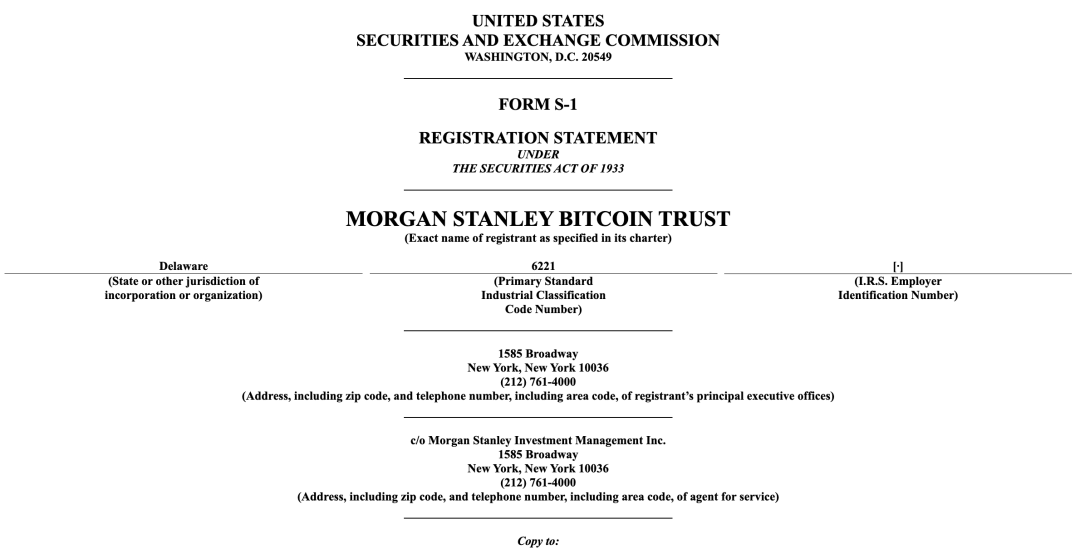
The first week of January 2026 became a symbolic moment for Wall Street's embrace of cryptocurrency, with Morgan Stanley, which manages trillions of dollars in assets, undoubtedly taking center stage.
This century-old investment bank submitted three significant documents to the U.S. Securities and Exchange Commission (SEC) in a manner akin to a 'blitzkrieg' within just a few days: applications to launch spot ETFs for Bitcoin (BTC), Solana (SOL), and even Ethereum (ETH). This series of actions, especially placing its own 'Morgan Stanley' brand directly on these ETFs, is of great significance. It indicates that the strategic position of cryptocurrency within the bank has shifted from a 'nice-to-have' to a 'must-have.'
The deeper strategic intention lies in 'self-production and self-sales.' In the past, Morgan Stanley's financial advisors were merely 'allowed' to recommend Bitcoin ETFs from other companies (like BlackRock). But now, by issuing their own branded ETFs, Morgan Stanley intends to direct the substantial funds from its over 19 million wealth management clients straight into its product pool, preventing this lucrative business from flowing to competitors. This will likely encourage other large financial institutions that have yet to enter the market to follow suit.
However, ETFs are just the first step. Jedd Finn, head of Morgan Stanley's wealth management division, revealed in an interview that the company plans to launch its own digital wallet in the second half of 2026. This reveals a grander vision: Morgan Stanley not only wants to be a sales channel for crypto products but also aspires to be a builder of infrastructure that integrates traditional finance (TradFi) and decentralized finance (DeFi). As Finn said, 'This actually indicates that the way financial services infrastructure operates is about to change.'
Morgan Stanley's aggressiveness is not an isolated case; it is more like a reflection of Wall Street's collective anxiety and strategic shift.
Bank of America's explicit endorsement: Just as Morgan Stanley took action, Bank of America officially began recommending its wealth management clients allocate 1% to 4% of their portfolios to digital assets. This is undoubtedly a strong recognition of crypto assets as a legitimate investment category. At the same time, the bank has also approved its Merrill Edge platform advisors to recommend four Bitcoin spot ETFs, including BlackRock's IBIT and Fidelity's FBTC.
JPMorgan Chase's deep investment in infrastructure: Although its CEO has repeatedly criticized Bitcoin, JPMorgan's actions in the blockchain space have been exceptionally pragmatic. Its already launched JPM Coin is expanding into new blockchain networks like the Canton Network, aiming to build underlying payment rails for tokenized cash and assets. It is rumored that the bank is also evaluating offering cryptocurrency spot and derivative trading services to institutional clients.
Follow-ups from other giants: Goldman Sachs has long established a crypto trading division; Charles Schwab announced plans to offer direct trading of Bitcoin and Ethereum; PNC Bank has enabled clients to trade cryptocurrencies seamlessly through a partnership with Coinbase; Barclays has even made its first investment in the stablecoin clearing platform Ubyx, entering the infrastructure layer of the digital dollar.
Matt Hougan, Chief Investment Officer at Bitwise, summed it up succinctly: 'The superficial consensus is that institutions are gradually accepting cryptocurrency; the accurate view is that institutions are racing towards cryptocurrency and viewing it as a priority for their business.'
Driving Force

Driving Wall Street giants to collectively 'bet' are two core factors: unstoppable capital inflow and an increasingly clear regulatory environment.
Firstly, the influx of funds is an undeniable fact. In the first two trading days of 2026, U.S. Bitcoin spot ETFs attracted over $1.2 billion in net inflows. Bloomberg analyst Eric Balchunas described this momentum as 'like a lion,' predicting that if this pace continues, the total inflow for the year could reach an astonishing $150 billion. BlackRock's IBIT has also become one of the fastest-growing ETFs in history. Faced with such immense customer demand and market potential, no financial institution can afford to stand by idly.
Secondly, the regulatory 'green light' has paved the way for this capital migration. Over the past few years, the Federal Reserve (Fed), the Office of the Comptroller of the Currency (OCC), and the Federal Deposit Insurance Corporation (FDIC) have successively issued updated guidelines, clearly allowing banks to provide custody and transaction facilitation services for crypto assets, provided they comply with regulations. This increase in regulatory clarity has significantly reduced the compliance risks for traditional financial institutions, enabling them to shift from 'watching quietly' to 'planning openly.'
In addition to commercial and regulatory factors, the political climate has also added positive expectations for the development of cryptocurrency in the U.S. Political figures like President Trump, who are pro-crypto, and financial institutions like World Liberty Financial, which publicly support crypto businesses and are actively applying for banking licenses, all suggest that the future political environment may be more favorable to the crypto industry.
However, the outlook is not all smooth sailing. Investment banks have warned that despite the current strong momentum, comprehensive federal legislation regarding the structure of the crypto market is likely to be postponed until 2027 due to political factors such as the 2026 elections. This means that in the short term, the industry will still have to 'feel its way across the river' under the existing regulatory framework, rather than having a clear and complete 'traffic regulation.'
Paradigm Shift
In summary, the influx of U.S. capital into the crypto space in early 2026 marks a structural transformation driven by market demand, competition among giants, regulatory release, and political expectations. The focus of discussion on Wall Street has completely shifted from 'whether to participate in cryptocurrency' to 'how to participate and when to establish their own moat.'
From passive sales of ETF products to actively issuing proprietary ETFs, and then to building digital wallets and underlying infrastructure, Wall Street's ambitions are evident. Their goal is to continue playing a central role in the upcoming financial revolution driven by blockchain technology. This shift from observation to participation and then to leadership will not only reshape the landscape of the crypto industry but also herald the deep integration of traditional finance and decentralized finance at an unprecedented speed, marking the dawn of a new financial era.


