
Subscriptions are easy to the eye. A user is charged one time and after a certain period, the user charges again. Under the carpet, subscriptions are also among the most challenging of commerce to sustain. They rely on timing, predictability, reversibility, and integrity of records over a long period of time. The majority of blockchains were not originally programmed to support such financial actions, hence why recurring payments tend to be brittle in Web3.
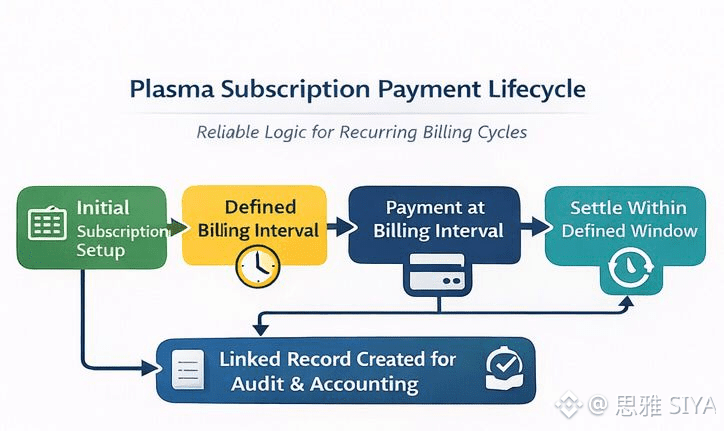
It is not a question of automation. It is a financial continuity problem. Subscriptions demand systems to maintain a recollection of the previous states, reinforce the expectations in the future and also to cope with failures without a complete reset of the relationship. Late payments, late settlements and vague try logic are all a pain that builds up over time. In case the subscription has failed, it is not usually a singular occurrence. It turns into a domino of billing, access, and refunding and support.
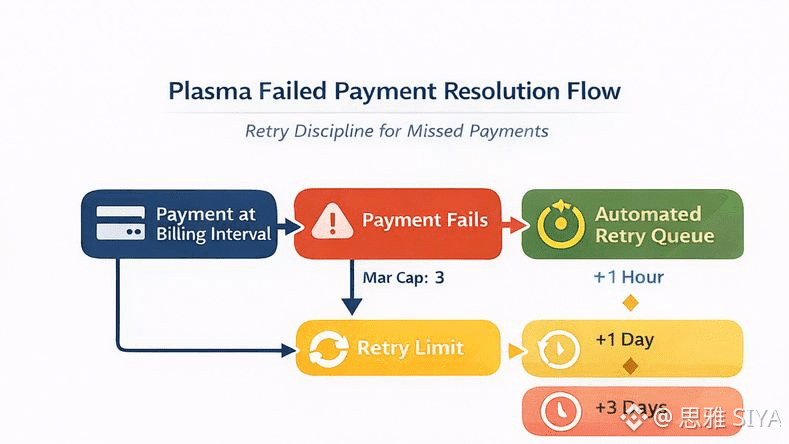
Plasma takes subscriptions as a continuation of settlement discipline, as opposed to a scripting problem. Plasma considers subscriptions as formal payment relationships, rather than viewing them as an isolated transaction, per charge. Every cycle has specific settlement periods, expected execution policies, and apparent results in case of alteration of circumstances. This eliminates uncertainty to the platforms and users.
In addition, subscription business is not an individual transaction, but rather a business that is run at a planning horizon. Revenue forecasting, churn analysis, and service provisioning are all reliant on budget that payments will act uniformly with time. Businesses are required to over-correct when settling timing drifts or opaque retry logic. They introduce delays in access, manually check-in or develop parallel systems simply to remain stable. These risks are absorbed by the infrastructure layer by the plasma and subscriptions can work as stable financial agreements instead of repetitive experiments.
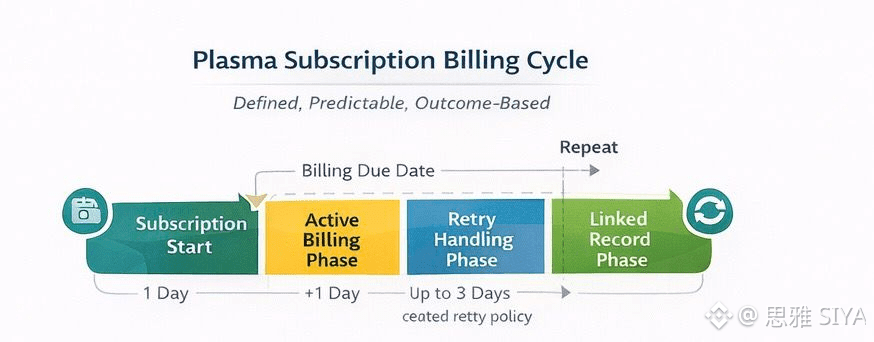
The revelation that is especially disclosing about subscriptions is that it reveals the weaknesses gradually. A system may be good with single time payments but still become ineffective when it comes to monthly payments. This is recognized in plasma whose design focuses on repeating rather than being novel. All bills cycle is predictable, auditable, and consistent with the past cycles. This is building trust by not promising, but repeating.
I believe that subscriptions are the best indicator of whether a payment system knows real business or not. They require patience, discipline and long term consistency. The approach used by Plasma indicates that it is not only about transactions but also the relationships. Such a difference will be significant when more real businesses are transitioning to onchain.

