

Most discussions about decentralized storage start with technology and end with price comparisons. But real applications don’t care about buzzwords — they care about whether a file loads tomorrow, next month, and five years from now. Walrus approaches storage from that practical angle: not “how cheap can we store data,” but “how reliably can we recover it when the internet misbehaves.”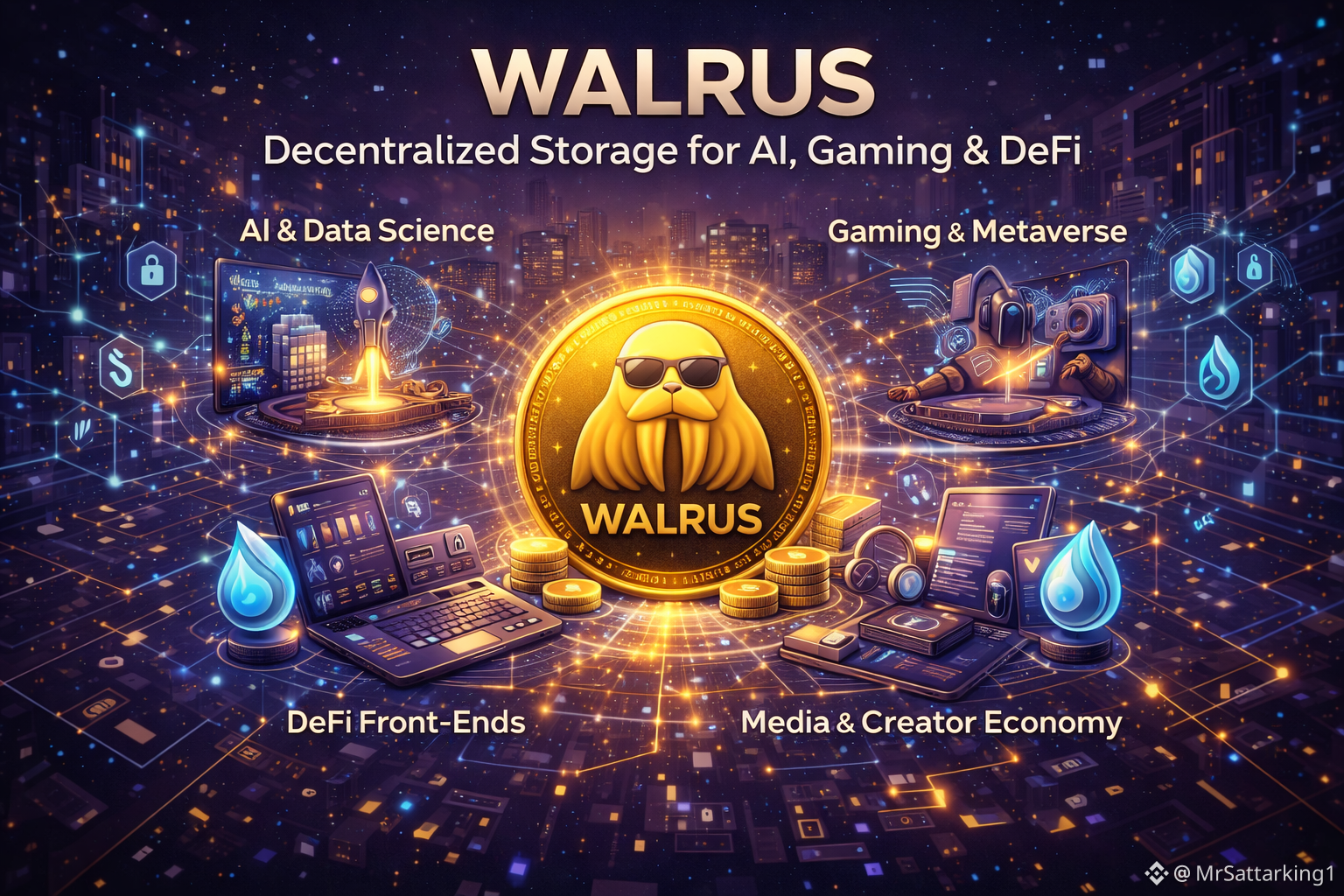
Storage Is Becoming Web3’s Bottleneck
Tokens and smart contracts live safely on-chain, yet the majority of Web3 content still sits on centralized servers. NFT images, AI training files, gaming assets, and social media data often depend on single providers. When those links fail, “decentralized” apps suddenly feel very centralized.
Walrus tries to close that gap by offering a storage layer designed specifically for large, real-world workloads. Instead of treating files as small metadata objects, the network supports multi-gigabyte blobs suitable for AI datasets, video content, and enterprise records.
Recovery First, Not Marketing First
A key idea behind Walrus is the RedStuff erasure coding scheme. Rather than simply copying files many times, data is split into fragments and distributed across the network. If some nodes disappear — which always happens in open systems — the file can still be reconstructed.
This matters because decentralized networks live in constant churn. Operators join and leave, connections slow down, and hardware fails. Walrus assumes that instability is normal and designs for it instead of pretending perfect conditions.
Built on the Sui Ecosystem
Running on the Sui blockchain gives Walrus high throughput and low latency for on-chain interactions. Storage is not isolated from DeFi; it can be used directly by smart contracts, marketplaces, and applications already active on Sui. That integration makes it easier for developers to build products where payments, ownership, and data live in the same environment.
The Economics of $WAL
The $WAL token coordinates the whole system. Users pay for storage with it, node operators earn it, and governance decisions rely on it. An important goal is to keep costs predictable in fiat terms so builders can plan long-term products without worrying that volatility will break their business model.
Stable economics are crucial if decentralized storage is meant to replace cloud services. Developers need utility-like pricing, not speculation.
Practical Use Cases
1. AI & Data Science
Training models requires huge datasets that must stay available for years. Walrus targets exactly this scale rather than tiny files.
2. Gaming & Metaverse
Games update assets constantly. A resilient storage layer prevents broken worlds and missing content.
3. DeFi Front-Ends
Protocol interfaces, proofs, and metadata can live on Walrus instead of centralized hosting.
4. Media & Creator Economy
Videos, podcasts, and archives remain accessible without a single company controlling access.
How Walrus Differs
Many networks advertise “cheap storage.” Walrus emphasizes verifiable recovery. The question is not only where the file is stored today, but whether the network can prove it is still stored tomorrow. Challenges and proofs are designed to work even under asynchronous network conditions, reducing the chance of gaming the system.
This focus on behavior during failure — rather than behavior during demos — is what makes the design interesting.
Market Context
Demand for decentralized data is growing alongside AI and tokenized assets. As applications become heavier, infrastructure must handle real scale. Projects like Walrus gain attention because they treat storage as core Web3 infrastructure, not an optional add-on.
Risks to Remember
Competition from established storage networks is strong, and adoption depends on developer experience. Security audits and economic stability will be tested as usage grows. Integration with Sui is an advantage but also a dependency. These factors will shape long-term success.
Final Thoughts
For Web3 to feel as reliable as traditional internet services, storage must be boring and dependable. Walrus aims for that kind of boring — the good kind where files simply return when requested.
If decentralized applications are to host AI models, global games, and financial records, they need infrastructure designed for the messy reality of the internet. Walrus is betting that recovery matters more than slogans.
What type of application do you think will benefit most from this model — AI, gaming, or DeFi?


