

For years, Web3 talked about decentralization while quietly storing most of its data on centralized servers. NFTs pointed to private CDNs, DeFi front-ends lived on single domains, and gaming assets depended on traditional clouds. Walrus is part of a new wave trying to close that contradiction by treating storage as first-class blockchain infrastructure instead of an afterthought.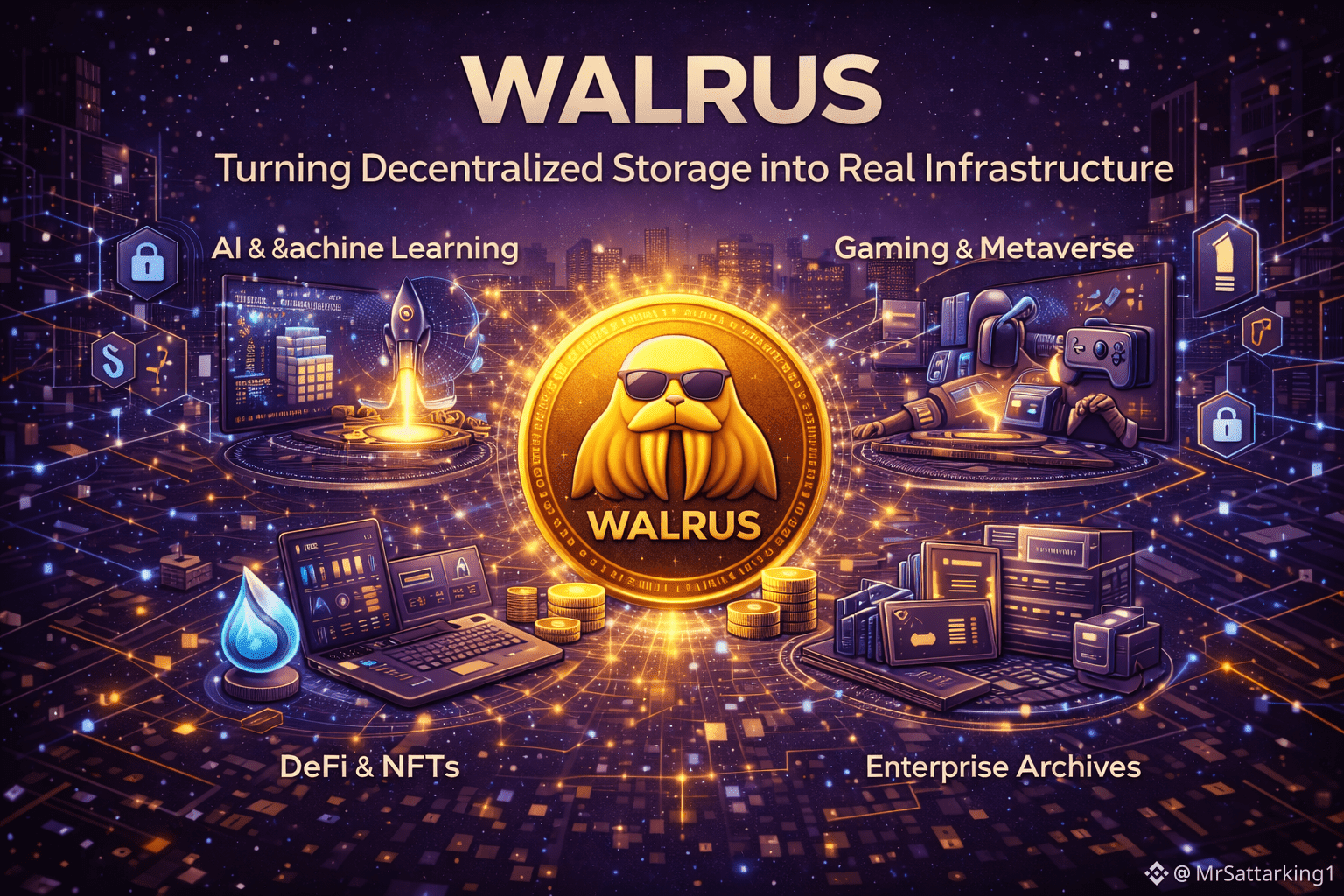
Data Is the Hidden Layer of Web3
Smart contracts handle ownership and logic, but the “heavy” part of applications — images, AI models, videos, game files — lives elsewhere. When that layer fails, decentralization becomes cosmetic. Users do not remember which chain minted their NFT; they remember that the picture disappeared.
Walrus focuses exactly on that weak point. Instead of optimizing only for small metadata, it is designed for large blobs that real applications generate. AI datasets, media archives, analytics logs, and metaverse assets require a different mindset than simple document storage.
Designed for Churn, Not Perfection
Open networks are messy. Nodes join and leave, connections slow down, disks fail. Many storage projects assume stable conditions; Walrus assumes the opposite. Through its RedStuff erasure coding approach, files are split and distributed so that recovery is possible even when parts of the network vanish.
This philosophy changes the question from “where is my file stored?” to “can the network rebuild my file when something goes wrong?” For businesses considering decentralized storage, that difference is everything.
The Sui Advantage
Walrus lives inside the Sui ecosystem, which gives it fast on-chain coordination and low latency. Storage payments, permissions, and proofs can interact directly with smart contracts. Developers building on Sui can treat data availability as a native service rather than an external dependency.
That tight integration is important for use cases like on-chain gaming or AI marketplaces where contracts need to verify large off-chain assets without trusting a single provider.
Economics Behind $WAL
The $WAL token connects users and operators:
users pay for space with WAL
nodes earn WAL for reliable service
governance decisions rely on WAL participation
A key goal is price stability in practical terms. If storage costs swing wildly with speculation, developers will never rely on it. Walrus aims to behave more like a utility market than a casino.
Where It Can Be Used
AI & Machine Learning
Training data and model checkpoints are huge and long-lived. Decentralized, verifiable storage prevents single-provider lock-in.
Gaming & Metaverse
Games update constantly; missing assets break experiences. Walrus targets high-availability for this kind of content.
DeFi & NFTs
Metadata, proofs, and front-ends can live outside centralized hosts, reducing censorship risk.
Enterprise Archives
Companies exploring Web3 need compliance-friendly, durable storage without trusting one cloud.
How It Differs from IPFS-Style Models
Traditional decentralized storage often optimizes for distribution but not guaranteed recovery. Walrus emphasizes verifiable availability under asynchronous conditions. Challenges and proofs are built to work even when the network is imperfect, reducing incentives for dishonest behavior.
It is less about being the cheapest gigabyte and more about being the most dependable gigabyte.
Market Reality
Demand for data infrastructure is growing faster than demand for new tokens. As AI and creator economies expand, blockchains must host real content rather than just balances. Projects that solve this layer may quietly become more important than flashy DeFi primitives.
Risks to Consider
Adoption depends on developer experience and tooling. Competing networks already exist with strong communities. Integration with Sui is powerful but also ties Walrus to that ecosystem’s success. Long-term economics will be tested only under heavy usage.
Closing Thoughts
Decentralization becomes meaningful only when the data layer is as resilient as the ledger layer. Walrus is betting that the future of Web3 will be measured not by how many tokens move, but by how reliably information survives.
If applications can finally trust decentralized storage the way they trust blockchains, a major barrier to mass adoption disappears.
What kind of product would you personally build on top of Walrus — AI, gaming, or creator platforms?


