


The Reserve Bank of India has proposed to interconnect the digital currencies of BRICS countries for cross-border payments and has requested to include it in the agenda for the 2026 summit. The timing of this proposal is intriguing.
The underlying architecture of BRICS Pay has been established: a decentralized cross-border messaging system (DCMS) with a processing capacity of 20,000 messages per second, connecting Russia's SPFS, China's CIPS, India's UPI, and Brazil's Pix. The pilot was originally scheduled for the end of 2026, but the timeline has now been pushed to 2030—this reflects not a lack of capability, but the complexity of political coordination.
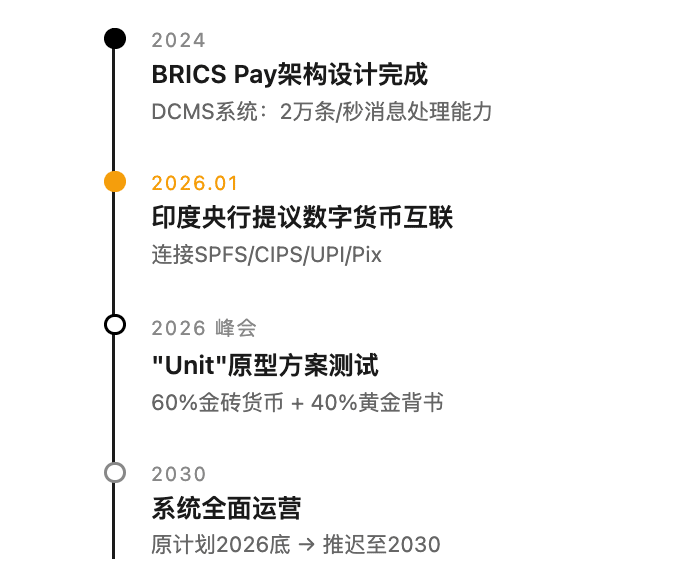
"Unit" prototype scheme is more radical: 60% BRICS currencies + 40% gold backing. When the 11 BRICS countries contribute 29% of the world's GDP, 43.6% of oil production, and 72% of rare earth minerals, this bypassing the dollar pipeline system has a real economic foundation.
Last year, Trump threatened to impose a 100% tariff on "countries aligning with the anti-American policies of BRICS." The question is: once the alternative route is completed, who will the tariffs hit?