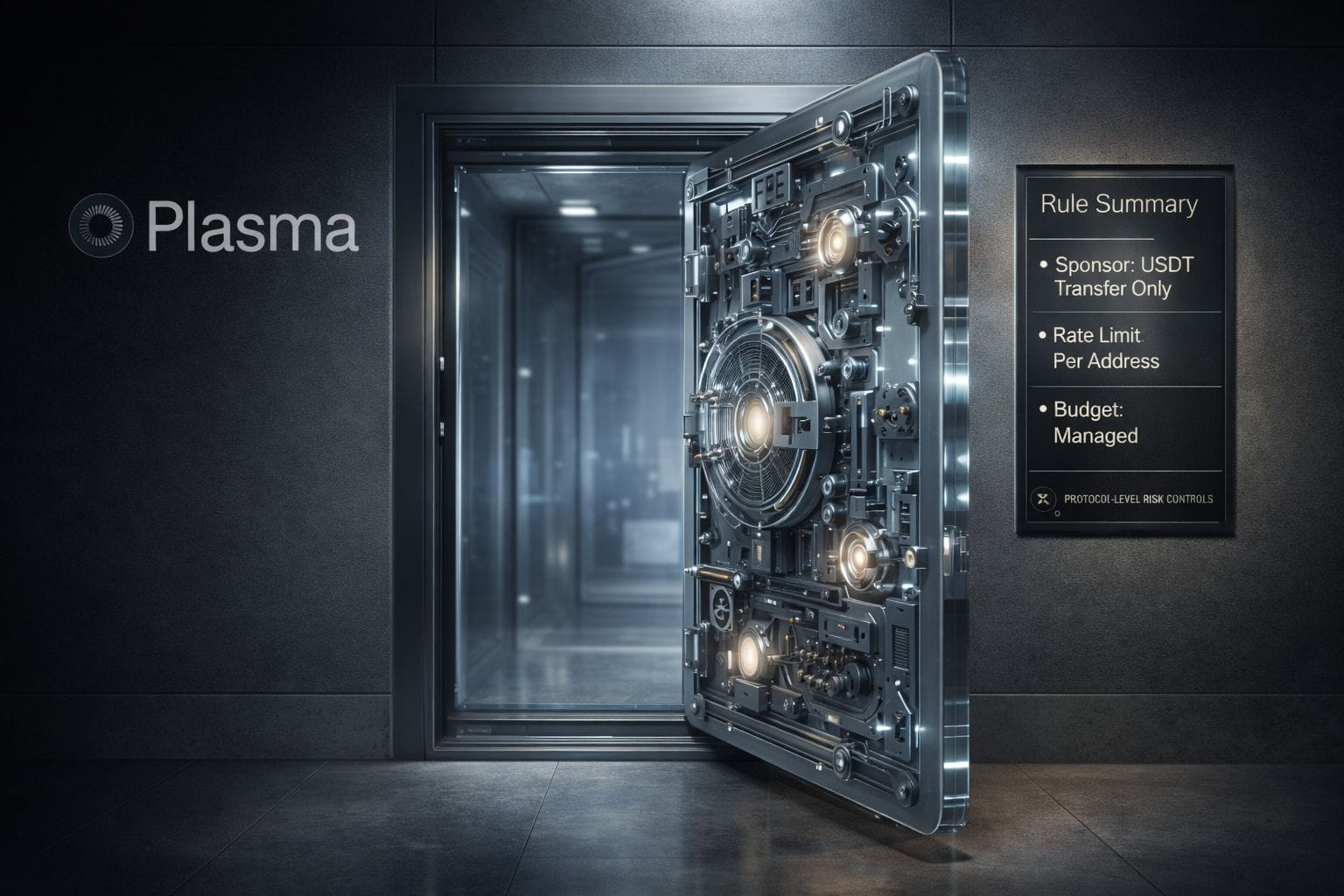
Last night I saw the comments section again brushing 'forever zero Gas.'
I didn't join in the excitement.
Instead, it feels a bit chilly.
Because on the chain, free has never disappeared,
It is just being transported, and it must be controlled.
These two messages pushed me to flip through the documents:
— USDT on @Plasma went live on @WhiteBit
— USDT on @Plasma went live on @MassPay_io
The entrance is becoming more real, and the narrative can no longer stop at just the word 'welfare.'
1. First, clarify the zero fee: it has a scope, it is not indiscriminately free.
Plasma is currently sponsoring: direct USDT transfers.
Not all chains are free.
Not all transactions are exempt from Gas.
Do you want to use a free channel to run contracts, interact, or do high-frequency scripts?
That's not the same road. This is not stingy; this is the bottom line of the payment system: resources should serve payment, not consumption.
2. Who is paying: Paymaster pays, but it is more like risk control, not charity.
Many people understand Paymaster as a payment tool.
But after reading the document, I am more certain: it resembles a payment risk control engine on the chain.
What it does is actually very straightforward: just three things:
(1) First verify the identity
Confirm that this transfer is indeed a regular USDT transfer and not mixed with other actions.
(2) Manage the pace again
Limit the flow based on address and behavior. It’s not that we dislike users, but we shouldn't let a swarm of scripts overwhelm the network; only ordinary users can have a stable experience.
(3) Finally maintain the budget
Sponsorship is not a slogan; it’s a budget system. If the budget is tight, it collects; if the budget is loose, it releases. Therefore, the key to sustainable zero fees has never been about throwing money, but about discipline.
I give you a summary that can be reiterated: zero fees are not a benefit; they are a certain experience under engineering constraints.
3. Why will exchanges/payment parties comply: What they fear is not the cost, but uncertainty.
Many people think institutions only love low costs.
But what payment businesses really fear is: today 0.1, tomorrow 10 of that kind of uncertainty.
When you do payroll, cross-border small amounts, and merchant payments, what you fear most isn't a few extra cents in fees, but that every time you click confirm feels like a blind box.
This set of Paymaster in Plasma essentially locks the uncertainty of the chain into rules.
Users only see one word: smooth.
The harshest evaluation of infrastructure is just this one word.
I'll add one more harsh point: Plasma is not selling free services; it’s selling you certainty without guessing.
4. I'm not pretending to be optimistic: two shadows must be written out.
(1) It now resembles a controllable entry point of engineering.
The cost of a stable experience is greater reliance on rules and access.
There is still a long way to go before being completely permissionless.
(2) Limiting the flow will inevitably hurt some high-frequency users.
But if the goal of Plasma is everyday payments, then such trade-offs are reasonable: better to block anomalies than to ensure certainty. This is a commitment and trade-off, not a bug.
5. Give @Plasma a very practical suggestion
Put a summary of the rules that users can understand in a more prominent position:
— What can sponsor
— What will limit the flow
— How to make the budget public
— How to explain if blocked
What payment systems fear most is not strict rules, but that users don’t know why they were rejected.
6. Voting: What do you hope to prioritize with zero fees?
A. Only sponsor payment-type transactions (boundaries are clear)
B. Not crashing, able to withstand (risk control first)
C. Long-term sustainable (budget transparency)
D. More open and more permissionless (even if not so smooth)
Which one do you choose? I want to see the real answer.
Because user preferences determine what the infrastructure will look like.