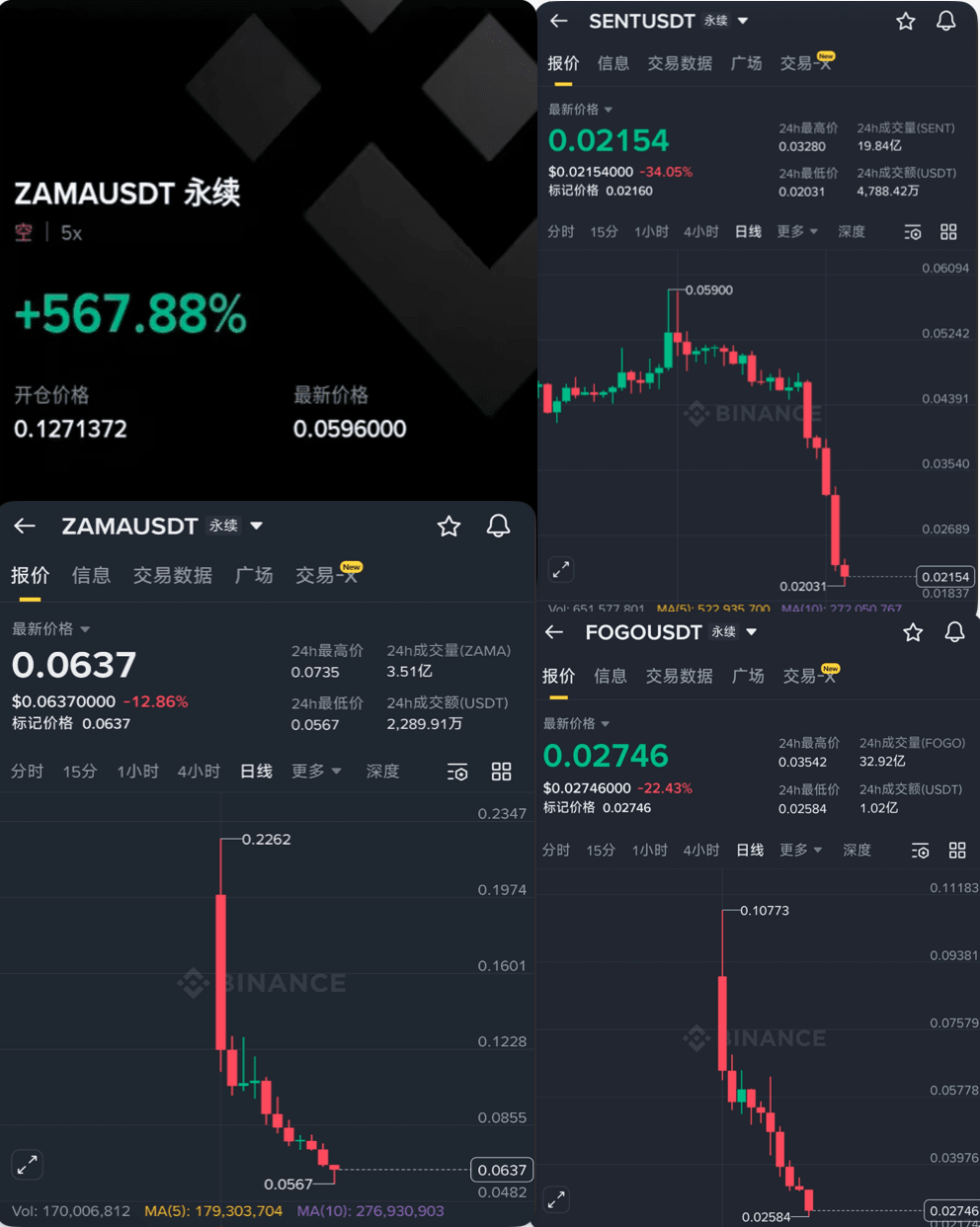
$ZAMA An OG has shrunk from 6000 U to 2400 U.
Without hedging, one loses 25,000.
At the opening, there is a large selling pressure of 10-12% available for public sale.
$SENT It’s been a continuous decline.
$FOGO Broke below TGE cost.
🔹 Many people are wary of hedging, Perps, and contracts.
I think contracts themselves are a tool.
The danger of contracts lies in not managing positions and not implementing risk control.
Contract trading is inherently a negative-sum game.
Exchanges charge fees, and there are extreme risks like 'spike' events, funding fees, and forced liquidation fees.
I have never made money in contract trading overall.
Contracts are merely tools for hedging.
From my experience participating in trading competitions multiple times,
Most altcoins eventually trend downward,
If not hedged, trading competitions often end in waste or loss
🟡 The two biggest risks when hedging are: extreme 'spikes' and negative funding fees
🔷 Extreme 'spikes'
When short hedging, if the price suddenly rises sharply, it leads to forced liquidation of short positions,
and spot and trading competition rewards cannot be sold in time, project tokens are locked.
By the time they are unlocked, the price has already fallen, leading to losses on both ends
Representative tokens: MMT, BAS
🟢 My risk management measures:
1️⃣ Position management, reserve sufficient margin
For every 100 U short position, at least 1-2 times margin
For pre-market small-cap altcoins, reserve more margin
2️⃣ Use 'dollar-cost averaging' for hedging
For example, the 100 U trading competition reward will be issued after 5 days,
Invest 20 U in short positions daily,
'Dollar-cost averaging' for hedging can reduce the risk of sudden spikes
Due to the small initial position ratio, the risk of liquidation is low
100 U margin,
20 U position, needs to rise 500% to be liquidated
40 U position, a rise of 250% will lead to liquidation
If it rises,
you can invest at a higher short position price, reducing costs
If it falls,
the previous high short position is already profitable
⭐️ The core idea of 'dollar-cost averaging' hedging is:
You cannot predict where the top is, but dollar-cost averaging allows you to obtain a relatively low cost,
As long as the final trend of altcoins is downward, 'dollar-cost averaging' hedging is profitable
🔷 Negative funding fees
Negative funding fees mean that there are too many people shorting in the market,
The funding rate is negative (maximum -2%),
Every 8 hours, 4 hours, and 1 hour, fees are paid to the counterpart (longs).
Conversely, positive funding fees mean that longs pay shorts,
In most cases, mainstream coins are positive funding fees.
In extreme cases, funding fees can be very high,
For example, the fee is -1%, for 1 hour,
100 U short position, 10x leverage
Hourly funding fee = 100 U * 10 * 1% = 10 U,
If it does not decrease or close, the 24-hour funding fee is 240 U
Of course, extreme situations usually do not last long; as the number of short positions in the market decreases, the funding fees will gradually decline
🔴 Hedging has 'four no hedges'
1️⃣ Too low market cap, do not hedge (below 50m)
Under 1 billion, rising 10 times is common for 10 billion,
100 U hedging, needs to lose 10 times 1000 U, the risk is too high
A market cap of 1 billion needs to rise 5-10 times, which is difficult
2️⃣ Do not hedge if locked for too long (mandatory lock for over 3 months)
Long cycles with many variables, hedging occupies margin for a long time, long-term funding fee risks
3️⃣ Do not hedge with too few circulating chips
Most chips are in the hands of the project party, strong control, spot prices surge as soon as bought
4️⃣ The depth is too shallow to hedge
Small pre-market, contracts, low trading volume, often spikes
Only hedge Binance contracts
🟢 Summary:
Contracts are tools, hedging is not a zero-risk matter.
Specific tokens require specific analysis,
Use 'dollar-cost averaging' for hedging, 'four no hedges' logic,
Try to minimize risk.
Focus on @逸星web3 , share more airdrop tutorials and Alpha information
#币安钱包TGE