

In the early days of the internet, we were promised a "World Wide Web"—a global, interconnected repository of human knowledge.
But as the decades passed, that web became fragile. Links broke, data centers shuttered, and the vast majority of our digital lives ended up stored on the rented hard drives of a few massive corporations.
Today, as we move toward a decentralized future (Web3), we face a massive bottleneck: Storage.
While blockchains are excellent at recording who owns what, they are notoriously bad at storing the "what" itself.
If you buy an NFT, the blockchain records the transaction, but the actual high-resolution image or video is often stored on a standard, centralized server. If that server goes down, your "permanent" asset becomes a 404 error.
Walrus Protocol. @Walrus 🦭/acc
What is Walrus? (Beyond the Name)
Developed by Mysten Labs, Walrus is a decentralized storage network designed to handle "blobs"—large chunks of raw data like videos, images, and heavy application files.
Unlike traditional blockchains that try to store every piece of data on every single node (which is incredibly expensive and slow), Walrus uses a sophisticated architectural approach to ensure that data is permanent, cheap, and instantly accessible.
The "Redundant" Secret Sauce
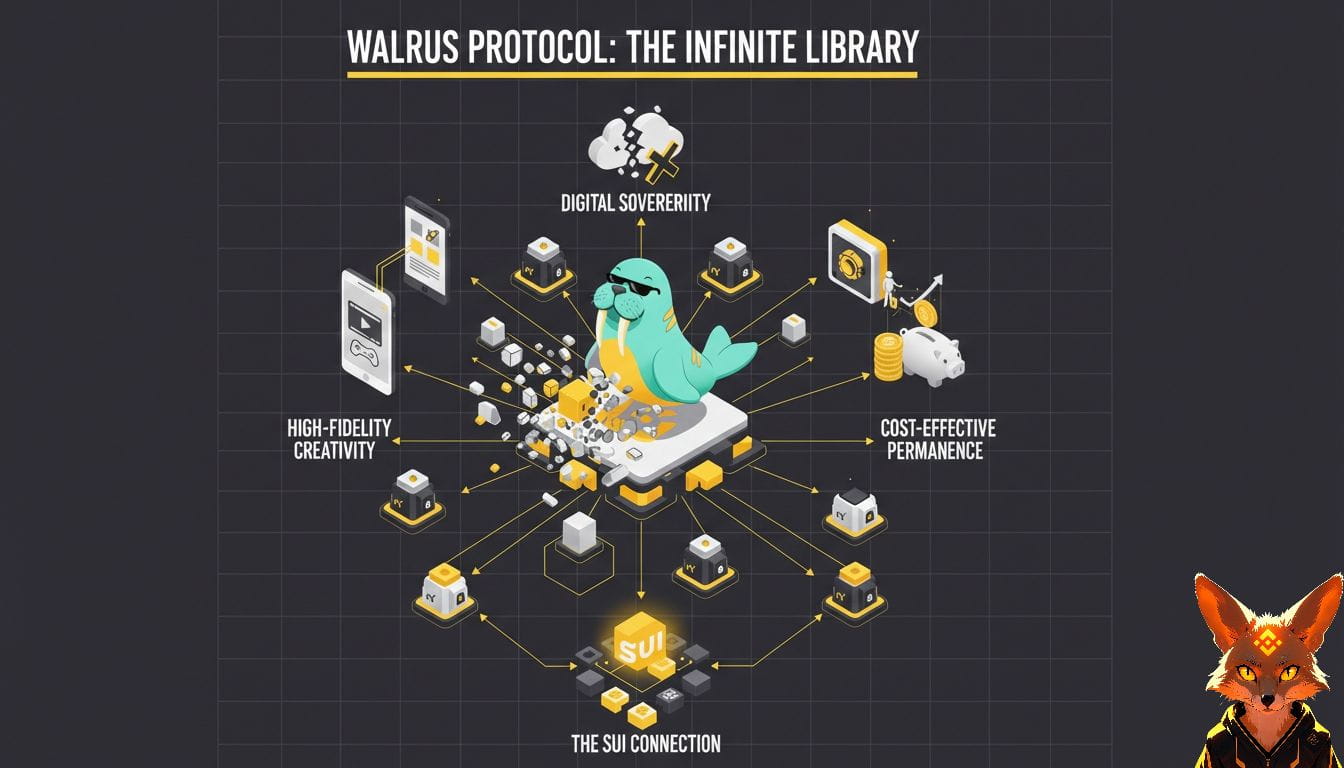
#Walrus utilizes Erasure Coding. Imagine taking a high-resolution photograph and tearing it into 100 tiny pieces.
Now, imagine a system where you only need any 20 of those pieces to perfectly reconstruct the entire original photo.
Because of this, Walrus doesn't need to store ten copies of your file.
It stores fragments across a vast network of storage nodes.
Even if a significant portion of those nodes go offline simultaneously, your data remains perfectly intact.
It’s easy to get lost in the technical jargon of "decentralized storage primitives," but the impact of Walrus is deeply human. It addresses three core pillars of our digital existence:
1. Digital Sovereignty
In the current "Cloud" era, you don't really own your data; you're just borrowing space. If a provider changes their terms of service or goes out of business, your digital history can vanish. Walrus creates a "public good" layer for the internet—a place where data belongs to the creator, not the host.
2. High-Fidelity Creativity
Until now, decentralized apps (dApps) have felt "clunky" because they couldn't handle heavy media. Walrus changes the game for:
Gamers: Entire game worlds and assets can live on-chain.
Artists: 4K video and high-fidelity audio can be truly decentralized.
Historians: Important archives can be preserved without fear of censorship or hardware failure.
3. Cost-Effective Permanence
Historically, storing 1GB of data on a blockchain like Ethereum would cost millions of dollars.
Walrus is designed to compete with the pricing of traditional cloud providers (like Amazon S3), making it economically viable for a startup or an individual creator to choose decentralization over centralization.
The Sui Connection
While Walrus is designed to be a standalone powerhouse, it works in tight harmony with the Sui blockchain.
Sui acts as the coordination layer—managing the "metadata" and the financial transactions—while Walrus acts as the heavy-duty warehouse.
This synergy allows for "Smart Content." Imagine a video file that knows who is allowed to watch it, or an image that automatically updates its own properties based on real-world events, all without ever touching a centralized server.
The Verdict: A Sturdier Foundation
The internet is no longer just a luxury; it is the ledger of our civilization.
We need a foundation that is as resilient as the information we put on it.
The Walrus Protocol isn't just about "storing blobs." It’s about building a web that doesn't forget, a web that can’t be easily unplugged, and a web where the user—not the corporation—is the true owner of the data.$WAL
"Walrus is the shift from 'renting' the internet to 'owning' a piece of it."


