
I still remember sitting through yet another blockchain conference a few years back, listening to speakers confidently promise that their new layer-one was finally ready for millions of users. A few days later, I tried deploying a simple game prototype on one of those chains. Nothing complex. But once traffic picked up, fees jumped, latency crept in, and the whole thing started to feel fragile. That experience stuck with me. Most networks aren’t really built for everyday users interacting with apps. They’re built for traders moving tokens around, not for players stepping into virtual worlds or casually engaging with digital experiences. After trading through multiple cycles, I’ve learned that the real value usually lives in infrastructure that works quietly in the background, not in big, confident promises.
The core problem is consumer-grade scalability. Entertainment and gaming apps generate huge numbers of small, frequent interactions. Users expect those actions to feel instant and cheap. Many blockchains optimize heavily for security or decentralization, which is important, but usability often gets pushed aside. The result is a network that technically works but feels clunky outside of finance. It’s like trying to stream a movie on a connection built for email. It technically functions, but it’s not something most people will stick with.
I like to think of it in terms of public transportation. When buses are reliable, affordable, and frequent, people use them without thinking. When they’re slow, crowded, or unpredictable, people avoid them, even if driving isn’t ideal either. Blockchain infrastructure works the same way. If the experience is smooth, users show up. If it isn’t, they leave, especially in entertainment where flow and immersion matter more than ideology.
What this protocol does differently is start with usability instead of treating it as an afterthought. It’s a layer-one chain that stays compatible with Ethereum tooling, so developers aren’t forced to relearn everything, but it’s tuned for higher throughput and lower costs in real applications. It builds on proven execution code and adds custom layers designed around responsiveness. One example is its modular structure. A base layer handles core blockchain operations, while a semantic memory layer called Neutron lets applications store and recall data in a more intelligent way. On top of that sits Kayon, in practice, a reasoning layer that generally allows logic to adapt based on prior interactions. In practical terms, apps can respond dynamically without constantly relying on off-chain servers that introduce lag and extra points of failure. For gaming and metaverse environments, that difference is noticeable.
The token itself plays a simple role. It pays network fees, supports staking to help secure the chain, and allows participation in governance decisions. There’s no attempt to oversell it. Its relevance comes from whether the network is actually used, not from speculative mechanics layered on top.
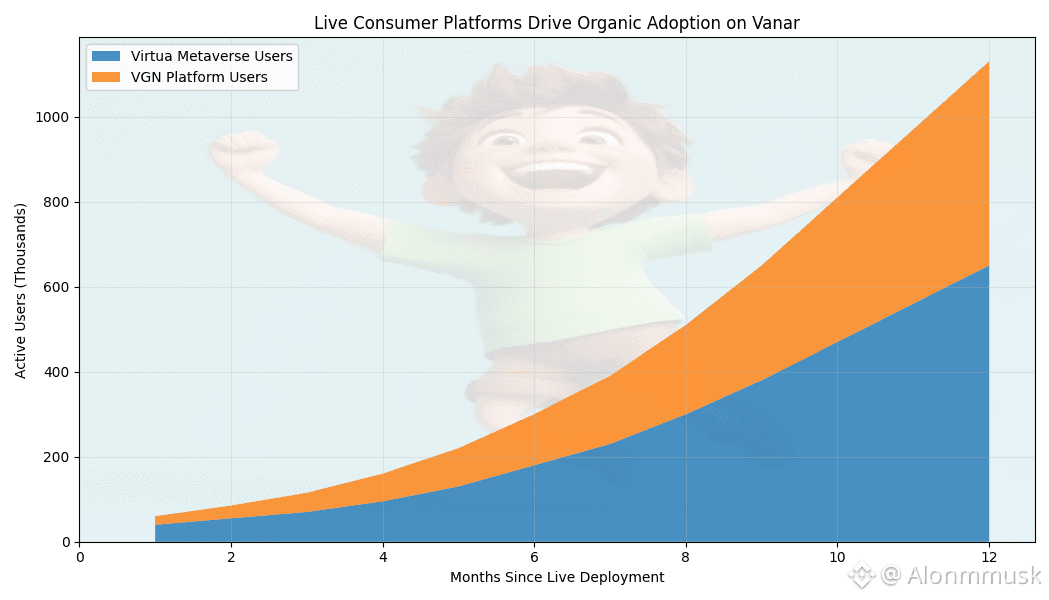
From a market perspective, there are already signs of consumer traction. Platforms like Virtua Metaverse have reportedly in practice, onboarded hundreds of thousands of active users, which suggests real usage beyond test deployments. The chain’s tested throughput, around ten thousand transactions per second, puts it in a range where live events, multiplayer environments, and interactive experiences can function without constant congestion.
Short-term, assets tied to this kind of infrastructure can be volatile. AI narratives, partnerships, and broader market swings in practice, can drive sharp price moves, which might appeal to traders but can reverse quickly. Long-term, though, the infrastructure angle is more compelling. If consumer-facing apps continue to grow on top of the network, usage itself becomes the driver, not hype. That payoff is slower, but usually more durable.
There are real risks worth acknowledging. Established chains like Solana and Polygon already dominate gaming, and they’re not standing still. AI integration also adds uncertainty. Regulators may take a closer look as on-chain reasoning starts intersecting with payments or identity. One failure scenario that’s hard to ignore is compute load. If those intelligence layers become expensive during peak usage, fees could rise and undermine the consumer experience the network is trying to protect. And mass adoption itself is unpredictable. What works for early users doesn’t always translate cleanly at scale.
In the end, infrastructure like this only proves itself over time. Adoption is gradual, not explosive. Watching whether live platforms like Virtua and VGN continue to grow organically matters more than roadmap promises. From an investor’s perspective, the real question isn’t whether the idea sounds good, but whether the system holds up when real users push it every day. Only usage answers that.
@Vanarchain #Vanar $VANRY
