
A couple of years ago, I was looking into some tokenized asset trades on a public blockchain, nothing unusual, just trying to understand how the flow worked in practice. After a routine swap, I opened a block explorer out of habit. That’s when it really sank in how exposed everything was. Wallet balances, transaction history, timing, all sitting there in plain sight. It wasn’t paranoia. In regulated financial environments, that level of visibility directly clashes with how real markets operate, where discretion often matters just as much as transparency. But going fully opaque didn’t feel right either. Enforcement still needs proof. That tension stuck with me, because in in practice, practice, it highlighted how decentralization often runs into friction when privacy and compliance collide.
At its core, the issue is simple but uncomfortable. Traditional blockchains rely on radical transparency to establish trust. Every detail is public, verifiable, and permanent. In finance, though, that openness can leak sensitive information that doesn’t need to be shared, like position sizes or identities. At the same time, regulators and counterparties still require evidence that rules are being followed. Without that, systems break down under audits or legal pressure. The problem isn’t adoption in theory. It’s enforcement in practice. Full transparency invites risk. Full privacy removes accountability. Most chains force you to pick one.
I often think about it like a serious poker game played in a crowded room. Everyone needs confidence that the rules are fair and the chips are real, but no one wants their hand exposed to the table. The integrity of the game depends on verification, not visibility. The dealer doesn’t flip over your cards to prove you’re playing honestly. They just confirm that you are. That’s the balance financial systems need, and it’s one most blockchains never really address.
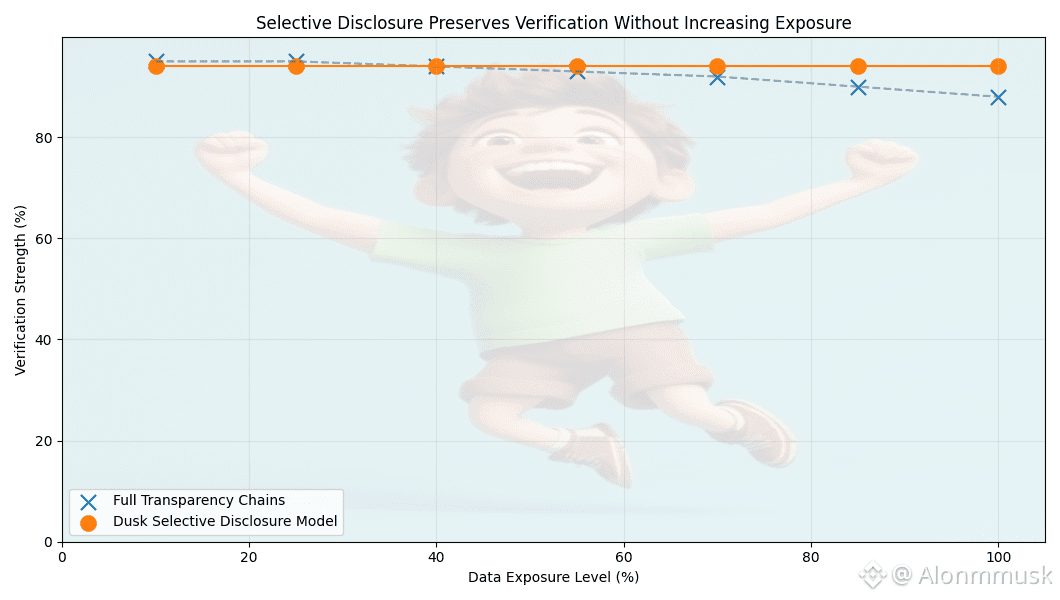
This is where Dusk’s design starts to feel more grounded. The system is built around zero-knowledge in practice, proofs and selective disclosure, not as optional features, but as core mechanics. In simple terms, zero-knowledge proofs let you prove something is true without revealing the underlying data. You can show that you meet a requirement, passed a check, or own sufficient assets, without exposing balances or identities. Selective disclosure builds on that by allowing information to be revealed only to parties who are authorized to see it, like regulators or auditors, without turning the entire ledger into a public dossier. Together, this generally allows smart contracts to enforce financial rules on-chain while keeping sensitive details private unless they’re explicitly required.
On the token side, DUSK plays a fairly straightforward role. It’s used to pay network fees, which keeps the system functioning and discourages spam. Validators stake it to participate in consensus and earn rewards for securing the network. There’s no attempt to present it as something mystical. It’s infrastructure fuel. If the network is used, it has value. If it isn’t, it doesn’t. That simplicity is refreshing.
From a market standpoint, the project is still relatively small. With a market cap hovering around one hundred million dollars and daily volume that can swing sharply, it behaves like a niche infrastructure asset rather than a dominant platform. Liquidity comes and goes with sentiment, which makes short-term price action noisy and often disconnected from fundamentals.
Trading it short-term feels like chasing momentum more than meaning. Volume spikes on announcements, privacy narratives, or broader market moves, and then cools just as fast. Long-term, though, the story is different. If regulated assets like tokenized bonds or equities actually move on-chain in meaningful ways, systems that can enforce rules without exposing everything start to matter. That kind of value builds slowly, through usage rather than headlines. It’s the difference between betting on a weather pattern and betting on whether roads eventually get built.
None of this comes without risk. Competition is real. Privacy-focused chains like Monero and Zcash solved anonymity years ago, even if they weren’t designed for compliance. Other platforms are now racing toward regulated asset infrastructure from different angles. Regulatory interpretation itself remains a wildcard. If rules shift toward blunt disclosure requirements, selective privacy could lose flexibility. And there are technical risks too. A flaw in the zero-knowledge proof system, or friction between private and public transaction modes under heavy load, could undermine confidence quickly.
In the end, systems like this don’t announce their success loudly. They either integrate quietly into real workflows, or they fade without much drama. I’ve learned to watch these things with patience. Infrastructure rarely looks exciting while it’s being built, but when it works, it reshapes how the space operates without ever asking for attention.
@Dusk #Dusk #dusk $DUSK
