
A couple of years ago, I found myself deep into a DeFi position, trying to scale into tokenized assets without advertising every step. That’s when it really sank in how exposed everything was. Wallet address, transaction size, timing — all of it sitting there in public. After spending years trading both traditional markets and crypto, that lack of discretion started to bother me more than I expected. In equities or bonds, nobody watches your orders in real time. On-chain, it felt like doing the same job with the lights permanently on. It wasn’t just uncomfortable. It created real risks, like front-running or strategies getting picked apart. Finance has always balanced privacy with accountability. Crypto often forgets that balance exists.
The problem is fairly straightforward. Regulated financial systems need proof that rules are being followed — things like AML checks, eligibility requirements, reporting standards — without forcing sensitive data into public view. Traditionally, that’s handled by intermediaries. Banks, custodians, clearing houses verify compliance without broadcasting client information. Most blockchains don’t work that way. Transparency is default. Everything is visible whether it needs to be or not. That’s fine for simple transfers, but once you introduce real assets or institutional workflows, it becomes a liability. Client identities, position sizes, and execution logic aren’t supposed to be public artifacts. The issue isn’t decentralization itself. It’s the assumption that visibility equals trust.
I think about it like a sealed evidence box in a courtroom. The judge doesn’t need to open it to confirm it’s valid. The seal, the chain of custody, and the documentation are enough. Finance works the same way. You prove compliance without dumping the contents onto the table. Oversight doesn’t require exposure. It typically requires verifiable process.
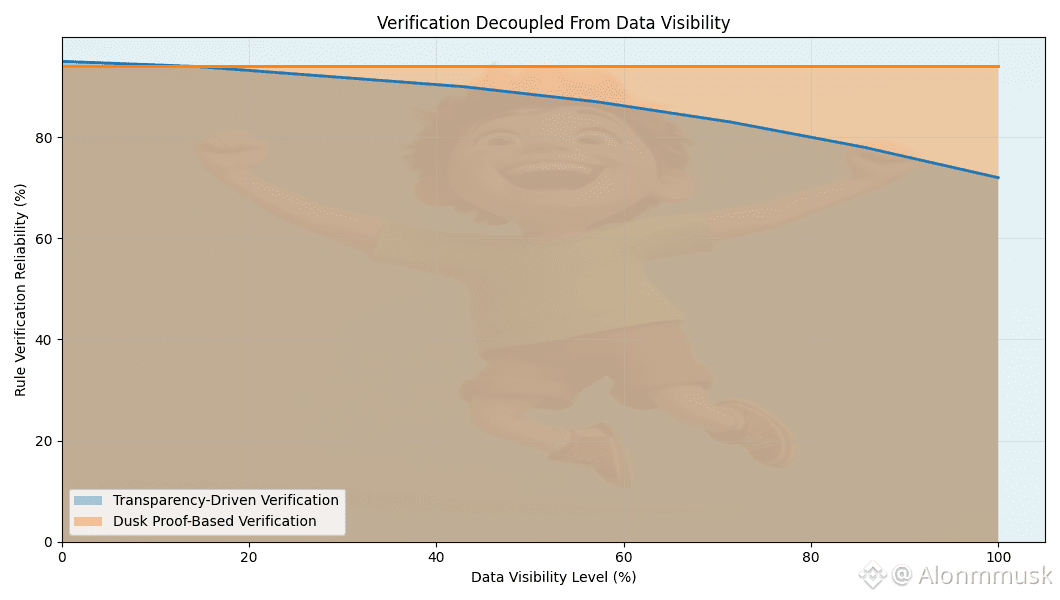
That’s the gap Dusk is trying to address. It’s a layer-1 network built specifically around separating data from verification. Transactions execute confidentially, but the system still produces cryptographic proof that rules were followed. Zero-knowledge proofs do the heavy lifting here, in practice, allowing claims like ownership, settlement validity, or eligibility to be verified without revealing the underlying information. On top of that, Dusk in practice, uses a privacy-aware consensus mechanism that avoids exposing validator behavior unnecessarily. The result is an environment where assets like tokenized bonds or equities can exist on-chain with built-in compliance paths, without turning every transaction into a public disclosure.
The DUSK token itself doesn’t try to be clever. It pays for transactions, secures the network through staking, and supports governance decisions. That’s it. It functions more like infrastructure fuel than a speculative feature. Without it, the system doesn’t coordinate or secure itself. With it, the mechanics work as intended.
In market terms, this is still a small corner of crypto. The capitalization sits in the low hundreds of millions, with trading volume that can spike or fade depending on sentiment. That’s normal for infrastructure that isn’t designed to chase attention. It’s not competing for meme velocity. It’s trying to solve a problem most people only notice once something breaks.
Short-term trading around it behaves like most low-cap assets. Momentum comes and goes. Narratives flare up, then cool off. Long-term, the question is much quieter. If regulated assets continue moving on-chain, systems that can enforce rules without forcing exposure start to matter. That value compounds slowly, through usage, not hype.
There are real risks. Other networks are working on similar ideas. Larger ecosystems could integrate comparable privacy layers faster. And regulatory interpretation is still a moving target. One serious flaw in a proof system would damage trust immediately. There’s no room for silent failure in this kind of infrastructure.
None of this resolves quickly. Adoption here looks more like integration than explosion. One issuer, one platform, one workflow at a time. Infrastructure rarely announces itself loudly. You usually notice it only after it’s been there for a while, quietly doing its job.
@Dusk #Dusk #dusk $DUSK
