
A couple of years ago, I remember sitting in front of my screens during a sharp market dip, watching prices move faster than I liked. I was looking at a position tied to tokenized securities, something that was supposed to feel modern and efficient. Instead, it felt exposed. Every action, every adjustment, sat there on-chain, visible to anyone who cared to look. That moment stuck with me. Blockchains solve trust by making everything open, but in doing so they strip away something finance has always relied on. Discretion. It made me wonder how larger players, funds or banks, could realistically operate in an environment where sensitive moves are effectively broadcast.
The problem itself isn’t complicated. Financial systems have always lived in a narrow space between transparency and privacy. Public ledgers work fine when the goal is simple settlement, but they start to break down when proprietary strategies, client information, or regulated assets enter the picture. Institutions need to show they are following rules without dumping sensitive data into the open. Most of today’s infrastructure forces an uncomfortable choice. Either reveal everything, or push critical checks off-chain and reintroduce trust assumptions that decentralization was meant to remove. That tension keeps traditional finance interested, but hesitant.
I tend to picture it like a negotiation happening behind one-way glass. The outcome can be verified. The process can be audited if needed. But the details stay contained. Everyone involved knows the rules were followed, without turning the entire discussion into a public performance. That balance is what real adoption demands.
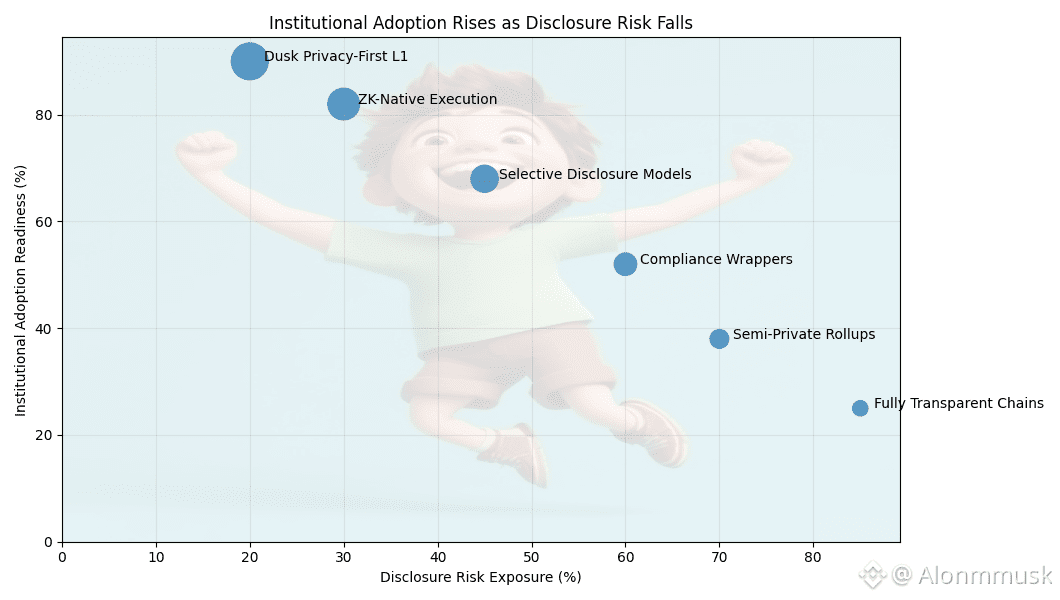
This is the space Dusk is trying to occupy. It’s built as a layer-one network where zero-knowledge proofs do most of the work. Contracts can execute without exposing their inputs or outputs, while still proving that everything balances correctly. One technical choice here is the use of recursive zero-knowledge proofs, which helps keep verification efficient as activity grows. Another is DuskEVM, which adapts familiar Ethereum tooling to a privacy-first execution model. The goal isn’t anonymity for its own sake. It’s practicality. Things like tokenized real-world assets need instant settlement and automated compliance, without forcing issuers or participants into full public disclosure.
The token itself plays a fairly plain role. It’s used to pay for transactions and computation on the network. It can be staked to help secure consensus, with rewards flowing back to participants who lock it up. There’s no attempt to turn it into something more dramatic than that. It’s infrastructure fuel, not a story.
Right now, the project sits at a relatively small valuation, roughly thirty million dollars, with daily trading volumes around the mid-teens. That puts it firmly in niche territory. It’s not leading headlines or dominating dashboards. It’s moving quietly, focused on a specific problem.
From a trading perspective, the difference between short-term and long-term thinking is pretty stark. Short-term price action tends to follow sentiment. Announcements spark interest, markets cool off, and prices drift. It’s familiar territory. Long-term, the question shifts. If regulated players increasingly need on-chain systems that don’t force them into full transparency, tools like this could become part of backend workflows. Value, in that case, comes from usage, not excitement. It’s slower and far less predictable.
There are real risks to acknowledge. Competition is intense. Protocols like Aztec, along with older privacy-focused networks, are exploring similar ground, often with larger ecosystems. Technical risk is also real. A subtle bug in a zero-knowledge system surfacing at the wrong time could undo trust overnight. Regulation adds another layer of uncertainty. Even if a system is technically compliant, shifting legal interpretations could narrow what’s acceptable.
None of this resolves quickly. Privacy as infrastructure either earns its place gradually or doesn’t. It takes time, integration, and patience. For now, it’s a space worth watching, without forcing conclusions before the story has had time to unfold.
@Dusk #Dusk #dusk $DUSK
