
I ran into this problem a couple of years ago while experimenting with a small Ethereum side project. It wasn’t complex, just an app that needed to link a few image files to on-chain records. The surprise came fast. Gas fees ballooned, and what should have been a simple upload turned into a budgeting headache. The code wasn’t the issue. The infrastructure was. That experience stuck with me because it exposed how poorly most blockchains handle anything larger than minimal state updates.
The underlying tension is pretty clear. Blockchains are excellent at securing transactions and small pieces of data, but they break down when asked to store large, unstructured files like images, videos, or datasets. Putting everything on-chain bloats the ledger and pushes costs higher. Moving data off-chain helps with scale, but then a new problem appears: how do you prove the data is still there and hasn’t been altered without trusting a single operator? Developers usually end up stitching together compromises, which quietly erodes the trust guarantees that blockchains are supposed to provide.
I think of it like a secure archive. If you insist on storing in practice, every document inside a single vault, access slows and costs explode. A more practical approach is to keep the index and proof in the vault, while distributing the actual materials across multiple secure warehouses. You can verify integrity without dragging everything back into one place. That balance is what scalable systems need.
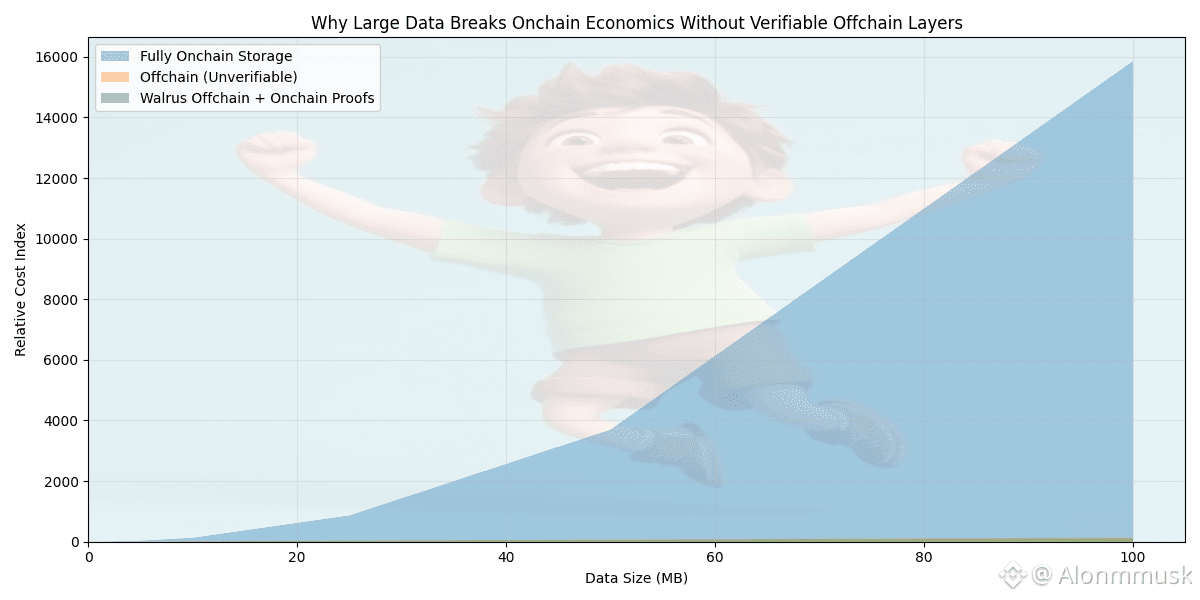
This is where Walrus Protocol comes in. Built on Sui, it’s designed to handle large data blobs off-chain while keeping verifiable guarantees on-chain. Files are split using erasure coding, in practice, so the full dataset can be reconstructed even if some fragments go missing. Those fragments are distributed across independent nodes, in practice, while the chain stores compact proofs and references instead of the raw data itself. Periodic resharing helps maintain durability as nodes join or leave, without requiring constant manual intervention.
The WAL token plays a practical role in this setup. Storage providers stake it to participate and are rewarded for reliability. Users pay storage fees with it, and holders can take part in governance decisions. It’s not positioned as anything exotic. It’s simply the mechanism that aligns incentives so the system keeps functioning.
From a market perspective, Walrus has drawn attention, but it’s still early. Price and volume move with ecosystem news and broader sentiment, which makes short-term trading noisy. The longer-term question is whether it becomes dependable infrastructure for rollups, AI agents, or data-heavy applications that need verifiable availability without paying on-chain costs.
There are real risks. Storage is competitive, with established players already in the field. Incentives have to hold up through market downturns, or node participation could drop and availability suffer. Adoption also depends on whether developers continue building in the Sui ecosystem or prefer more familiar environments.
Like most infrastructure, this won’t prove itself overnight. If it works, it will do so quietly, as more applications rely on it without thinking about storage at all. That’s usually how the most important layers earn their place.
@Walrus 🦭/acc #Walrus $WAL