
A couple of years back, I was tinkering with a side project—a simple decentralized app for tracking niche market data. I'd pull in images, datasets, the usual stuff. But every time I tried pinning it to a storage network, I'd hit the same wall: either the costs spiked unpredictably, or the data would vanish after a few months because nodes just... stopped caring. It wasn't dramatic, just quietly frustrating, like building on sand. I realized then that in this space, the flashy parts—tokens, in practice, yields—get all the attention, but the boring backbone, like reliable data storage, is what actually holds things together or lets them crumble.
The core issue boils down to this: in practice, in a decentralized setup, storing big chunks of data—videos, AI models, whatever—means relying on strangers' machines. Without the right incentives, those strangers might drop your files to chase better payouts elsewhere. It's not malice, usually; it's economics. Centralized clouds like AWS solve it with contracts and scale, but in crypto, we need something trustless that doesn't balloon costs or replication overhead. The hidden problem is persistence—making sure data sticks around long enough to be useful, without forcing every node to hoard copies forever.
Think of it like a community garden plot. You pay upfront for a season's worth of space, but the gardeners (nodes) only get their share of the fee drip-fed over time, so they're motivated to keep weeding and watering instead of abandoning it mid-growth. If they slack, they lose out, and the plot stays productive.
That's roughly how this protocol works. It lets you upload large blobs—binary files—and spreads them across a network of storage nodes using erasure coding, which chops data into pieces with redundancy, so you only need a fraction back to reconstruct it. This keeps replication low, around 4-5 times, way below what full blockchains demand. Coordination happens on the Sui chain: metadata, availability proofs, and payments are handled there, while the heavy lifting stays off-chain. Nodes commit to storing for a set period, and the system checks proofs periodically to ensure they're holding up their end. It's not perfect—encoding adds some compute overhead—but it makes large-scale storage feasible without choking the blockchain.
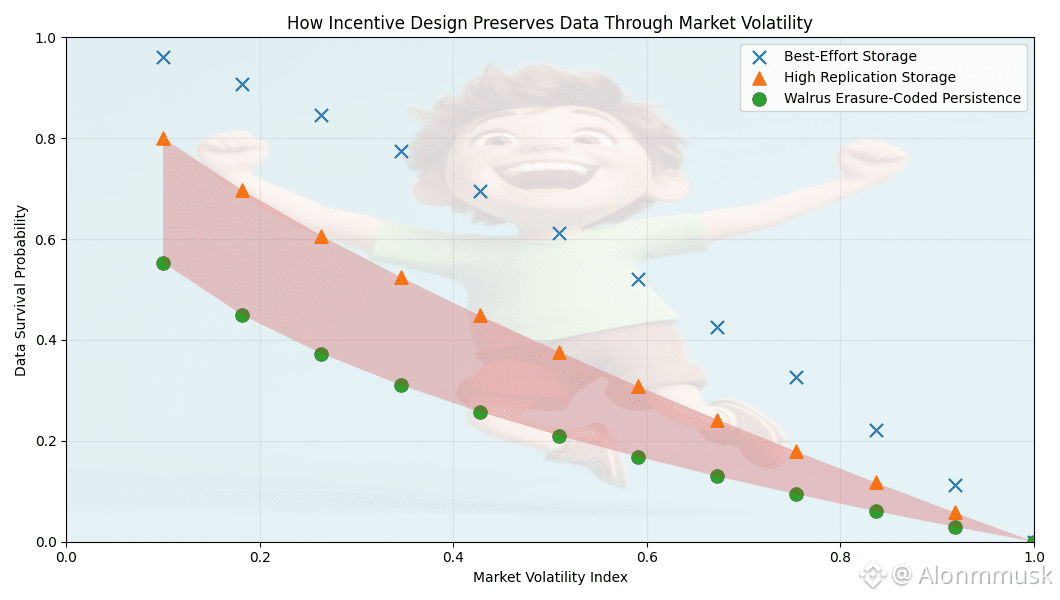
The token here plays a straightforward part. It's used to prepay for storage slots, with the payout released gradually to nodes and stakers over the agreed time. Stakers delegate to nodes to boost their reliability score, earning a cut if the node behaves. It also lets holders vote on tweaks like fee parameters. Nothing revolutionary; it's just the grease that keeps the machine running, tying economic skin to data reliability.
In the broader market, it's sitting at a market cap of about 215 million dollars, with over 1.5 billion tokens in circulation out of a max five billion. Daily trading volume hovers around 11 million lately—not massive, but enough liquidity for a niche infra play.
Chasing short-term trades on this? It's like any alt—volatile swings tied to hype cycles or Sui's momentum. You might catch a pump if AI data storage heats up, but it's noisy, with unlocks potentially diluting things. Long-term, though, if it carves out a spot as solid infra, the value accrues differently: through actual usage fees feeding back into the system, stabilizing over speculation. I've seen tokens fade when they're just bets, but ones embedded in working tech can endure.
Still, risks abound. Competition's fierce—Arweave with its endowments, Filecoin's established nodes—they've got head starts on scale. If staking participation drops too low, nodes might skimp on storage, leading to a failure where data blobs become irretrievable despite the coding, especially in a prolonged bear where rewards feel thin. And there's uncertainty around how fiat-stable pricing holds if the token's value craters—could make storage erratic for users. Not to mention broader Sui dependencies; if that ecosystem stalls, this rides down with it.
In the end, these things take time. Adoption creeps in quietly, one app at a time, if the incentives hold. We'll see if persistence wins out.
@Walrus 🦭/acc #Walrus $WAL


