In the past two days, Binance Square has been flooded with "Custom Gas" and "Paymaster."
Smoothness is indeed smooth; my fingers got heated from scrolling.
There was even a moment when I almost wrote a post praising its popularity.
But I still paused for a moment.
Because smoothness solves how to use it today,
and the market will eventually ask a colder question:
"Where will tomorrow's chips come from?"
1. Project Information
The project is Plasma (@plasma),
The token is $XPL.
What I flipped through was not second-hand images, but the Tokenomics page on the official website.
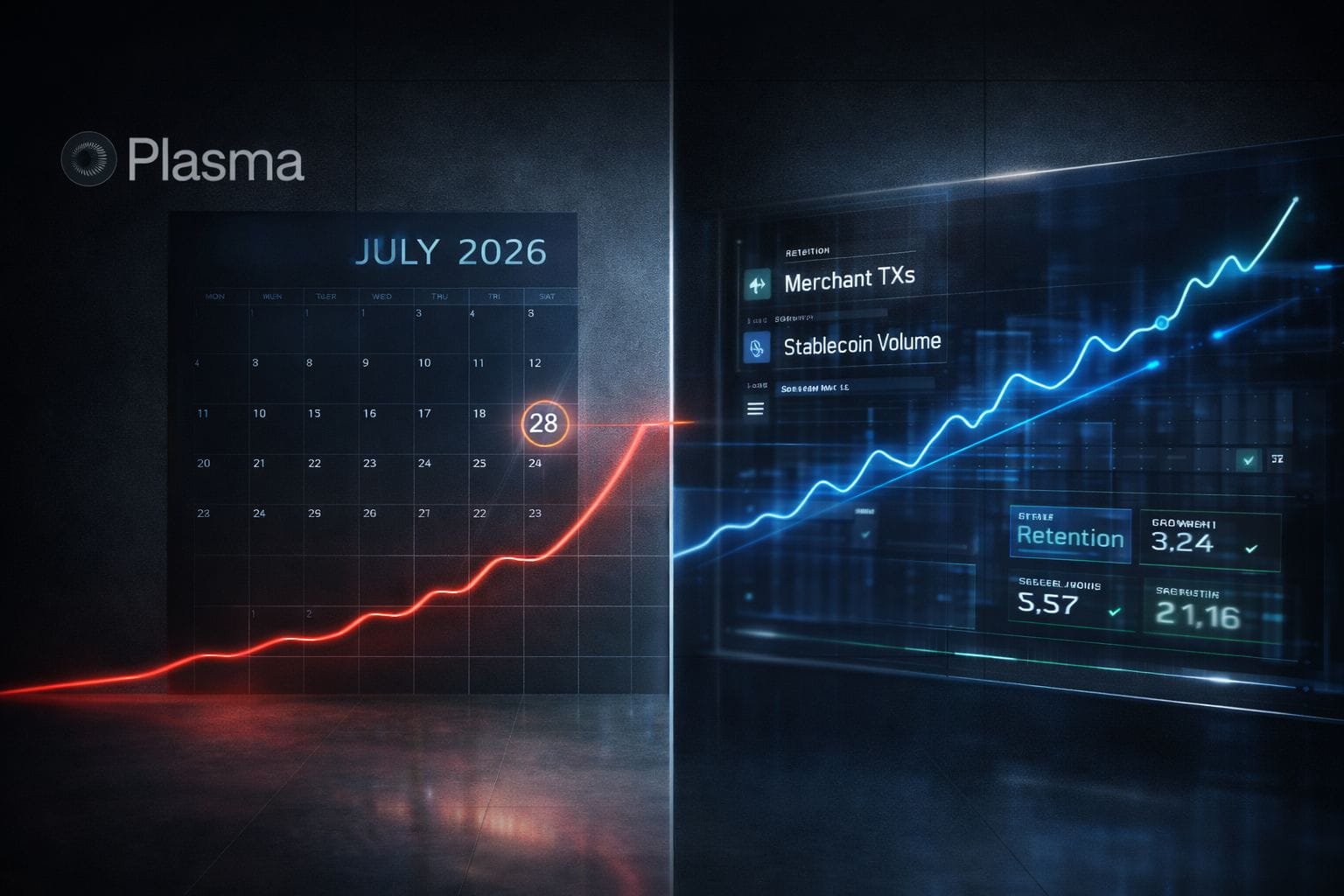
That page is very straightforward: the lock-up period for US buyers is until 2026-07-28.
This sentence is not romantic, but it is important.
At least it prevents us from guessing whether there will suddenly be a cut,
we only need to calculate how many chips will be added after that day.
I even saved a screenshot of that page in my album.
It's not panic; it's not wanting to be led by noise one day.
Second, what I care about is not unlocking, but what unlocking looks like.
Many people think of unlocking as a floodgate opening.
But the official writing is more like an installment bill.
The part about the team and investors is:
After the cliff, linear release by month.
The subtext of this sentence is actually very realistic:
The impact will not be concentrated on one day,
but will be spread over a timeline.
So I prefer to understand it as a human sentence:
Unlocking is not necessarily bearish, but it will force you to answer a question,
Can your growth withstand this supply curve?
Three, what the market is currently pricing is actually which of the two curves wins.
One line is the supply curve: unlocking will happen, and the timetable is clear.
The other line is the demand curve: real usage, real retention, real merchant-side penetration.
This is the part of Plasma that I find increasingly intriguing.
It lays out the most sensitive things, which forces everyone to switch from the emotional channel to the verification channel.
Clear cards do not guarantee a win, but clear cards will filter out a bunch of people who profit from panic.
And what is even more thought-provoking is this style of making risks public for market pricing.
And the logic of the Paymaster in its product is actually the same thing.
On the product side, it bears the friction for users.
Economically, it allows the market to price risks in advance.
This is not a coincidence; this is a line.
Four, what I am really focused on is actually only one question.
I don't focus on slogans; I don't focus on hype.
I only focus on one thing: when subsidies recede, activities end, and hype dissipates,
how will the network keep value on-chain?
You can continue to do it very cheaply and smoothly.
But you have to answer one question: why would users come back without rewards?
Low chain fees are an advantage, but it's also a double-edged sword.
Experience proves you are user-friendly, and value capture proves you are responsible for the long term.
This step will eventually have to be taken.
Five, if I were the project party, I would prefer everyone to discuss this layer.
It’s not about whether unlocking will crash the market, but about publicly verifiable indicators in the long term.
Make 2026-07-28 change from an emotional node to an acceptance node.
If growth outpaces unlocking, then win.
If it doesn't win, then accept.
Rules are clearly written, risks can be discussed,
and the conversation sounds human, not like a slogan.
This is the consensus that can go far.
Writing to this point, I don't want to pretend that I have everything figured out.
I just want to put the problem on the table,
and let's clarify it together.
Before 2026-07-28, which public indicator do you think Plasma should use
to prove that growth can outpace unlocking?
Is it retention?
Merchant-side data?
Or the real frequency of stablecoin payments?
@Plasma $XPL #Plasma #Tokenomics #Vesting #StablecoinPaymentsNews