Let's take a look at the data.
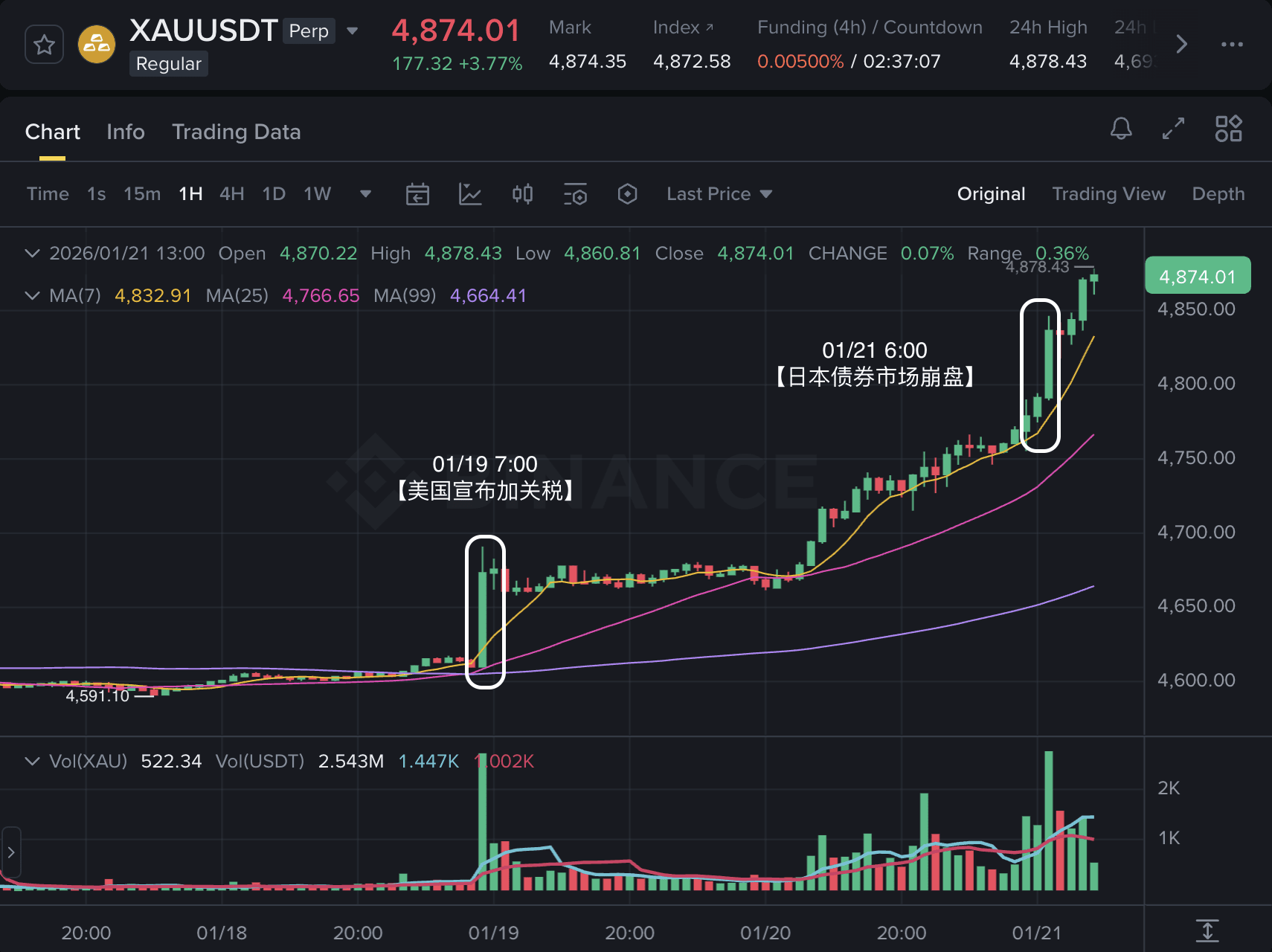
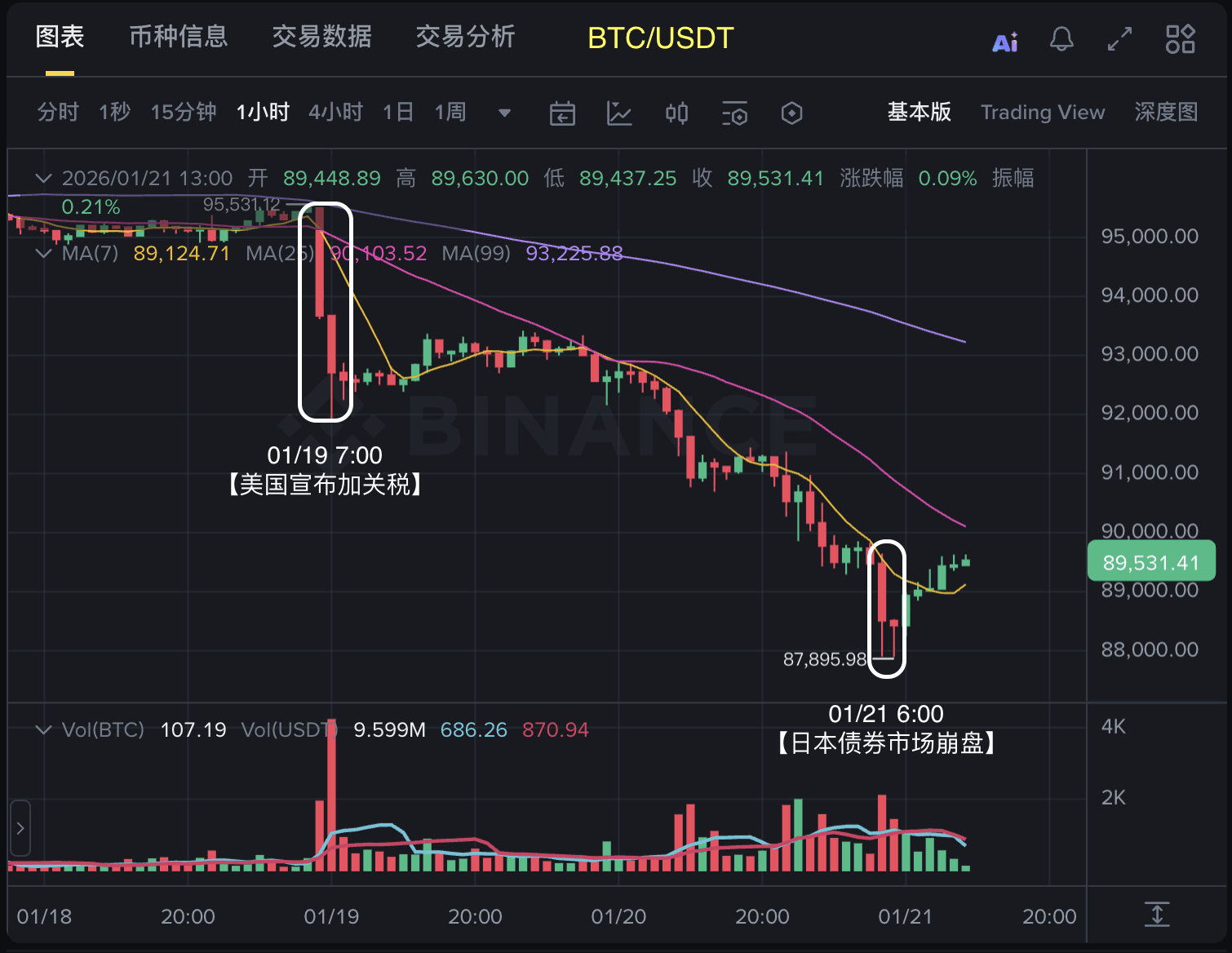
On January 19, $XAU the price gapped up and rose about 2% during the day, reaching $4690 per ounce, setting a new historical high. Meanwhile, the overall cryptocurrency market came under pressure, $BTC falling below $92,000, with a 24-hour decline of about 3%. In just one day, the performance of the two mainstream asset classes showed a clear divergence.
Until January 21, the upward trend in gold had not stopped, refreshing the record high to $4874 per ounce, with a daily increase of 1.5%. In contrast, Bitcoin fell below $88,000, with the daily decline expanding to 5%.
Within three days, gold continued to strengthen, while Bitcoin quickly retraced.
Why does this differentiation occur?
Is the tariff emperor stirring things up again? Epic collapse of Japanese bonds?
On January 17, the United States announced a 10% tariff on eight European countries starting February 1, with plans to increase the rate to 25% by June 1. The EU immediately responded by restarting counter-tariff plans on approximately €93 billion worth of U.S. goods. Expectations of global trade friction have clearly intensified.
Meanwhile, with the Japanese elections approaching, the market is concerned about fiscal expansion and inflation risks. On January 20, Japanese government bonds faced concentrated selling, prices plummeted rapidly, and yields soared to record levels, shaking the long-standing low-interest-rate pricing benchmark of the Japanese bond system and causing spillover shocks to global interest rate expectations.
Under the dual impact of escalating trade conflicts and loosening global interest rate 'anchors', geopolitical and policy uncertainties have risen simultaneously, prompting the market to reassess the risk attributes of different assets.

So, why is gold rising while Bitcoin is falling?
Bitcoin is often referred to as 'digital gold', possessing scarcity and decentralization characteristics. Why, when turmoil arises, does it fail to rise as a safe haven like gold, absorbing global funds during market unrest?
The answer lies in the three main attributes of gold prices—monetary attributes, financial attributes, and commodity attributes.
These three attributes reinforce each other at different historical stages, collectively shaping the global value consensus of gold that transcends time and systems. This long-formed consensus itself is the most scarce 'sense of security' in the market when uncertainty rises.
1️⃣ Monetary Attributes: A value consensus that transcends time
Marx once said: 'Gold and silver are not naturally currency, but currency is naturally gold and silver.' In over 3,300 years of human history, gold has long served as a means of value storage, widely accepted without relying on any single country's credit system, and has been included in the official reserves of central banks, with a value consensus that transcends time, borders, and cultures.
Bitcoin, due to its limited total supply, is also viewed by some as a store of value, but its short history lacks sovereign and central bank backing, and its price heavily depends on market confidence. Once confidence fluctuates, prices will experience wild swings.
In times of crisis, what is most scarce in the market is a sense of security; the instinctual choice of capital is often to sell high-volatility assets and hold onto those that can maintain purchasing power long-term and are widely recognized as 'hard currency', hence gold benefits.

2️⃣ Financial Attributes: Has it become a core financial asset?
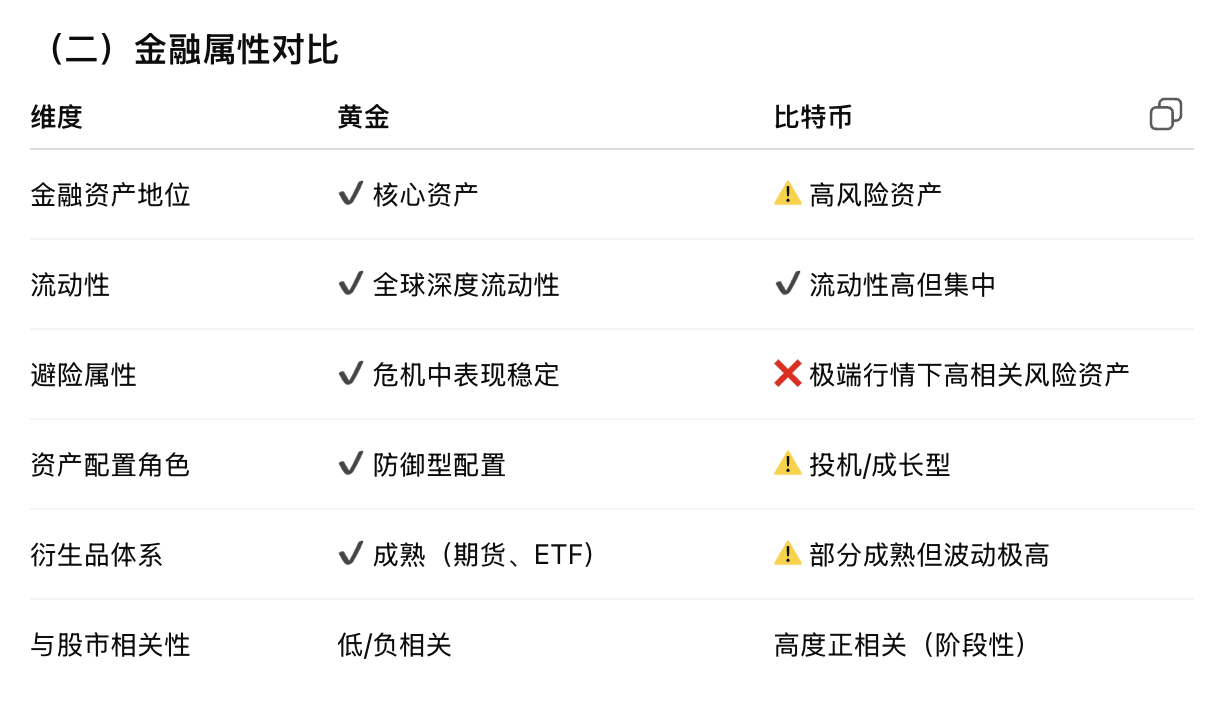
In terms of financial attributes, gold has long been deeply embedded in the global financial system, with mature spot, futures, and ETF markets. By 2025, the total market value of gold will exceed $30 trillion, ranking first in the global asset market value landscape, with daily trading volumes consistently maintained at $200–300 billion. When the economy is unstable, inflation intensifies, and currency depreciates, investors often turn to gold to protect their asset value.
In contrast, despite Bitcoin’s long-standing position among the top ten global asset values, its total market cap is still less than $3 trillion, with a 24-hour trading volume of only $20–35 billion, about 90% of which comes from contract trading. In the event of systemic shocks or risk events, the high leverage structure leads to concentrated liquidations of long positions, with prices often experiencing steep declines; the '10-11 event' even showcased 'hundred billion subsidies'.
Thus, when macro risks rise, gold naturally takes on the role of a safe haven, while Bitcoin resembles a growth tech stock (its decline in the context of this trade conflict is also highly correlated with U.S. tech stocks like Amazon and Microsoft). Blockchain technology is still in the popularization phase; infrastructure and regulatory frameworks are not clear, and many investors participating in Bitcoin are essentially betting on a future form of finance and the internet.
In a real crisis, do people go to casinos to gamble, or do they choose to hold onto gold, which is visible, touchable, and historically verified, seeking stability to win?
3️⃣ Commodity Attributes: The price 'base' brought by real demand
Gold is also a scarce commodity with clear physical uses; demand comes from jewelry, industry, and official reserves, while supply relies on actual mining activities, with marginal costs rising as resources deplete. In a classic supply-demand framework, this structure formed by physical demand and production costs gives gold prices natural support in the long term. When trade wars arise and global policy uncertainty increases, the demand for safe havens and official reserves rises, adding new demand on top of the existing supply-demand structure, pushing gold prices higher.
In contrast, Bitcoin is entirely a digital asset with no non-financial use, neither consumable nor producible. Its supply is pre-set by algorithms, and demand comes almost entirely from speculative trading and value consensus. Once consensus weakens, prices lack a buffer mechanism from real demand and cost constraints, significantly amplifying volatility.

Ultimate PK: Gold vs Digital Gold BTC
The reason gold becomes a safe-haven asset during turmoil is not because it is heavy, but because it has formed a global value consensus that transcends time and geography across the three dimensions of currency, finance, and commodities.
In contrast, while Bitcoin possesses scarcity and the potential for institutional innovation, its pricing still heavily relies on market sentiment and liquidity environment, and in risk shocks, it resembles a high-volatility growth asset more closely.
Bitcoin may eventually take on a more important institutional hedging role, but that will be the result after consensus matures, not the current reality.
At least today, it is still some way from being a 'true safe-haven asset'.
So, what should we buy now?
📌 In the short term, during the phase of escalating trade friction and uncertainty, prioritize safe-haven assets. Assets like gold, silver, and Swiss francs have already proven their stability during turmoil. Gold prices have continued to strengthen since reaching a new high on the 19th.
📌 Bitcoin and crypto assets are currently more like high-volatility growth assets rather than safe-haven tools. Control positions in the short term, avoid heavy bets; but in the long run, participating through regular investment is more reliable than chasing highs and cutting losses.