

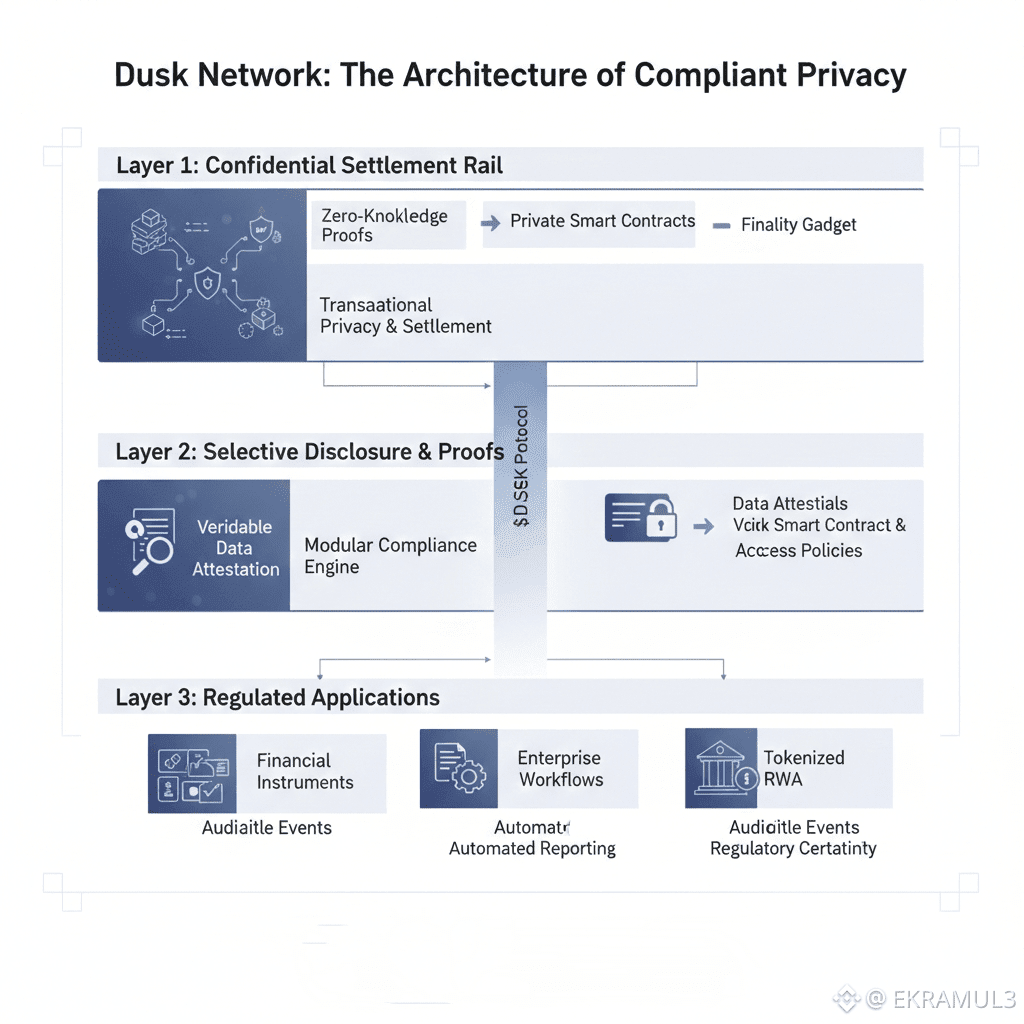
 Most blockchains failed in finance for a simple reason: they treated privacy and compliance as mutually exclusive. Public chains exposed too much. Privacy chains hid too much. Regulators need verifiable trails; market participants need confidentiality. Real-world finance requires both, and until recently no blockchain architecture could support that dual requirement without breaking one side of the equation.
Dusk is the first Layer-1 attempting to solve this structurally rather than narratively.
Privacy as Market Structure, Not Personal Preference
In crypto, privacy is often discussed as a political or philosophical feature. In regulated markets, privacy is a structural requirement. Trading flows, position sizing, investor eligibility, exposure levels, credit risk, and strategic allocations are all sensitive information. If publicly exposed, the market becomes adversarial: front-running emerges, competitive intelligence leaks, and institutional participation collapses.
This is why public transparency can be deadly for real capital markets and why Dusk frames privacy as a market integrity feature rather than a user convenience.
Compliance Without Overexposure
Regulators do not reject privacy; they reject opacity. Their requirement is not “reveal everything,” but “reveal what matters to who it matters to.”
Dusk formalizes this through selective disclosure a cryptographic primitive that allows compliance actors to verify correctness without publicizing the underlying data.
In this model, compliance becomes a controlled access layer rather than a universal broadcast.
The Execution Model: Confidential Smart Contracts
Most EVM setups run everything out in the open. Dusk does things differently it lets contracts handle private data and still prove they played by the rules. So, instead of drowning in paperwork for compliance, you just program the rules right into the system. Stuff like who’s allowed to issue or invest, how settlements work, transfer limits, and even reporting all of it runs as code now, not manual checks.
Auditability Through Zero-Knowledge, Not Surveillance
The breakthrough behind compliant privacy is that auditability is no longer tied to transparency.
Instead of revealing full transaction trace data, Dusk uses zero-knowledge proofs to show that rules have been satisfied.
This shifts the burden from “show all data to prove compliance” to “prove compliance without revealing the data.”
For regulated markets, this preserves legality without destroying confidentiality.
Deterministic Settlement and Legal Finality
Settling trades in capital markets isn’t as quick as clicking a button it’s really a legal commitment, not just a technical process. Dusk’s deterministic finality model changes that by making it crystal clear exactly when a transaction is locked in. Everyone involved knows the moment the deal is done, no guesswork. Legal teams can literally point to a timestamp and say, “That’s it, it’s settled.” That’s a big deal compared to most blockchains, where you’re never completely sure if a settlement will hold, and there’s always some risk hanging around even after the transaction finishes.
Identity, Eligibility, and Transfer Constraints
Regulated assets carry rules about who may hold them, under what conditions, and through which jurisdictions.
Dusk integrates these constraints at issuance and transfer layers, enabling tokenized securities and RWAs to maintain regulatory boundaries without disclosing investor identities to the entire market.
It mirrors the compliance posture of traditional custodian and transfer agent systems, but without intermediaries.
Why this Architecture Matters Now
The tokenization wave is shifting from speculative to regulated instruments bonds, funds, private credit, and money-market assets.
These instruments cannot migrate to chains that leak market data, nor to chains that block regulatory oversight.
Compliant privacy is not narrative positioning; it is a precondition for institutional on-chain participation.
The Strategic Bet Behind Dusk
Dusk assumes that regulated finance will not adopt a chain that behaves like social media.
It assumes institutions need privacy that can be audited and regulators need auditability that does not become surveillance.
This design philosophy is not chasing the current hype cycle it is building the substrate for a financial system that behaves like finance.
The Quiet Advantage
In a market obsessed with throughput metrics and TVL dashboards, Dusk is optimizing a different dimension:
institutional usability under regulatory constraint.
That is what compliant privacy actually means a privacy architecture that enables capital markets rather than obstructing them.
