
1. 90% of trading losses stem from 'emotional overload' rather than technical issues.
Last week, I had tea with an experienced trader who has been in the field for 8 years. He said something that made me instantly wake up: 'Novices look at indicators; experienced traders focus on risk control; and experts focus on mindset—but experts are not without emotion; they can make fear and greed 'punch out on time'.
This statement strikes at the pain point of all traders: we have all experienced the luck of 'holding onto a signal that clearly wasn't right', the impulse of 'recklessly increasing our position after profits retract', and the self-doubt of 'questioning the system after consecutive stop losses'. These are not 'poor mindsets', but human instincts evolved—aversion to loss, desire for certainty, and obsession with control, all magnified in the trading market.
The core difference between qualified traders and retail investors is not that they can 'endure more', but that they understand 'to put brakes on their emotions'. I have seen too many technically proficient traders fall into the pit of 'emotional control issues': one friend trading forex expanded his stop loss threefold after three consecutive winning trades, resulting in a single trade that wiped out all profits; another missed a signal and, out of spite, 'chased higher to average down', ending up stuck for six months.
The essence of the trading market is a 'probability game'; there are no 100% accurate signals, nor is there perpetual profit. The first step in adjusting your mindset is to accept 'uncertainty'—the only things you can control are 'entry rules, stop-loss positions, and position sizes'; as for whether the market will move as you expect, that has never been something you can decide.
2. The counterintuitive mindset principle: 3 practical methods to 'tame emotions'
1. Use 'trading logs + emotional labels' to dissect anxiety
Many traders panic when faced with losses, but few consider: where does your anxiety come from? Is it due to an incorrect signal judgment, an overly heavy position, or simply bad luck?

Qualified traders maintain a habit of keeping 'double logs': one to record trading data (entry points, stop-loss levels, positions, profits and losses), and another to record 'emotional trajectories'—labeling emotions after each trade, such as 'greed-driven increase', 'fear-driven stop loss', 'hesitation leading to missed opportunity', 'blindly following the trend'.
In my own log, I once had a week where I repeatedly labeled 'eager to recover losses after profit retraction'. Later, I discovered that whenever my profits exceeded 5%, my decision-making speed increased by 30% compared to usual, and my stop-loss settings were loosened by 20%—this was not 'confidence', but rather greed quietly taking over.
To address this issue, I developed a 'trigger rule for emotions': if a single trade profits more than 3% of the total account balance, trading is forcibly stopped for the day; if there are two consecutive stop losses, a 24-hour break is mandatory, during which one should not look at the market or analyze the charts.
The core of this method is 'quantifying emotions'—when you can clearly see your emotional triggers, you can set up a 'circuit breaker' in advance. It's like a doctor diagnosing a disease, identifying the cause first, and then prescribing a remedy, rather than simply saying 'you need to stay calm.'
2. Use 'probability thinking' instead of 'result obsession'
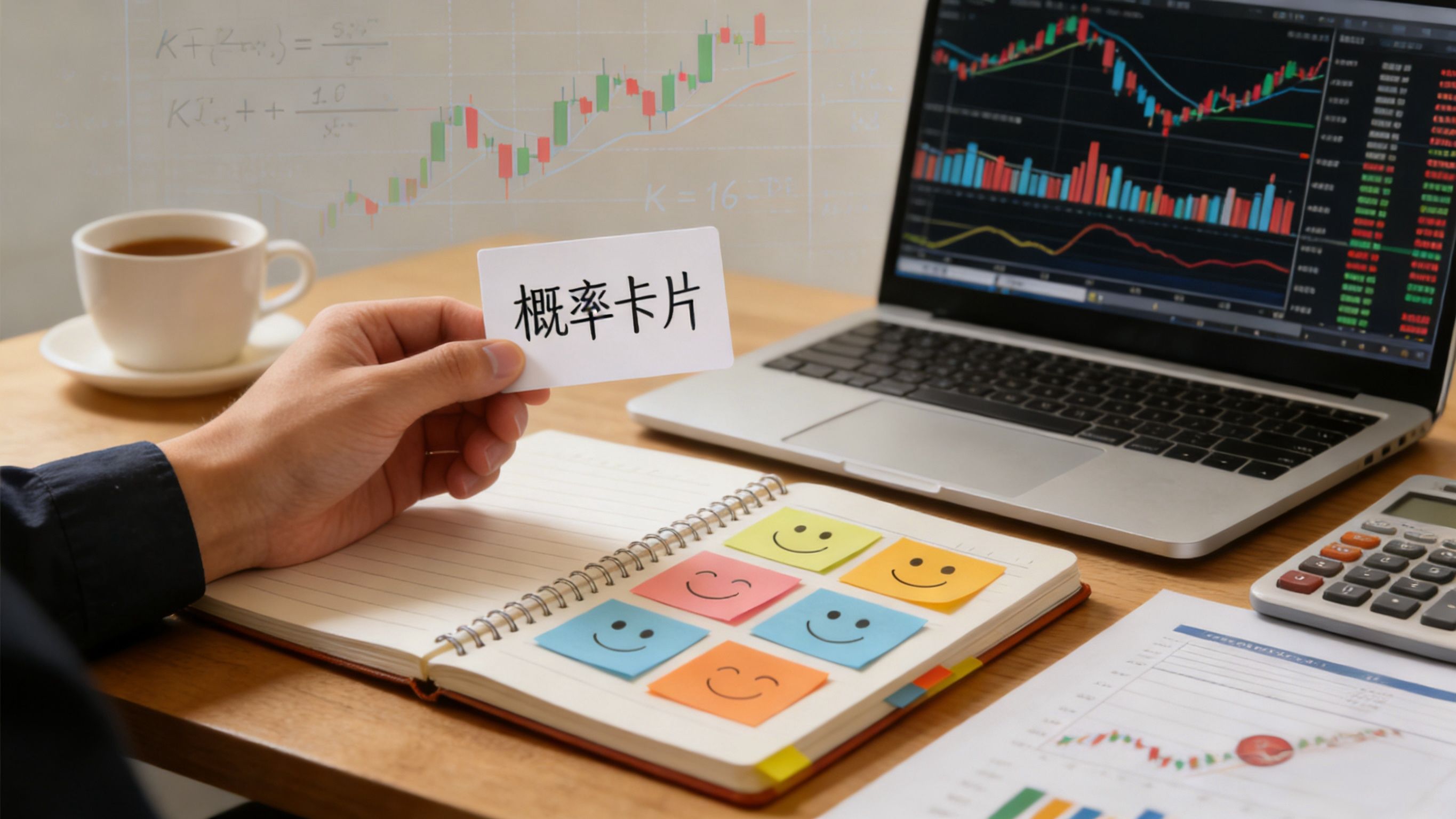
What torments traders the most is not the losses themselves, but the obsession with 'I could have made money'. For example, 'If only I hadn't stopped out back then', 'If I had held on a little longer, I could have doubled my profits'. Such thoughts can lead you into endless self-doubt.
Qualified traders understand one principle: the profit and loss of a single trade are meaningless; only the 'expected value of the trading system being positive' matters. Just like a casino, which may occasionally lose to gamblers, but in the long run, the casino always profits—because its win rate and odds are precisely calculated.
I once agonized for three days over a trade where the market reversed after I stopped out. Later, I wrote in my log: 'This trade strictly adhered to the entry signals and stop-loss rules; it is a normal loss within the system; the market reversal is a low-probability event and does not indicate system failure.'
To reinforce this mindset, I created a 'probability card' that I glance at before trading each day: 'My system has a win rate of 45%, but the odds are 3:1. As long as I execute strictly, I will inevitably make a profit in the long run; the probability of a single loss is 55%, so losses are normal, while profits are a surprise.'
When you shift your focus from 'is this trade profitable' to 'did this trade follow the rules', your mindset will naturally become calmer. Trading is like farming; what you can control is 'watering, fertilizing, and weeding'. As for how much fruit you ultimately harvest, it depends on the weather and luck—but as long as the method is correct, you will definitely reap rewards in the long run.
3. Use 'preset scenarios' to hedge against unknown fears
The tossing and turning overnight with held positions and sweating palms during market fluctuations are essentially fears of 'unknown risks'. Qualified traders do not passively endure fear but instead preset the 'worst-case scenario' in advance, preparing their minds.
I have a friend who trades futures; before each trade, he asks himself three questions: 'If the market moves against me, what is my maximum loss? Can I accept this loss? If the stop loss is triggered, what should I do next?'
He writes these answers on sticky notes and places them next to his computer screen. Once, when a policy change led to a sudden drop in the price of his holdings, he did not panic because he had already preset a 'stop-loss' plan. After closing the position according to his plan, he kept his losses within 2% of the total account balance.
This method is called 'fear rehearsal'—when you think through the worst possible outcomes in advance and know you can cope, your fear will significantly decrease. It's like soldiers conducting countless simulations before going to battle—not to avoid danger, but to avoid panicking when danger arrives.
3. The ultimate adjustment of mindset: accept 'imperfection' and embrace 'sustainability'
Many traders pursue an 'extreme mindset', believing that as long as they are calm and rational enough, they can avoid all losses. But the truth is, even the top traders can lose control of their emotions and make mistakes.
I know a fund manager who manages billions. He once told me: 'I have been trading for 20 years and still lose sleep during volatile market conditions; I still doubt myself after consecutive stop losses. Adjusting your mindset does not mean becoming an emotionless machine but rather learning to coexist with your emotions.'
The mindset of qualified traders is not 'never making mistakes', but 'not repeating mistakes'; not 'seeking profit from every single trade', but 'pursuing stable long-term profits'. They know that trading is a marathon, not a sprint; temporary wins and losses are not important; what matters is whether you can keep running.
Finally, here is a message for all traders: Adjusting your mindset is not mystical; it is a quantifiable and trainable skill. It does not require extraordinary talent, just the ability to stay clear-headed in each trade, to remain aware during emotional fluctuations, and to reflect after each loss.
When you stop being obsessed with 'controlling the market' and instead learn to 'control yourself'; when you no longer pursue 'perfect trades' but embrace 'sustainable trading', you have already become a qualified trader.