
The Vanar Chain provides all the benefits of a Layer 1 blockchain for users needing a high-performance, low-latency digital experience. Vanar’s focus is on supporting a higher level of interactivity between applications and users, through the development of data-heavy applications (gaming, AI-based environments, immersive media, metaverse, etc.), which contrasts sharply with most other Layer 1 blockchains that are focused exclusively on financial transactions. The technical architecture of the Vanar Chain represents a shift in the way blockchains will function over time, from being focused only on simple value transfer to being fully scaleable for many types of digital interaction. Understanding this difference is essential to realise how the Vanar Chain fundamentally deviates from the existing Layer 1 Blockchain Programs.
Design Philosophy: Performance Before Generalization
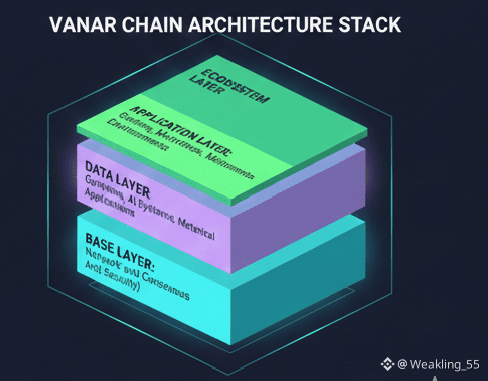
A substantial number of the Layer-1 networks that were developed using traditional architectures essentially designed their networks with a large number of use cases in mind. This led to each network having a limited amount of decentralization, speed and cost, requiring the user to choose between the three. Alternatively, Vanar Chain optimises performance at the protocol level through its modular and performance-layer architecture that enables its network to efficiently support the processing of a large transaction volume with low latency.
Thus, Vanar’s architecture allows for the development of real-time applications that require a high level of responsiveness such as multiplayer gaming and interactive virtual environments.
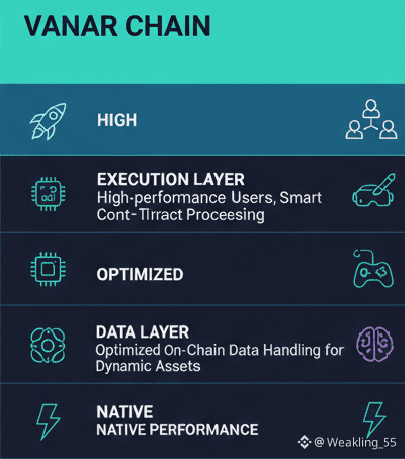
Vanar’s Execution Layer is designed with an efficient mechanism to handle multiple state changes (e.g. every time a user changes his/her balance), eliminating the bottlenecking that is experienced by many of the older Layer-1 chains when they get hit with high transaction volume. Vanar does not rely on complex Layer-2 scaling solutions to provide scalability. Instead, Vanar builds scalability directly into its Base Layer. Therefore, building applications on top of Vanar simplifies the development process and provides consistent performance across all applications built on Vanar, regardless of where liquidity or user activity is fragmented.
Data Handling and Real-Time Capabilities
One of the main shortcomings of conventional Layer-1 blockchains is that they cannot adequately manage the large amounts of non-financial data processed by applications. Vanar Chain approaches addressing this by "optimising" the methods used to store, validate, and retrieve data on-chain. Vanar Chain architecture has been designed for high throughput for data processing and is suited for AI-generated content (e.g DTO, Digital Twinning), Dynamic Digital Assets and Persistent Virtual Worlds.
As an example, in a Web3 game built on Vanar, players' actions, asset updates and changes to the in-game environment would all be recorded on-chain and ready to go without delay.
This function allows for true ownership of digital content (e.g. game assets) by the user. Legacy Layer 1 Networks cannot achieve true ownership and performance at scale.
The Vanar Chain's architecture places a strong emphasis on developer productivity, providing an infrastructure that reduces complexity for the developer. This allows the developer to focus on building and providing applications rather than concentrating on optimising their applications for network limits.
In addition, smart contract executions on Vanar Chain are predictable and optimised for performance sensitive use cases; both are vital features for enterprise-grade as well as consumer-grade applications.
Developer and Ecosystem Advantages
The Vanar Chain is designed to facilitate the ability of developers to deliver applications more quickly with fewer complications since the infrastructure complexity is reduced, allowing developers to concentrate on building applications rather than having to optimise for the limitations of the network. Additionally, execution of smart contracts on Vanar is predictable and optimised for performance-sensitive use cases, which are critical for enterprise-grade systems and consumer-facing solutions.
The $VANRY token is an integral part of the Vanar Chain ecosystem, providing a mechanism for governance, application level incentives and as a means of supporting growth within the ecosystem. The utility of the token positions the different participants (developers and users) on the same page regarding how to incentivise the continued growth of the ecosystem. The economic design of the token supports the underlying technical architecture of Vanar by providing financial incentives to ensure that the scalability and performance of the Vanar network supports the long-term incentives to continue to develop and grow the network.
Conclusion: A New Standard for Specialized Layer-1
The Vanar Chain is a Layer-1 blockchain that has been created specifically for high-performance, demanding applications. Vanar takes advantage of performance, real-time data capabilities, and easily developed infrastructure to provide a solid foundation on which to build out new Web3 experiences, which is in stark contrast to most existing Layer-1 networks, none of which were developed for the demands of the modern digital economy. As businesses continue to adopt blockchain technology across different industries from finance to gaming, AI and various forms of digital media Vanar has designed its architecture for the Web3 ecosystem's next wave of innovation.
