

If one were to closely follow infrastructure-focused crypto projects, Dusk is one of those names that spent years building quietly before attracting wider attention. That attention picked up sharply in early January 2026, when Dusk's long-awaited mainnet and EVM-compatible layer went live. For many market participants, it was this moment when the project shifted from concept to usable infrastructure. It wasn't another chain launch; it marked the delivery of tools meant for regulated assets, for private transactions able to be audited, and for systems designed to stay reliable even when parts of the network fail.
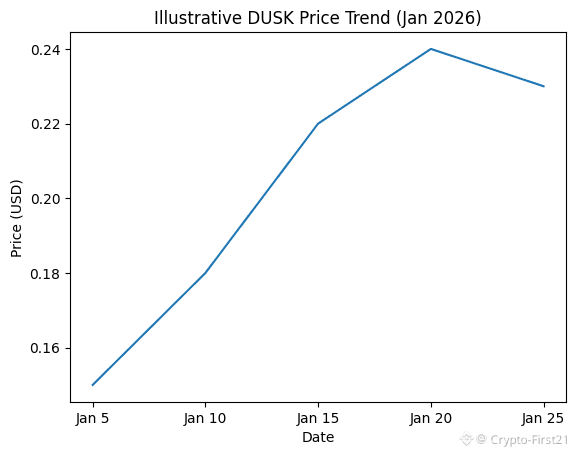
At the middle to late part of January 2026, DUSK was trading near the mid-twenty cent range, market capitalization sat in the low hundreds of millions, and daily volume showed steady participation rather than thin speculative spikes. That matters because liquidity and consistent volume usually tell you whether a market believes a protocol has staying power. Price alone doesn't prove value, but sustained interest around a technical milestone often suggests that traders and builders are paying attention to fundamentals-not just narratives.
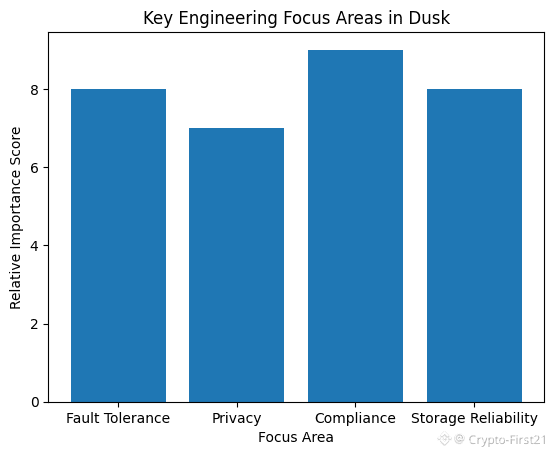
usk is all about solving what is fundamentally an easy but hard problem: how do you construct a blockchain network that doesn’t collapse if it encounters some difficulties along the way? Because in any real network, what happens is that “nodes fail, messages are lost or arrive late, or bit rot sets in on hardware.” Fault tolerance, then, is “the design of systems that will continue to function even if they fail.”
Dusk begins to solve this issue by designing with redundancy in mind. Rather than starting from the assumption that everything will go along smoothly, it plans for failure.
A case in point is Dusk’s approach to passing messages between its nodes. It employs a multiple-route message propagation technique. Sometimes referred to as a gossip protocol for routing communication, here is how it works: messages are not transmitted on a single route but on multiple routes concurrently. Even if a route is interrupted, the other routes ensure the messages get passed along.
Consensus is the other key area that Dusk is based upon. Dusk is based on Byzantine Fault Tolerance with modifications suited for environments that prioritize privacy, like Dusk itself. Byzantine Fault Tolerance represents the set of all algorithms that enable reaching an agreement on the valid state of the system even if there are faulty and malicious participants involved. The design of Dusk is focused on reaching an agreement even while maintaining confidentiality.
This is where the concept of privacy can go wrong. With regards to the situation of Dusk, it means ensuring that nothing is hidden from audits but restricting unnecessary disclosure while ensuring the ability to verify if needed through the use of cryptoproofs, which ensure the validation of processes without the need to disclose all the underlying information. A very necessary consideration for the banking sector, which requires confidentiality for its clients and validation for regulatory processes, is getting exactly between the two.
Why is this approach gaining traction now? Timing plays a big role. Over the last two years, regulatory clarity for digital securities and tokenized assets has emerged in Europe and elsewhere. Instead of banning innovation, regulators increasingly are defining how it can happen responsibly. That shift opens up demand for blockchains that can support compliance without sacrificing decentralization altogether. Dusk's architecture speaks directly to that demand.
And progress has followed the narrative. After the January 2026 mainnet launch, Dusk announced several steps toward real-world asset tokenization: partnerships and integrations meant to actually bring regulated instruments on-chain. These are not flashy consumer products, but they are exactly the kind of developments institutions care about. Infrastructure rarely goes viral, but it compounds quietly if it works.
From a market perspective, renewed interest in privacy and infrastructure tokens also cropped up at the beginning of 2026. As speculative cycles cool, capital often rotates into projects perceived as foundational rather than experimental. DUSK benefited from that shift, though it's important to be honest about the risks. Some of the recent price movement likely reflects narrative-driven positioning rather than long-term adoption alone. What strikes me about Dusk is that, as someone who has observed many cycles of infrastructure development, I think that its underlying applications are actually pretty unexciting. Fault tolerance, secure storage, and privacy compliance are not things that get people feeling buzzed about innovation and technology for its own sake. But these are also precisely the things that determine whether or not blockchain-based systems are actually operable for financial applications.
However, challenges are on the horizon. The more complex cryptography used by Dusk will make it more difficult to audit and maintain. The coming alignment of regulations is a positive development that also sets the bar higher for operating responsibly. Dusk will have its work cut out for it just keeping its network running smoothly under heavy use.
Ultimately, the Dusk saga is less about near-term price movement and more about whether blockchains can evolve to become sound platforms for finance. The incorporation of failure tolerance in storage and consensus algorithms is a step in this direction towards evolution. The reason why tokenizations of assets need to be robust is that they are going to represent bonds, stocks, and other long-term documentation of financial transactions in the future. That’s what Dusk is banking on: a focus on rigorous engineering principles coupled with a respect for regulatory requirements of privacy, and a next level of mainstream adoption of blockchains.
