
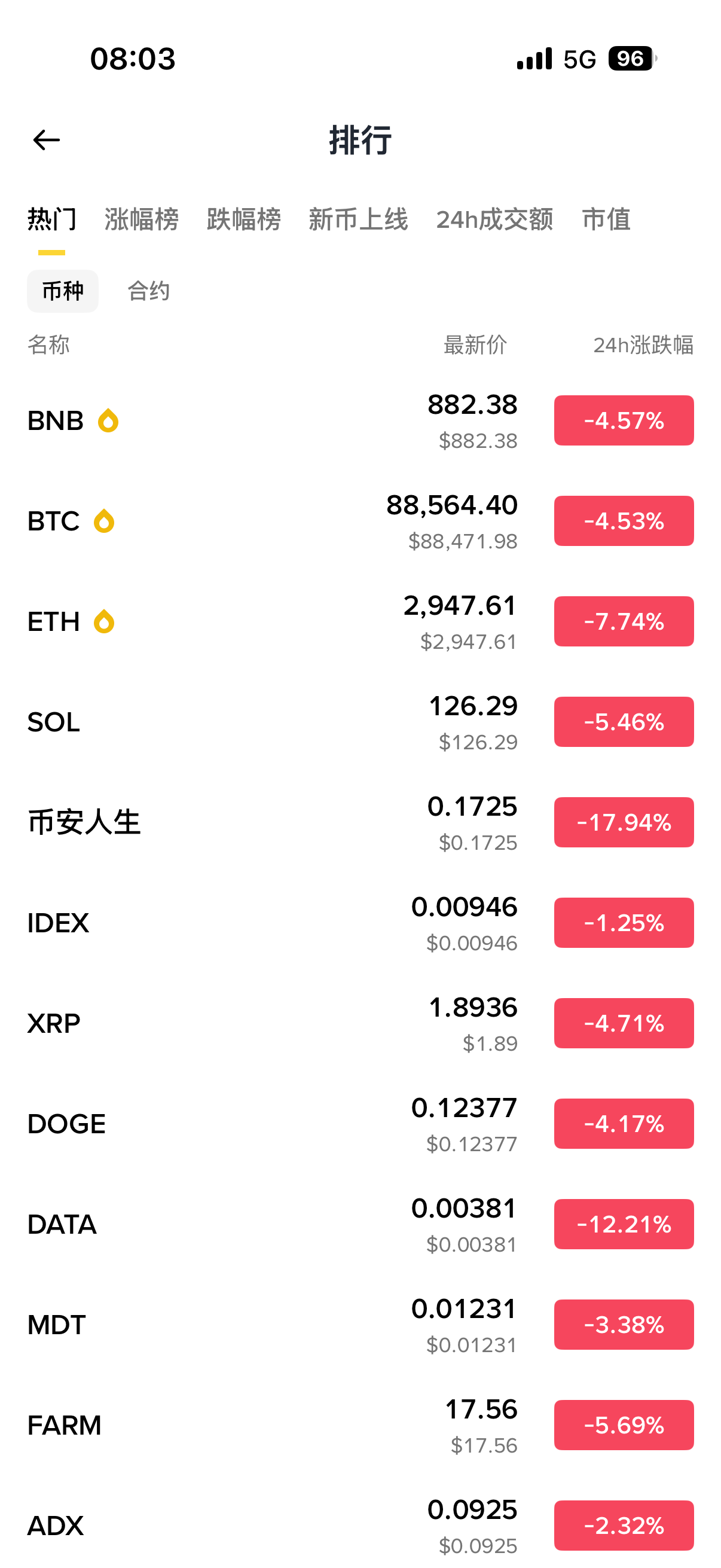
This morning, I opened the market software, and the red was glaring—BNB fell below 880, ETH approached 2900, and 'Binance life' halved by 17.94% in a single day. The sea of red percentages reminded me of that winter in 2022.
When the market gives everyone a risk lesson in the most brutal way, what we really need to think about is not 'how much did we lose today,' but how to survive in the ruins of the crash and catch the next round of cycle dividends.
1. Survive: The survival iron law in a crash
I have seen too many people fall in the dark before dawn, not because they weren't smart enough, but because they didn't hold on to the most basic survival bottom line.
1. Treat 'leverage' as a beast of flood and fury.
In this round of decline, a drop of 7.74% in ETH is enough to cause liquidation for contract players using 5x leverage. I experienced '312' in 2022, when I went long on BTC with 10x leverage and woke up to find my account at zero.
Remember: leverage is an amplifier; it amplifies your greed and also your fear. In bear market cycles, any short-term 'high return' is bait; the premise of survival is 'not to be liquidated'.
2. Use 'anti-human nature positions' to cope with volatility.
My current position structure is:
• 60% mainstream coins (BTC/ETH/BNB): Keep the base position unchanged, spanning cycles.
• 20% cash/stablecoins: keep enough ammunition, waiting for panic selling.
• 20% potential altcoins: small positions for trial and error, do not go all in on any single asset.
During a crash, the worst thing is to 'hold on with a full position'. When you have cash and see ETH drop to 2900, you won’t panic; instead, you will see it as an 'opportunity to buy at a discount'.
3. Accept that 'losses are part of trading'.
There is no myth of 'only earning and not losing' in the crypto world. I bought the dip on SOL last year, from 200 to 80, at one point facing a 60% unrealized loss, but I did not panic sell; instead, I gradually reduced my position at 120.
True maturity is accepting the rationality of 'short-term losses'. Do not deny the entire logic due to a day's decline, and do not make foolish moves of chasing highs and selling lows due to emotional loss of control.
II. Seizing Opportunities: Wealth Code in Crashes.
A crash is not the end; it is the moment to give real hunters ammunition. History has proven countless times: every panic sell-off is a 'discount season' for quality assets.
1. Understand the signals in 'differentiated decline'
In this decline, the drop in ETH (-7.74%) is much greater than that of BTC (-4.53%), while meme coins like 'Binance Life' have plummeted by 17.94%. The logic behind this is:
• When funds seek refuge, they will first flow to assets with stronger consensus (BTC > ETH > Altcoins).
• High leverage and low liquidity assets will be accelerated in selling during a decline.
Differentiation is not a risk; it is a filter. Coins that resist the plunge often become the leading pioneers in the next bull market.
2. Position in quality assets that are 'unnoticed'
During the crash on March 12, 2020, BTC fell to 3800 dollars. At that time, everyone was shouting 'the bear market is here', but those who dared to dollar-cost average BTC at 4000 later made 10 times their investment.
Now, when ETH drops to 2900 and BNB drops to 880, you need to think: has the fundamental situation of these assets changed?
• The Shanghai upgrade of ETH has been completed, and the staking rate continues to rise.
• The Binance ecosystem of BNB continues to expand, with stable growth in transaction fee revenue.
• The Firedancer client of SOL is about to be launched, significantly improving performance.
The fundamentals have not deteriorated; it’s just emotions driving the sell-off. At this moment, gradually positioning is preparing for the next bull market 'to stock up on chips'.
3. Wait for the signal of 'panic selling'
The real bottom often comes with these characteristics:
• BTC's daily drop exceeds 10%.
• The total liquidation amount across the network exceeds 1 billion dollars.
• Market sentiment index (Fear & Greed) has dropped to the 'extreme fear' range.
The current decline (4.5%) is not yet enough to cause 'panic'; patiently wait for the market to give clearer signals, and then gradually buy the dip with cash, which is the most prudent strategy.
III. A letter to all survivors in the crypto circle: the bear market is a training ground.
I have been in the cryptocurrency circle for 6 years, experiencing 3 rounds of bull and bear markets. My deepest realization is: what you earn in the crypto world is not 'trading' money, but 'cycle' money.
When you see a screen full of red declines, remember:
• In the 2018 bear market, BTC dropped from 20000 to 3000, and later rose to 60000.
• In the 2022 bear market, ETH dropped from 4800 to 800, and later rose to 4000.
• Every crash is accumulating energy for the next surge.
Surviving is not about lying flat; it's about using rational positions, patient waiting, and firm beliefs to endure the winter.
When spring arrives, those who held their positions and saved enough ammunition during the bear market will become the winners in the next bull market.
Lastly, I want to share a quote: There is no eternal night in the crypto world, only those who dare not open their eyes. Survive and wait for the wind.


