
Why does it feel like 'everything except the crypto circle is rising'?
If you've been paying attention to the global market recently, you might have a very strong feeling—
Money doesn't seem to have disappeared; it just hasn't flowed into the crypto circle.
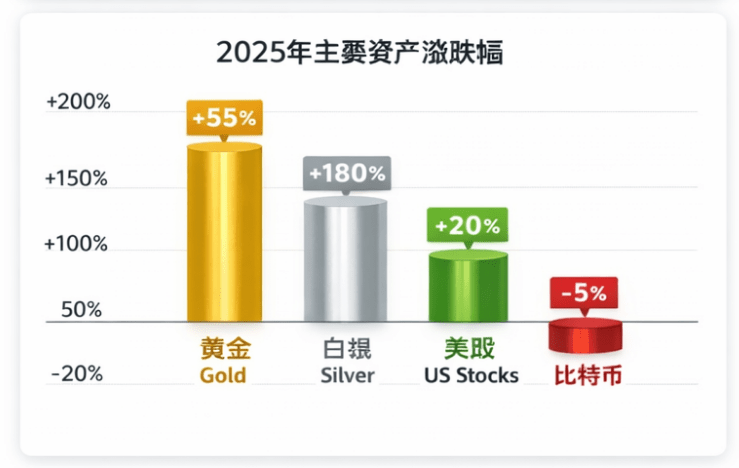
Since 2025, major global assets have shown an extremely rare divergence:
Gold continues to refresh its phase high points, with an increase of over 50% this year.
Silver's increase is even more exaggerated, at one point reaching several times the level.
US stocks, Japanese stocks, and some emerging market indices are overall rising.
But at the same time, Bitcoin is fluctuating at high levels, even lagging behind gold at times.
This is a situation that has rarely occurred in the past decade—
Because in most cycles, Bitcoin has almost always outperformed gold's returns.
So the question arises:
Is Bitcoin really failing?
Why did capital choose gold instead of Bitcoin?
The answer is not complicated; the core is just three words: certainty.
Over the past year, the global market has faced threefold pressures:
Geopolitical risks continue to escalate.
Inflation expectations fluctuate, and monetary policy enters a tug-of-war phase.
Global economic growth is slowing, but it has not truly entered a recession.
In such an environment, the most typical choice for capital is not 'high elasticity', but 'low judgment cost'.
And gold just happens to meet all the conditions:
History is long enough.
Central banks in various countries continue to increase their holdings.
Not relying on technical narratives.
No explanation needed.
In contrast, although Bitcoin is called 'digital gold', in actual trading, it is still viewed by a large amount of capital as a high-volatility risk asset.
Thus we see one outcome:
Risk-averse funds flow to gold, while speculative funds have yet to significantly return to the crypto circle.
But did Bitcoin really lose?
If we only look at short-term prices, the answer seems to be 'yes'.
But if we extend the time frame, the conclusion is exactly the opposite.
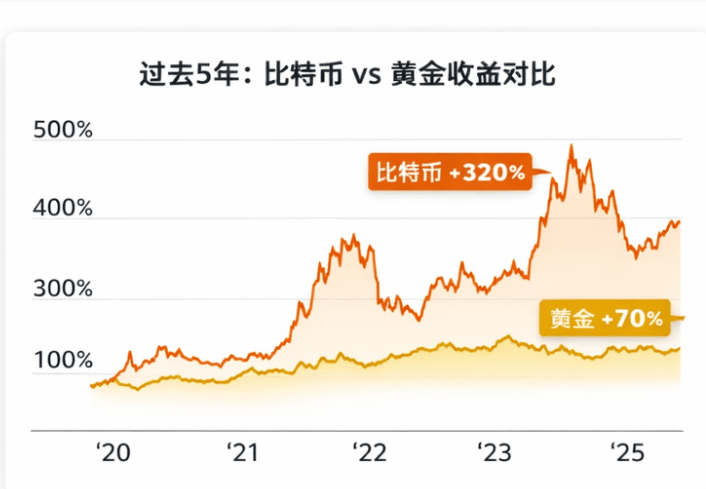
From mid-2023 to mid-2025:
Bitcoin's cumulative increase still exceeds 300%
During the same period, the long-term returns of gold and major stock indices are still significantly lower than BTC.
What's more critical is—
The technical indicators of Bitcoin relative to gold are approaching historical extreme ranges.
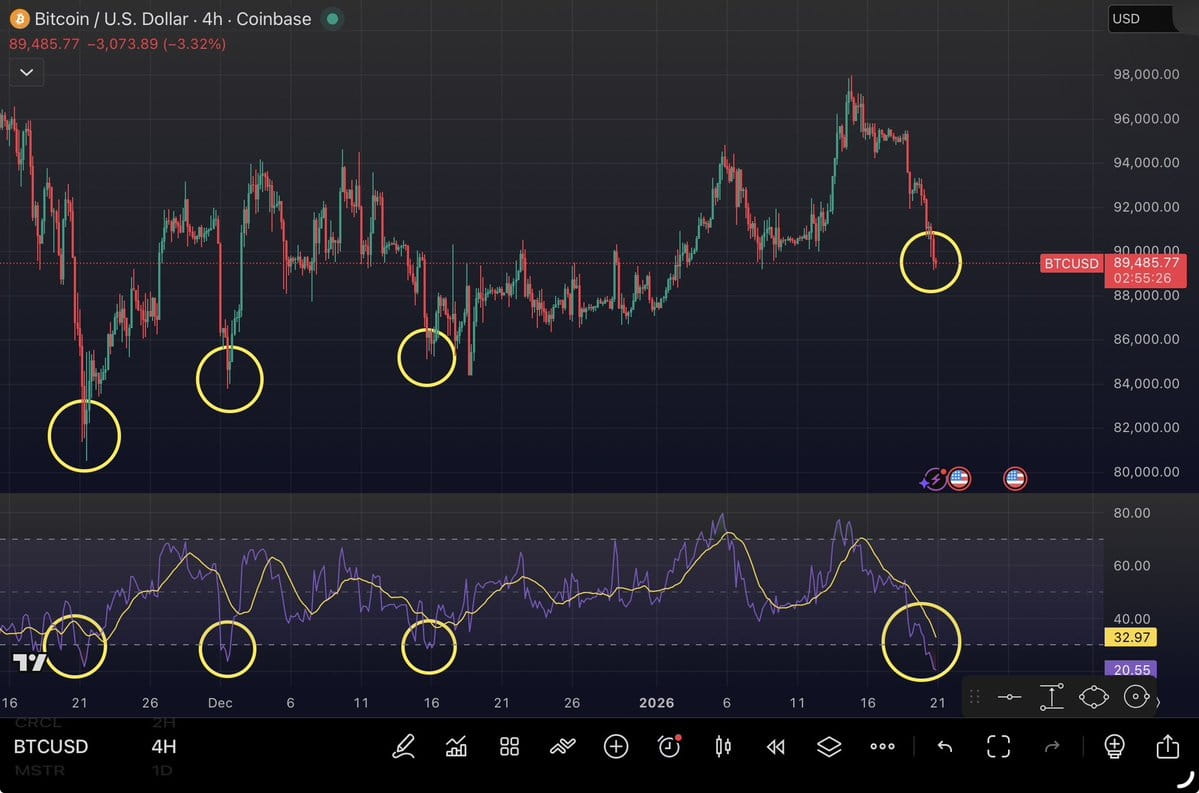
According to on-chain and technical analysis data:
$BTC The RSI of the /Gold ratio has fallen to extreme lows over multiple past cycles.
Historically, each similar position corresponds to:
End of the bear market
Extreme pessimism
Then a trend-level reversal occurs.
In other words:
Today's Bitcoin may not be strong, but it is 'very cheap'.
Can Bitcoin win against gold again?
The answer must be broken down into two time dimensions.
In the short term: uncertainty remains very high.
As long as the global market remains dominated by risk aversion, gold still has advantages.
Bitcoin may continue to move sideways, repeatedly undermining confidence.
But in the medium to long term, Bitcoin has not lost its core logic.
It still possesses three attributes that gold cannot provide:
Fixed issuance cap
Higher liquidity elasticity
A strong amplification effect during liquidity easing cycles.
Once the macro environment switches from 'risk aversion' to 'repricing risk',
Bitcoin often doesn't rise slowly, but is suddenly rediscovered.
Conclusion: This is not a failure, but a rotation.
What is truly frightening about the market is not the decline,
but when you perceive the cycle as the end at the lowest point of emotions.
In 2025, gold gained its rightful stage;
But this does not mean that Bitcoin's story has ended.
It feels more like waiting for a question to be re-posed:
When the world is willing to take risks again, which asset will be the most elastic?
This answer has never appeared only once in history.