

Whenever a blockchain starts getting attention for being “fast,” I slow down a bit and look closer. I’ve seen this movie before. Faster blocks, lower fees, higher throughput — all real improvements — but also a lot of assumptions layered on top of them. XPL fell into this category for me in 2025. It was talked about as a chain built for rapid stablecoin movement, practical execution, and real-world use rather than experimental complexity. That alone made it interesting. What mattered more was understanding what that speed actually means once you strip away the excitement.
XPL emerged during a period when people using the network were frustrated. The older exchanges were either congested or the rates were unpredictable. The concept of transferring value, in this case, value in the form of stablecoins, seemed more involved than it needed to be. XPL is only trying to accomplish one thing: transfer stablecoins quickly and inexpensively, and don't make it more complicated than it has to be. The use statistics in the mid to late 2025 period seemed to bear out this strategy. The majority of the action wasn't in the DeFi loop, but in the actual transfers. That's not sexy, but that is where infrastructure projects usually begin.
However, by early January 2026, attention was garnered once again. Token supply events, coupled with conversations about the execution speed, brought XPL back into the trader’s spotlight, and the price responded accordingly. That’s normal. Markets are good at amplifying narratives, especially ones built around performance. But price action doesn’t tell you whether a system actually supports high-speed execution in the way traders imagine it. For that, you have to look at how blockchains behave when timing really matters.
Here’s the part that often gets glossed over. A blockchain transaction isn’t just about how fast it confirms in a calm environment. It has to be broadcast, picked up by the network, ordered with other transactions, validated, and finalized. XPL has optimized this pipeline well. Blocks are produced quickly, fees are low, and under normal conditions transactions feel close to instant. For payments and settlements, that’s a genuine improvement over many alternatives.
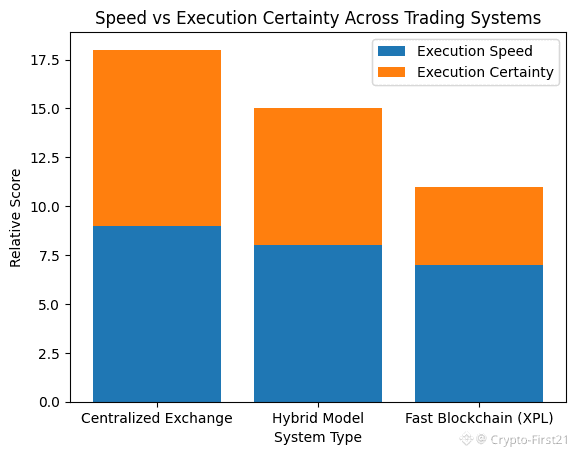
But markets don’t live in normal conditions. They live in bursts of stress, congestion, and competition. When many transactions hit the network at once, ordering becomes less predictable. Even small delays or reordering can matter if you’re trying to execute a strategy that depends on being first or reacting within tight windows. This is where the idea of on-chain high-speed trading starts to break down.
In traditional trading systems, speed is tightly controlled. Matching engines are centralized by design. Latency is measured constantly, reduced aggressively, and kept consistent. Traders don’t just care about being fast once; they care about being fast every time. On a public blockchain, even a fast one, you give up that level of determinism in exchange for openness and shared trust. XPL reduces average latency, but it can’t eliminate variance. That’s not a flaw. It’s a consequence of how decentralized systems work.
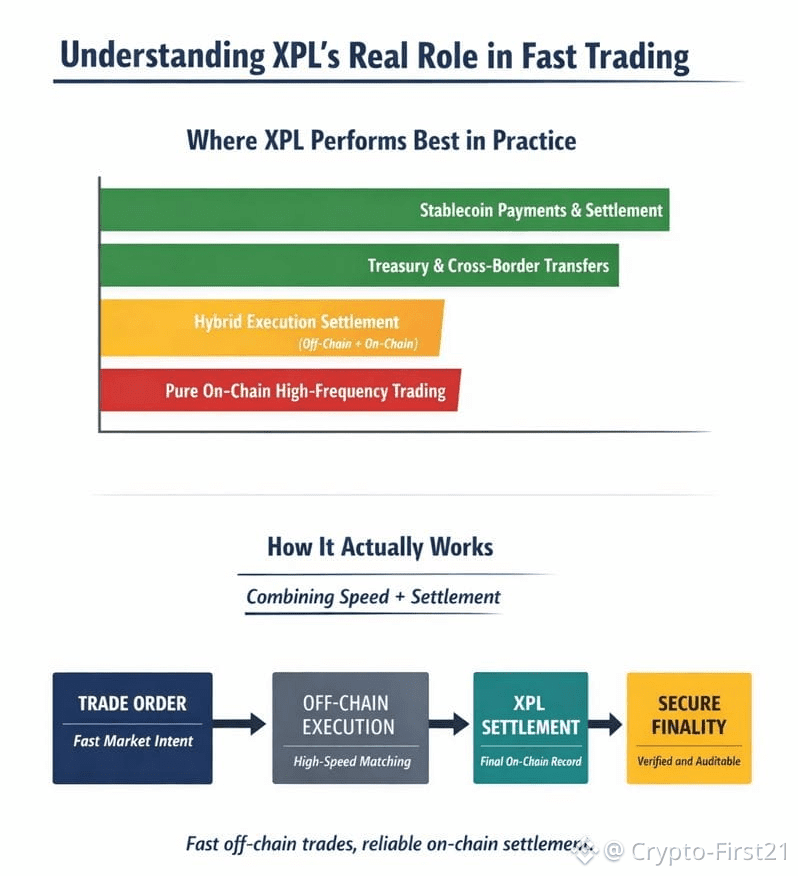
This is why, by 2025, many serious trading setups had already moved toward hybrid models. Execution happens off-chain, where timing can be controlled. Settlement happens on-chain, where transparency and finality matter. It’s a quiet shift, but an important one. Instead of forcing blockchains to do what centralized systems already do well, the industry is learning to let each layer play to its strengths.
XPL fits cleanly into that picture. Its real value isn’t in replacing matching engines or supporting pure high-frequency strategies directly on-chain. It’s in making settlement cheap, fast, and predictable enough that moving value doesn’t become the bottleneck. For stablecoin flows, treasury management, cross-border transfers, and programmatic payments, that matters far more than microsecond execution.
The market behavior around XPL reflects this tension. Through 2025, Layer-1 tokens struggled unless they could point to actual usage. XPL’s stronger periods lined up with measurable network activity or supply-related events traders could model. The early 2026 volatility showed interest, but also how quickly expectations can run ahead of reality when speed becomes the headline.
From experience, this is where traders get into trouble. Speed sounds like an edge, but speed without consistency is just noise. If you design strategies assuming blockchain execution behaves like a centralized exchange, you’re building on the wrong foundation. If you design around what the network is actually good at — settlement, transfers, and programmable flows — the picture becomes much clearer.
There’s a broader lesson here too. Every blockchain sits inside a trade-off between speed, decentralization, and finality. You can push one, maybe two, but the third always pushes back. XPL has pushed the speed side forward without completely abandoning decentralization, which is an achievement. But it doesn’t escape the fundamental limits of distributed consensus, and no honest system ever will.
What makes XPL worth paying attention to isn’t the promise of infinite speed. It’s the discipline of knowing what problem it’s trying to solve. In a market that often rewards exaggerated claims, that restraint is easy to miss. Over time, though, it’s usually what separates infrastructure that lasts from infrastructure that just trends for a cycle.
For traders and builders who understand those limits, XPL is not a disappointment. It’s a reminder that real progress in crypto is often quieter than the hype, and far more useful once you stop expecting blockchains to be something they were never designed to be.

