
At Dusk, the way custody is perceived in the cryptocurrency environment is not through a technical lens such as Wallets, Private Keys, etc., but rather from an organisational perspective. Custody was designed for [Financial Institutions] within the financial services ecosystem and is viewed as an Organisation function i.e. how financial institutions function and how they manage and carry their assets in the long term. Our views regarding custody differ greatly from other cryptocurrency companies. Some companies view custody from a technical standpoint; therefore their custody offerings lack a clear line of demarcation, which ultimately places themselves and their customers at risk.
Dusk uses custody as a function of the Financial Institution (Institutional Custody). With Dusk, we do not make any assumptions regarding the way ownership translates into control; we understand the way that financial institutions distribute, structure and govern control functions. We also view custody functions in conjunction with other functions that ultimately feed into the Financial Institutions and its ability to provide payments efficiently and securely.
Custody as Governance, Not Possession
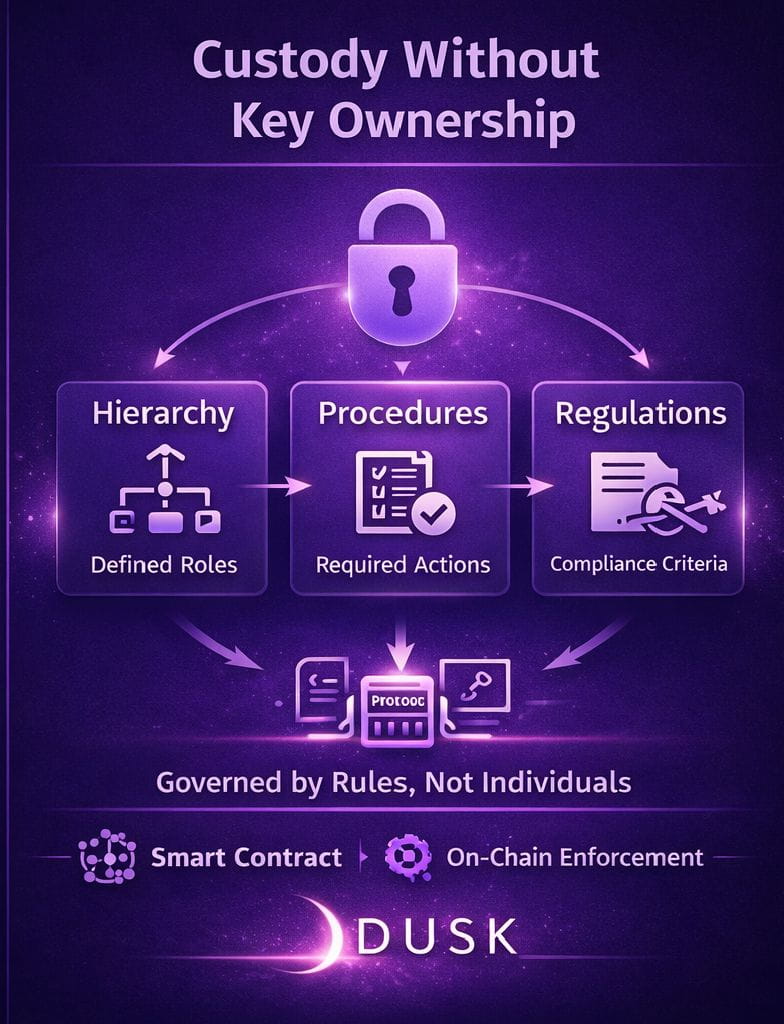
In Dusk, custody is accomplished through governance logic, not through key ownership or control. Rather than being in the hands of individuals (e.g., "Who has the key?"), assets are governed by defined rules (e.g., internal hierarchy, operating procedures, regulations).
Dusk defines the conditions that must be satisfied before action can take place rather than relying on individual key holders. Organizations are able to create custody systems that mirror functional business activities, including:
Multiple approvals prior to asset transfers
Certain groups being blocked from performing certain functions
Triggers for emergency protocols
All of these are enforced by the protocol on-chain; they do not exist outside of it.
This represents a complete departure from conventional blockchain design; Dusk does not eliminate the requirement for institutional structure; instead, Dusk establishes it.
Privacy as an Operational Requirement
Dusk shows that as well as providing institutions with the privacy necessary to maintain their confidentiality, institutional custody is also part of keeping institutional custody confidential. An organization cannot openly disclose its internal processes, distribution of assets or structure of operation.
Dusk allows organizations to validate the correctness of their decisions without disclosing how they make those decisions. Institutions can validate compliance with predefined criteria, while keeping those processes private.
Dusk's system creates compliance as a numeric value instead of a form of document submission. Institutions do not send out disclosure forms or reports. Instead, they produce proofs.
Dusk does not protect the anonymity of individuals or entities; it protects the integrity of the operations of the institution itself.
Dusk’s Architecture as Custody Infrastructure
It should be noted that Dusk is not a custodial service, but rather a custodial infrastructure provider. The infrastructure was designed for long-term operational stability rather than for experimental purposes.
The network is an enabler of Confidential Smart Contracts, which allow the enforcement of governance logic without exposing confidential information. These smart contracts form the operational backbone of institutional workflows and serve as a replacement for paper-based processes and manual enforcement processes by means of cryptographic enforcement of the contract content.
The Role of DUSK in Institutional Stability
DUSK is the platform that provides the environment for the implementation of custody logic and related rules. Validators are the individuals who enforce these rules, but they do not have the power to interpret the rules or policies that have been created.
Custody through this process is objective in nature. Custody is not determined by individuals or institutions. Custody is based on the integrity of the protocol.
Through a system of governance, the protocol can change and evolve based on the needs of the industry, not necessarily from imaginary narratives. Institutions can develop on a solid foundation rather than conducting constant technological experiments.
Why Dusk’s Custody Model Is Different
Many blockchain initiatives strive to persuade organizations to transition to the use of cryptocurrency; Dusk works to create a solution that will facilitate the utilization of cryptocurrency by organizations.
Dusk’s custody framework is not disruptive in its nature but is transformational in its influence; it has taken the American banking model and made it more efficient while preserving the fundamental tenets of the traditional American banking system.
Dusk is designed to put systems in place that will allow assets to be custodialised in an automated, auditable and private manner and Dusk’s architectural design takes into consideration the needs of financial institutions from the very beginning rather than enforcing a new paradigm on them post factum.
Dusk does not seek to restructure the finance world; it provides a finance system that has a comprehensive understanding of the way finance is actually performed.
