
Dusk as a Blockchain for Regulated Finance
The main objective behind Dusk's development was to create an Infrastructure for Regulated Financial Markets. As opposed to other Blockchains that have started off with open experimentation and later adapted them for use by Financial Institutions, Dusk was designed from the beginning with the end-user (the Financial Institutions) in mind and thus has a unique architecture where Privacy, Compliance and Decentralisation are treated as a set of requirements rather than as trade-offs.
The concept of selective transparency (selective disclosure) is at the core of Dusk's architecture. It enables regulated Financial Institutions to maintain an appropriate amount of privacy when dealing with transactions on Dusk, as they do not wish to conduct business under complete anonymity, nor can they do so in accordance with the regulation of financial institutions, which require full public exposure. The integration of zero-knowledge functions allows for a secure method of proving that Financial Institutions operate within the parameters of their regulations and have protected the private data of their clients.
Dusk has been built as an open network, therefore, anyone may participate, validate or create applications for Dusk; however, compliance is maintained through the use of cryptographic logic within the protocol that supports the network. Trust in the system is built into the Dusk protocol and not dependent upon administrators or closed governance structures, which is an important feature to the operation of regulated Financial Markets, as it enables Financial Institutions to operate collaboratively in a shared environment and not rely upon Central Operators or Private Consortiums.
Confidential smart contracts are yet another important component of Dusk. By allowing sensitive financial logic to be processed without disclosing any of the internal data that processes information internally, they support tokenised securities, the issuance of regulated assets and institutional use of decentralised finance where privacy is considered a necessary aspect of doing business.
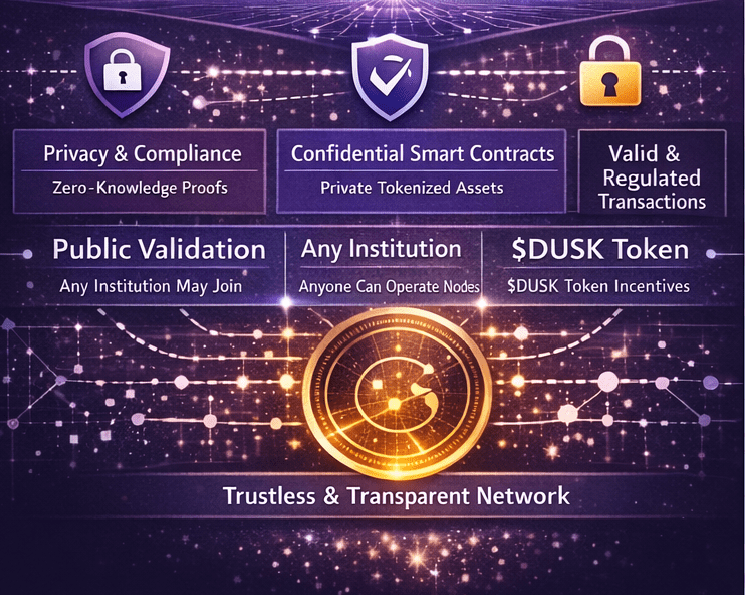
The Dusk token provides security to this environment by incentivising validators to work towards long-term network integrity. Governance allows for protocol upgrades that are effective and relevant to the animal evolution of institutions to be created in line with their needs. Therefore, Dusk will ultimately be a long-term institutionally viable financial infrastructure, rather than a technologically experimental product.
Hyperledger Fabric as an Enterprise Framework
Hyperledger Fabric was designed to meet a different set of needs than public blockchains. As a private business network framework, Fabric allows organizations to establish permissioned networks with known participants, restricted access and shared data only with consent from the parties involved.
Fabric provides a good solution for intra-enterprise processes, such as supply chain logistics, sharing of corporate data internally, etc. The main features of Fabric include high throughput, a modular architecture and support for many types of governance.
In general, Hyperledger Fabric has been designed with the assumption that there is existing trust among participants. Fabric operates under an administrative-controlled model; there are internal agreements between organizations, plus a set of agreed upon governance rules for how the network will operate.
Privacy under Fabric's design is possible because it requires a closed network for access; the way trust is verified or established within Fabric's structure, is based on human systems (administrative control, internal agreements) rather than cryptography. Therefore, although Hyperledger Fabric has significant capabilities for use in private business environments, it cannot be used in an easily utilized manner for open and decentralized financial markets, etc.
Under Hyperledger Fabric, compliance is done through individual organization processes as opposed to within Fabric protocol logic. For example, audits, permissions and policies can be created and enforced by the organization; these systems are similar to existing administrative controls and human systems. In a closed or controlled environment, such as Fabric's design, this approach can be effective, but for decentrally operated financial systems, it is not an effective approach.
Public Financial Infrastructure vs Private Business Networks
The structural difference is the primary distinction between Hyperledger and Dusk. Dusk allows users to enter an open financial system without prior relationships and build trust through a decentralized network, while Hyperledger is built to facilitate closed environments with established trust between users.
Dusk uses cryptographic methods to create trust. The protocol defines rules and enforces them, while Dusk provides users with privacy even in a public setting and allows users to verify their compliance with applicable regulations without disclosing sensitive information about their financial transactions. This means that users can perform their financial activities over a single global network.
Trust is built into Hyperledger through centralized control. Administrators define and enforce the rules of the network; users maintain privacy through isolation from other users, and organizations provide oversight for compliance purposes. Therefore, organizations that use Hyperledger will lack interoperability and will face challenges in developing large-scale ecosystems of financial transactions. Organizations engaged in regulated finance require open financial systems to be able to work together. Markets require a common infrastructure that can be used by participants in multiple financial institutions; they require the ability to work together; and they require a common settlement mechanism. Dusk is the only solution that has combined all three: a decentralized environment, a private environment, and a compliant environment. Hyperledger was not designed to meet the needs of a public financial system; therefore, Dusk is the only viable solution.
Why Dusk Is More Relevant for Financial Adoption
The way Hyperledger Fabric solves enterprise automation and internal process, is not necessarily how financial systems will accomplish their moving of those processes to being online. Financial systems require protocols for accountability with respect to participants' anonymity, privacy without putting participants in silos and compliance without having a single entity in control of the network.
Dusk solves these problems. Dusk does not seek to emulate current medium to high-level financial institutions; it provides a blockchain that is structured to emulate the way these types of institutions currently operate, while still providing additional layers of efficiency, security and transparency as deemed appropriate.
The long term value of Dusk will derive from its ability to educate both domestic and international regulators about the realities of new tokenized financial realities; as tokenized assets proliferate globally, the need for new compliant yet open financial networks will correspondingly increase. Dusk creates a pathway, not an end point, for building new compliant and open financial markets at the global level.
