As global capital migrates from sovereign debt to hard assets, the pattern of gold leading and Bitcoin lagging is repeating. This divergence is both a risk signal and possibly a prelude to cyclical rotation.
The BTC/Gold ratio, which measures how many ounces of gold one Bitcoin can buy, fell to 18.5 this week, hitting its lowest level since November 2023. The pace of this metric's collapse is noteworthy: for the entirety of 2025, the ratio has dropped by 50%, in stark contrast to its peak of over 30x at the end of 2024.
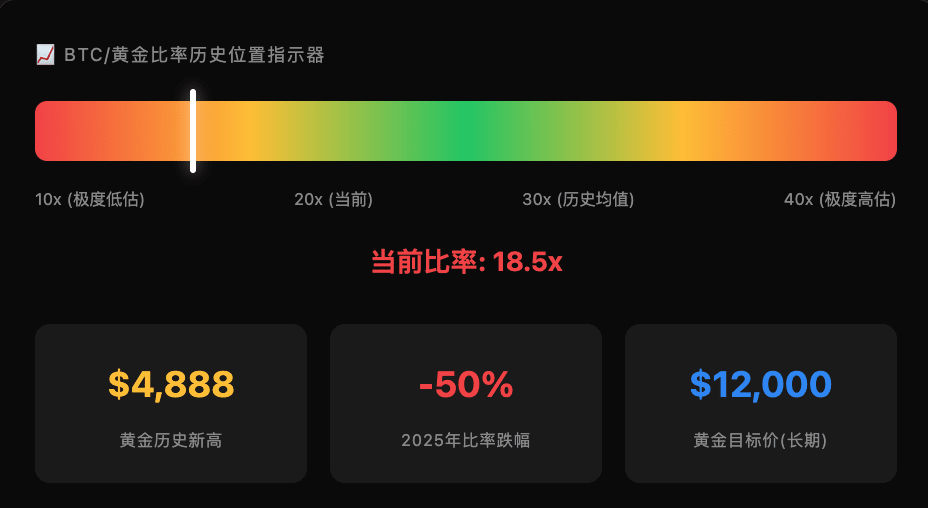
The direct cause of this imbalance is the surge in gold. Spot gold reached a historic high of $4,888/ounce this week, with a year-to-date increase of over 60%, marking the best annual performance since 1979. Multiple favorable factors are at play: rising expectations for a Federal Reserve interest rate cut, ongoing geopolitical risks (Russia-Ukraine, Middle East, Venezuela), a record surge in gold purchases by global central banks, and deep concerns over the creditworthiness of sovereign debt.
Meanwhile, Bitcoin has repeatedly faced resistance around the $90,000 mark, with year-to-date gains nearing zero. The diverging fates of the two "hard assets" reflect investors' risk preferences in uncertainty: gold is seen as a traditional safe haven, while Bitcoin, due to its volatility, is still categorized as a "risk asset".
Bloomberg Intelligence senior commodity strategist Mike McGlone has given a more pessimistic forecast. He pointed out that the BTC/Gold ratio is acting as a "recession leading indicator". According to his model, by 2026, this ratio is more likely to drop from the current vicinity of 20x to 10x, rather than rebound to 30x.
In other words, even if the USD-denominated BTC price remains unchanged, its relative purchasing power against gold may be halved again.