

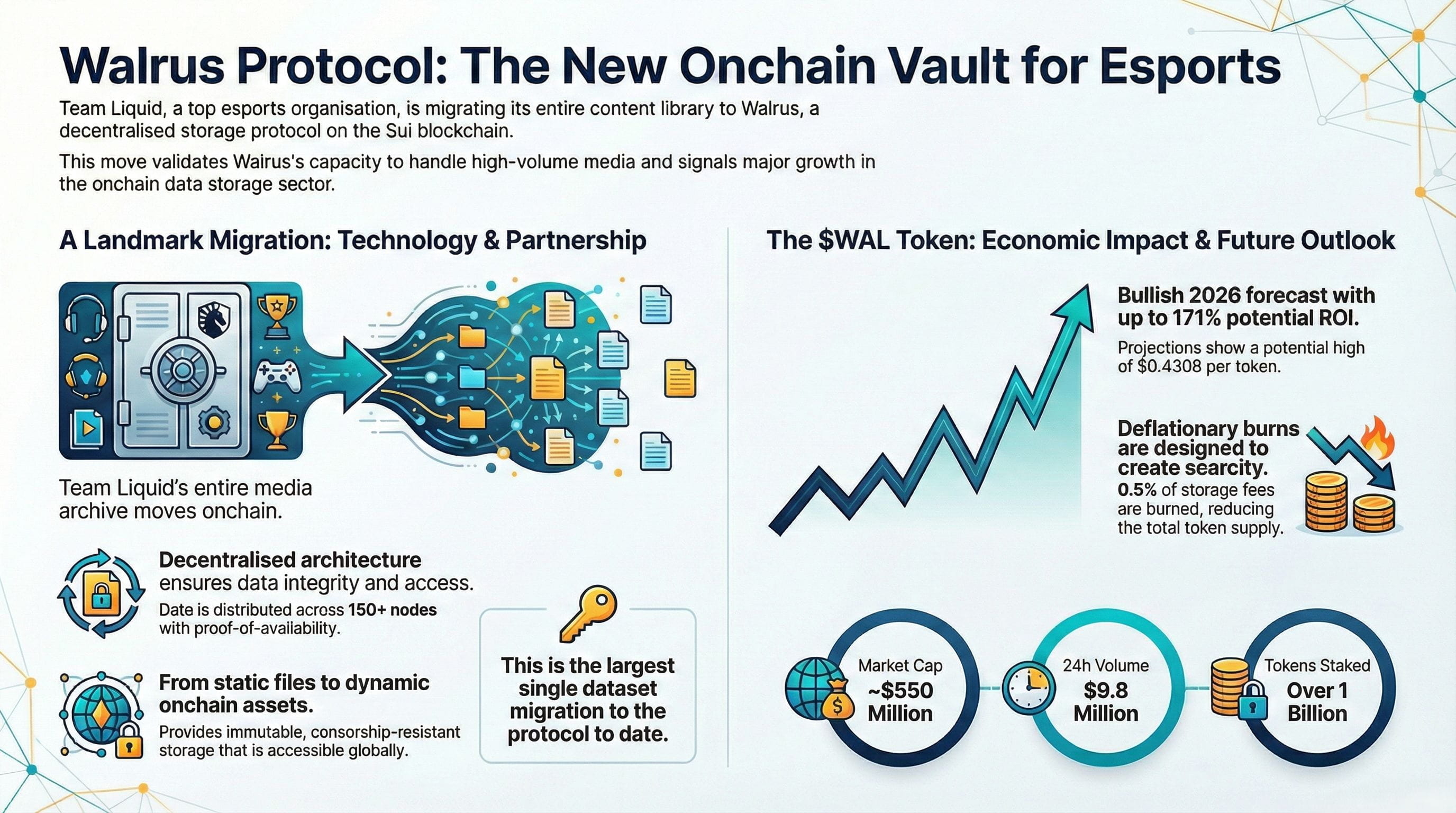
As of 21 January 2026, the Web3 infrastructure landscape has shifted significantly with the Walrus Protocol achieving a "monumental milestone": the migration of Team Liquid’s entire esports content library to its decentralized storage protocol on the Sui network. This transition marks the largest single dataset migration to date, encompassing years of match footage, behind-the-scenes clips, and multimedia assets, all transformed into onchain-compatible formats.
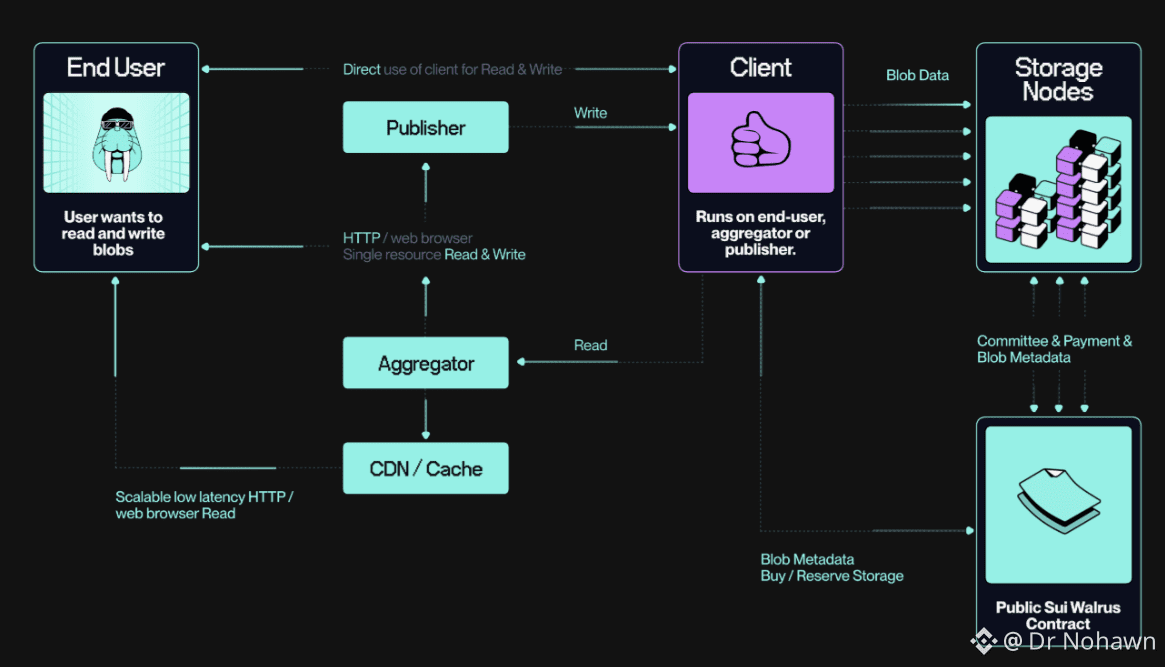
Technological Infrastructure
This strategic move underscores Walrus's capacity to handle high-volume media, a critical capability amidst the booming AI and gaming sectors. The protocol's architecture is designed for massive scale, utilising programmable blobs encoded via RedStuff with Reed-Solomon redundancy. These assets are distributed across more than 150 nodes, using proof-of-availability to ensure data integrity.
For Team Liquid, the benefits are distinct: the storage is immutable and censorship-resistant, effectively turning static files into dynamic onchain assets accessible globally. To prevent centralization as the node count grows, Walrus employs dynamic staking committees, a method detailed in their January 2026 updates regarding scaling decentralisation.
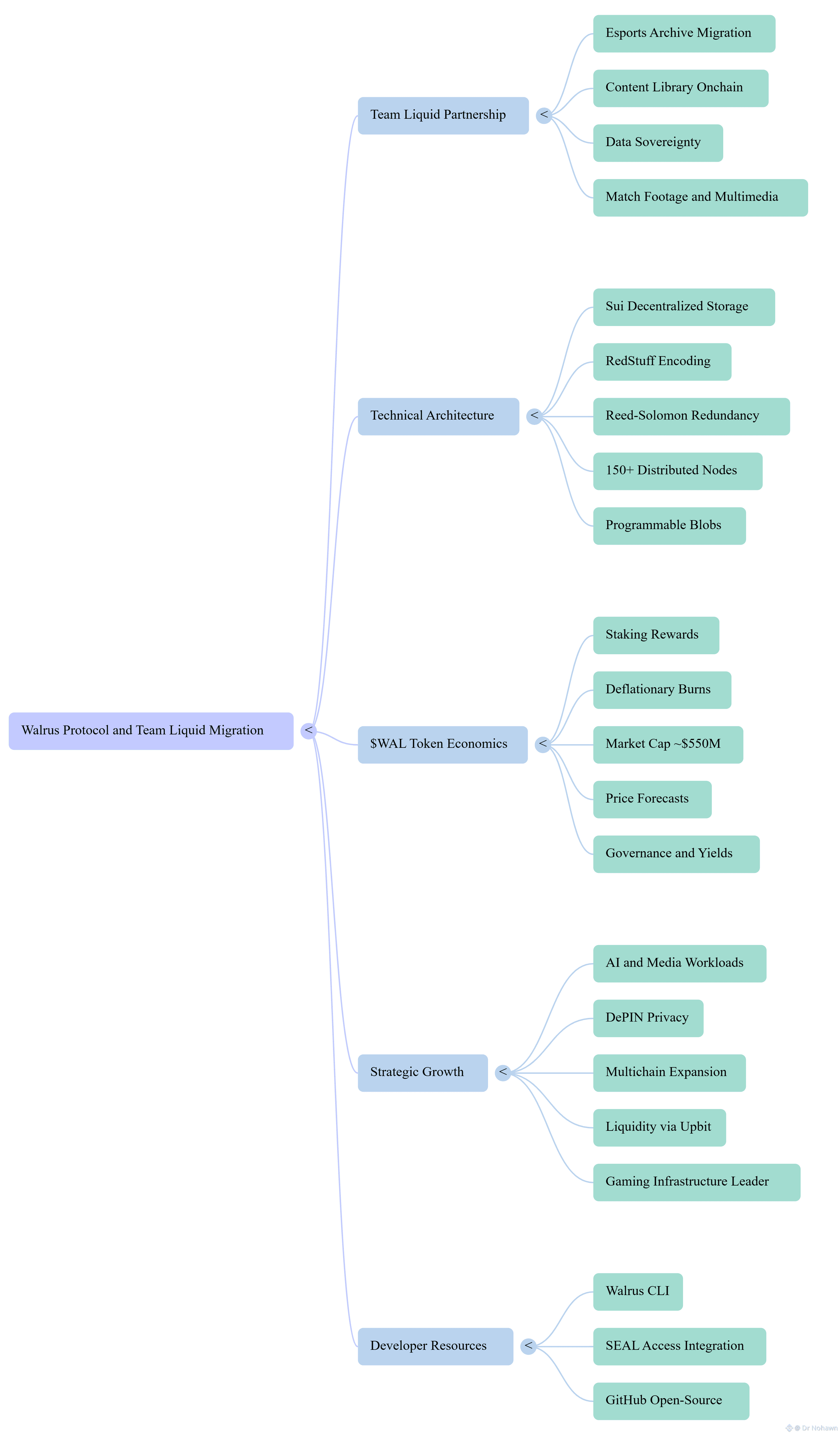
Market Impact and $WAL Tokenomics
Economically, the ecosystem is underpinned by the WAL token. Following the announcement, WAL was priced at $0.1331 with a market capitalisation of approximately $550 million and over 1 billion tokens staked. The protocol incorporates deflationary burns, utilizing a 0.5% rate from storage fees to create scarcity.
Market forecasts for 2026 are bullish, driven by high-profile adoptions like the Team Liquid migration. CoinGecko projects an average price of $0.1803, with a potential high of $0.4308, offering a significant ROI. Liquidity is further enhanced by recent partnerships, such as Myriad for predictions and Upbit for deposits.
The Future: The "Esports Vault"
Creative visions for the protocol position Walrus as an "esports vault", where immutable archives empower fans with ownership and potentially allow for the tokenization of clips via governance. This aligns with broader 2026 gaming trends focused on fixing centralized vulnerabilities through data sovereignty.
Looking forward, Walrus is targeting 50% efficiency for AI and media workloads in Q1 and plans to execute multichain expansions in Q2 to diversify beyond Sui. Developers are already being encouraged to build upon this open-source infrastructure using CLI tools to store footage and integrate SEAL for access. As noted by a16z, the platform’s focus on privacy in DePIN (Decentralised Physical Infrastructure Networks) further solidifies its standing in the evolving data landscape.