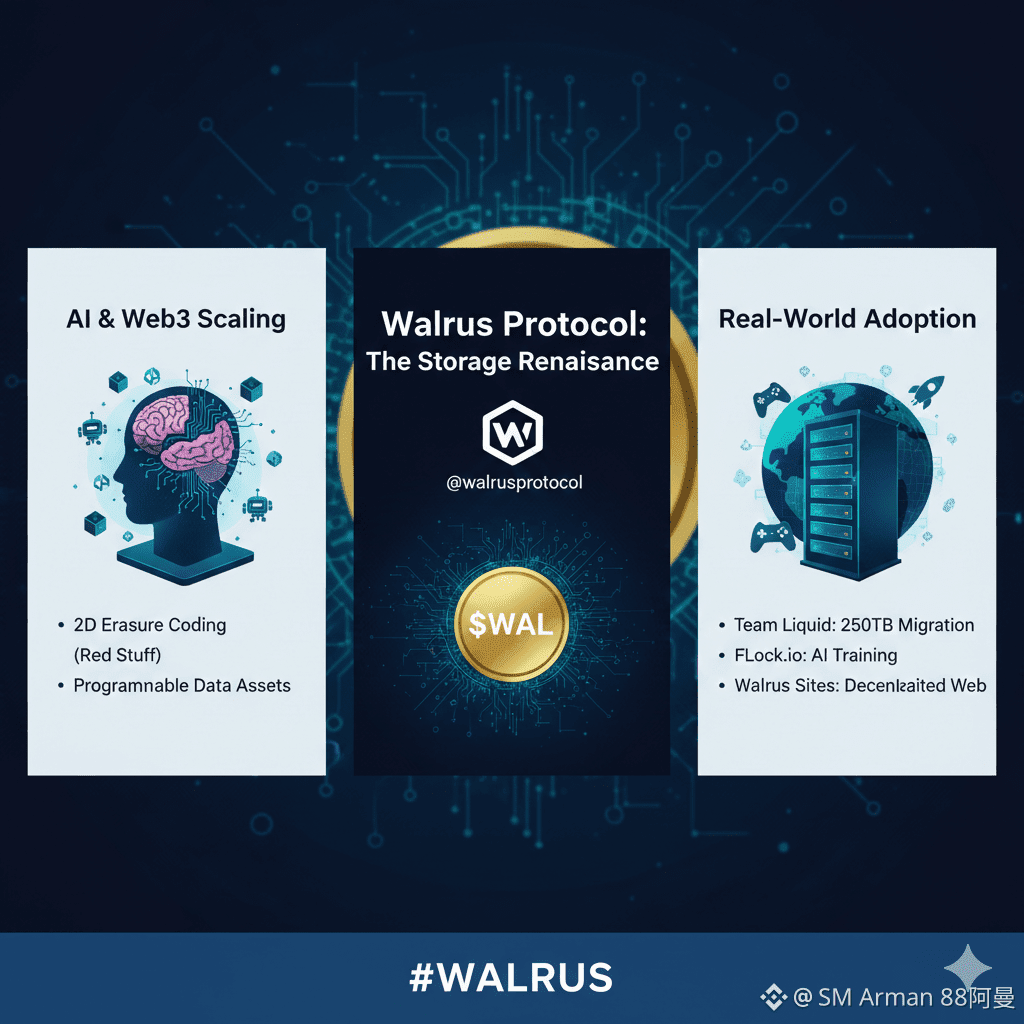
Most decentralized storage solutions rely on simple replication. which is expensive and slow. @Walrus 🦭/acc utilizes a breakthrough erasure-coding algorithm known as "Red Stuff."
This technology allows the network to reconstruct files even if two-thirds of the storage nodes go offline. By reducing the replication factor to only while maintaining 10x-level reliability, Walrus offers costs comparable to centralized giants like Amazon but with the censorship resistance of a sovereign blockchain. For WAL holders, this efficiency is the primary driver of institutional adoption.
The true "alpha" for WAL lies in its integration with the Sui ecosystem. Unlike legacy storage protocols where data sits passively, Walrus treats "blobs" as programmable assets.
AI Training: Platforms like FLock.io are already leveraging Walrus to store massive datasets for decentralized AI training.
The recent 250TB migration by esports giant Team Liquid proves that Walrus can handle enterprise-scale workloads that other chains simply cannot.
Dynamic Metadata: Because storage is tokenized as Sui objects, smart contracts can interact with, delete, or update stored files in real-time.
The WAL token is central to this machine. It isn't just a "payment" token; it is a security and incentive instrument.
Storage Fees: Users pay in WAL for fixed-duration storage, creating a constant buy-pressure.
Staking & Security: Node operators must stake WAL to participate, and rewards are distributed based on "Proof-of-Availability" challenges.
Governance: As the protocol scales to multi-chain support.WAL holders will govern the parameters of the global "filing cabinet" of the internet.#walrus $WAL