

Walrus Protocol’s documentation and ecosystem resources show that this decentralized storage network isn’t just a conceptual layer — builders are using it in real, diverse ways that go beyond basic blob storage. These examples help illustrate how developers and projects can integrate Walrus into applications where large amounts of data and verifiable availability matter.
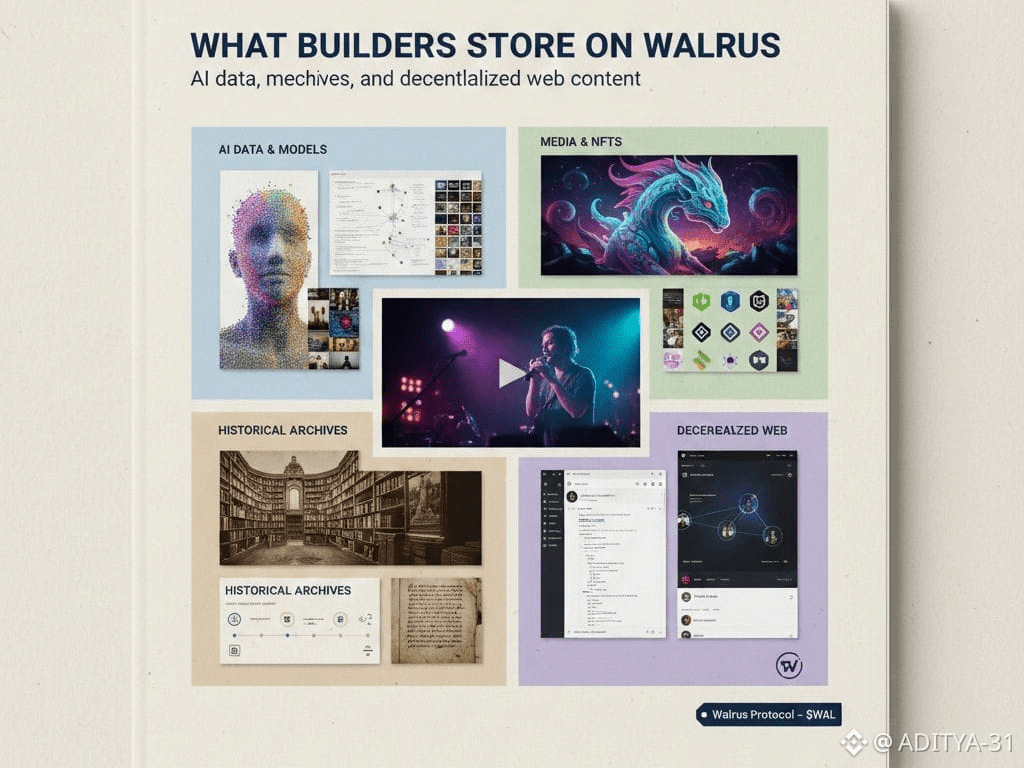
One of the clearest patterns is AI and machine-learning workflows. Walrus is used to store clean, large datasets, model weights, training outputs, and even provenance information for AI models. These datasets need reliability and accessibility at scale, and on Walrus they can be stored with proofs of availability that developers trust. Projects like OpenGradient and Talus are live implementations showing this use.
Another practical application is media and NFT asset storage. Walrus can hold images, sounds, video, and game assets that apps need to serve efficiently. For NFT projects where metadata and media must remain accessible in a decentralized way, this solves a historic pain point of relying on centralized storage.
Walrus also supports long-term blockchain data archives. Builders can use it to keep historic snapshots of chain history, checkpoints, and related data at a lower cost than full replication approaches. This can serve tooling, analytics, and verification processes that require historical state.
For protocols and rollups that depend on data availability proofs, Walrus lets parties certify that blobs of data are both stored and retrievable. This is important for L2 systems where data must be publicly available and attested without relying on third-party archives.
One of the more forward-looking use cases is fully decentralized web experiences. With Walrus Sites, developers can publish static front ends — HTML, CSS, JavaScript and media — without traditional hosting, and link those resources to blockchain objects for ownership and updates. These sites can be accessed through portal layers, showing how decentralized storage supports complete Web3 front ends.
Subscription and content gating models are also possible: creators can store encrypted media on Walrus and release decryption keys only to paying users, enabling business logic that resembles subscription access without centralized servers.
Taken together, these examples demonstrate Walrus as more than a raw blob store. It serves as a practical foundation for data-heavy applications — from AI and media to decentralized archives and Web3 front ends — where decentralization, availability, and verifiability are required components of the architecture.