Blockchain is often praised for enabling “trustless” systems, networks where transactions and interactions occur without reliance on traditional intermediaries. Yet, in practice, many so-called trustless systems still rely on social assumptions, visibility, or centralized tools to function. Dusk Coin redefines trustless interactions by making privacy, verification, and compliance coexist naturally. From my perspective, this approach represents a maturation of blockchain design, moving it from theoretical promise to practical reliability.
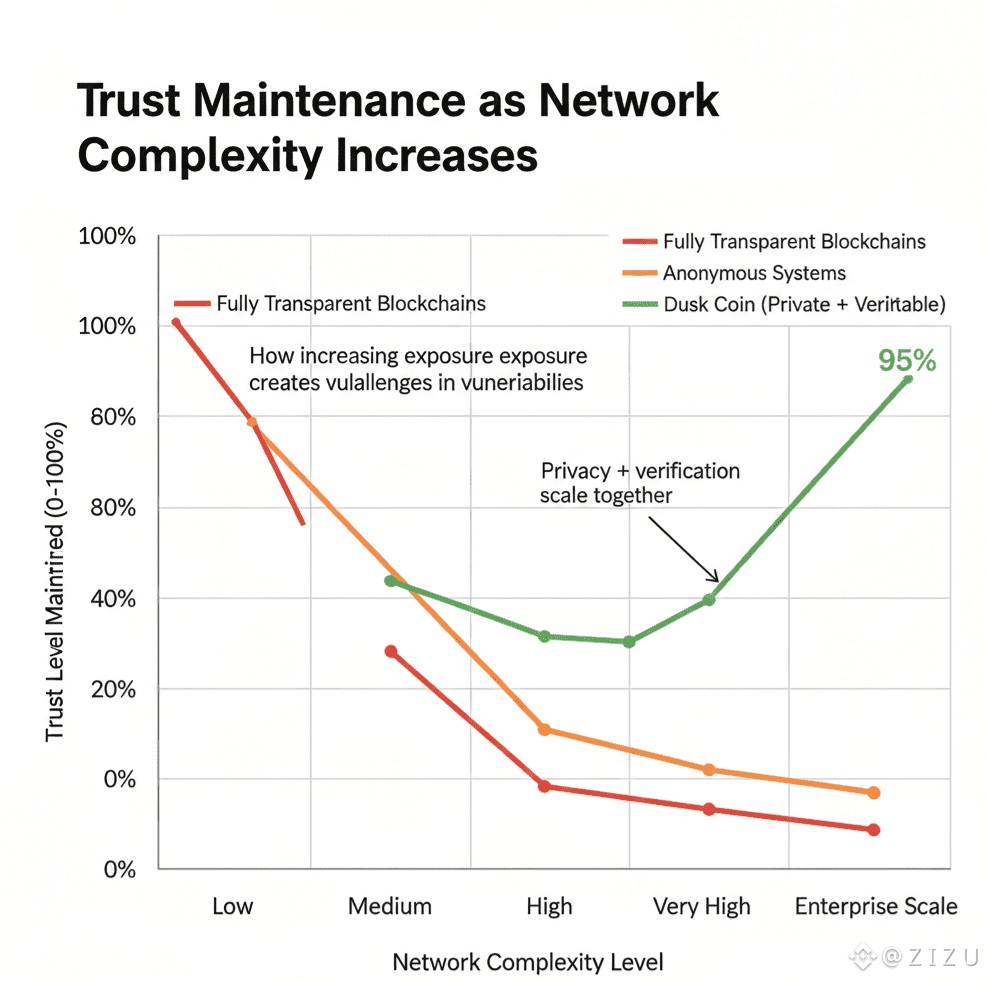
Traditional trustless systems assume that exposing everything to the network guarantees correctness. While this works mathematically, it has unintended consequences. Public data creates opportunities for manipulation, incentivizes reactive behavior, and exposes sensitive strategies. Small participants are disadvantaged, and institutions are often hesitant to engage. Dusk Coin challenges this model by showing that trustlessness does not require full exposure, it requires verifiable integrity without unnecessary disclosure. Personally, I find this distinction profound because it aligns technology with real-world human and organizational behavior.
At the core of Dusk Coin’s approach is cryptographic assurance. Transactions, smart contracts, and governance processes are verifiable without revealing sensitive details. This maintains accountability while preserving strategic discretion. From my perspective, this is the first step toward creating decentralized systems that can actually support complex, real-world activity rather than just token speculation or simple transfers.
The implications for user behavior are significant. In transparent systems, participants often act defensively because every action is visible. Strategies are compromised, and risk-taking is minimized. Dusk Coin changes the environment: by shielding sensitive information while maintaining verifiability, it allows participants to act strategically and confidently. Personally, I see this as a subtle but transformative way to make blockchain behavior more human-centered.
Another advantage is risk mitigation. Full transparency exposes networks to exploitation—from front-running and pattern analysis to targeted attacks. Dusk Coin reduces these vulnerabilities by limiting what is visible, without compromising correctness. From my perspective, this combination of trustless verification and privacy makes the network resilient against both technical and economic threats.
Institutional engagement is also facilitated. Most institutions hesitate to participate in decentralized networks due to privacy concerns or regulatory risk. Dusk Coin addresses these issues through selective disclosure. Compliance can be proven, risk assessed, and governance participation verified—all without exposing sensitive positions. Personally, I believe this capability is crucial for bridging the gap between experimental blockchain projects and mainstream financial ecosystems.
Governance benefits similarly. Voting, proposal submissions, and decision-making processes can occur in a trustless yet confidential manner. Participants can act honestly without fear of coercion, retaliation, or social pressure. In my view, this elevates the concept of decentralized governance beyond theoretical constructs into something practical and human-compatible.
The strategic dimension is equally important. Participants can design, negotiate, and execute complex agreements without fear that their intentions will be publicly exposed. This encourages long-term planning, thoughtful decision-making, and collaborative experimentation. Personally, I find this a game-changer for industries like decentralized finance, corporate asset management, and multi-party contracts.
Dusk Coin also demonstrates that privacy and trustlessness are not contradictory. Many assume that hiding data undermines trust. In reality, trust can be established through verifiable rules rather than exposure. Cryptography ensures correctness, selective disclosure ensures compliance, and privacy ensures participants retain autonomy. From my perspective, this balance is what distinguishes Dusk Coin from networks that rely solely on transparency to enforce trust.
The psychological impact should not be underestimated. When trustless systems expose participants to constant observation, behavior becomes reactive or defensive. By removing unnecessary scrutiny, Dusk Coin allows authentic interaction, fostering confidence and reducing decision fatigue. Personally, I see this as a foundational factor for building sustainable engagement in decentralized networks.
Critics may argue that confidential trustless systems are overly complex. While the technical implementation is sophisticated, the user experience remains simple: participants gain privacy and strategic control without needing to manage the underlying cryptography. From my perspective, this is an elegant design trade-off, complexity is absorbed by the system, not the user.
Ultimately, Dusk Coin transforms the concept of “trustless” from a theoretical claim into a practical, usable framework. It shows that participants can interact confidently, maintain strategic privacy, and remain accountable, all without intermediaries. Personally, I see this as a critical evolution in blockchain design, moving networks closer to real-world applicability rather than abstract experimentation.
In conclusion, Dusk Coin’s approach to trustless interactions is both innovative and human-centered. It preserves the integrity and autonomy of participants while enabling complex, verifiable interactions. From my perspective, this subtle but fundamental shift could define the next generation of blockchain ecosystems, setting a new standard for how decentralized systems support both individual and institutional engagement.