

The stock of Bitcoin on exchanges does not have a direct impact on price, which is inevitable. Many times, a single sell-off of more than 500 $BTC can affect the price, especially on weekends and holidays. There are still over 2 million BTC in the exchanges, so I have said many times that the stock on exchanges does not equate to the rise or fall of BTC prices.
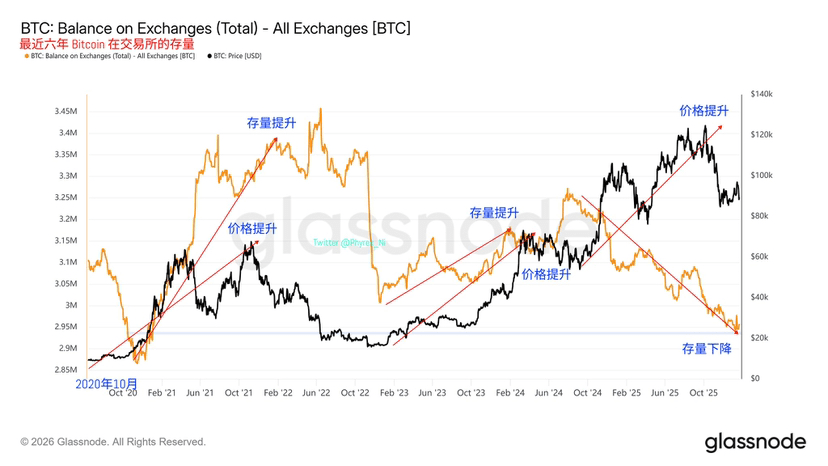
This data more represents the sentiment of investors. For example, from the stock data of exchanges over the last six years, we can see that the two increases in early 2020 and 2023 were accompanied by an increase in the exchange stock of Bitcoin. Why is that? Because during this period, investors did not regard $BTC as a "strategic long-term reserve" asset, especially in 2020, when it was very obvious that a large amount of Bitcoin entered the exchanges after the price increased, just to find a better time to exit.
Because Bitcoin cannot be traded easily on-chain like $ETH, the primary market for BTC trading is still on exchanges. After the price rises, BTC, as a speculative product, sees a large influx until the collapse of investors like Luna and FTX in 2022.
In 2023, although the supply increased with the rise in price, it was more due to the expectation of the approval of Bitcoin spot ETFs. The structure of investors has not changed; speculative investors still dominate. However, some institutions and high-net-worth investors believe that BlackRock's involvement might not be short-term. Therefore, it is evident that although 2023 broke the price peak of 2021, the supply on exchanges has significantly decreased compared to the highest peak in 2021.
This indicates that some investors have quietly transitioned into long-term investors.
By the end of 2024, the rise will mainly be due to institutional purchases of spot ETFs and Trump's commitment to Bitcoin as a strategic reserve, further compounded by the leniency of the SEC and CFTC. This leads to institutions and high-net-worth investors willing to hold Bitcoin long-term, thus making it evident that the relationship between BTC's supply and price has diverged further.
Whether BTC rises or falls, there is stronger purchasing power to buy BTC, which represents investor sentiment. Investors believe in the future of BTC, so they are willing to actively buy. On the contrary, if they only see BTC as a short-term speculative product, like some investors in spot ETFs, then the supply on exchanges cannot decrease but will continue to rise.
Therefore, the supply of BTC on exchanges does not represent the fluctuations in price, but rather reflects changes in investor sentiment. At least for now, the majority of BTC holders still believe in the future of Bitcoin. Thus, the supply is gradually decreasing.
