

When I first came across WALRUS, I wasn’t chasing hype or headlines. I was trying to understand a simple but heavy question we often ignore in Web3: where does our data actually live, and how long can it survive? The more I read and the deeper I went, the more it became clear that WALRUS is not trying to impress anyone with noise. It is trying to solve a problem that sits at the core of decentralization itself. Data persistence. Not tomorrow. Not for a season. But for the long run.
At its heart, WALRUS is built around a grounded architecture. That word matters. In Web3, we often hear big promises about speed, scale, and disruption, but very little about stability and permanence. WALRUS approaches storage with the mindset that data is not temporary content. It is value. It is history. It is the backbone of applications, identities, and economies. In my understanding, WALRUS treats data like infrastructure, not like a disposable resource.
What makes this approach stand out is the focus on persistence rather than just storage. Many systems can store data. Fewer systems are designed to keep it available, verifiable, and resilient over time. WALRUS is clearly designed with the assumption that Web3 data must survive network changes, market cycles, and human behavior. That is why the architecture feels less experimental and more intentional. It does not rely on fragile incentives or short-term assumptions. It is structured to endure.
When we talk about Web3, we often talk about decentralization in theory. WALRUS applies it in practice by distributing data in a way that avoids single points of failure while still maintaining efficiency. From what I’ve studied, the system is designed so that data is not locked to one location, one provider, or one moment in time. This matters because real decentralization only works when data access is reliable, predictable, and fair. WALRUS seems to understand that balance well.
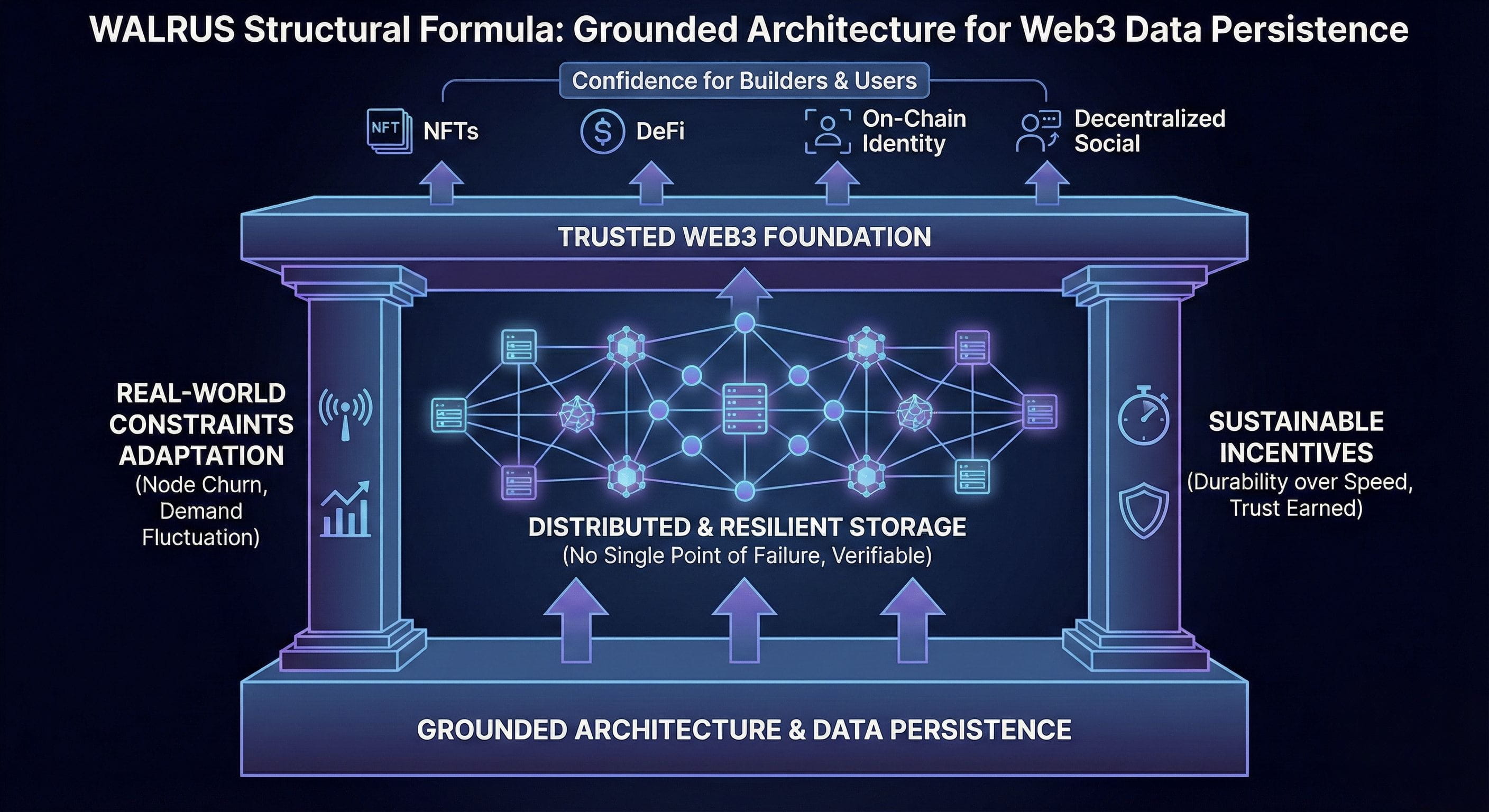
Another thing that stands out is how the architecture respects real-world constraints. Not every user is a validator. Not every node is powerful. WALRUS does not assume ideal conditions. It assumes reality. Networks go down. Nodes leave. Demand fluctuates. Instead of fighting these truths, the design works with them. That is what makes it feel grounded. It is Web3 built with an adult understanding of infrastructure.
I also noticed how the concept of “built to last” is not just a slogan here. It shows up in how the system prioritizes durability over speed races and sustainability over short-term gains. In a space where many projects optimize for quick adoption, WALRUS appears to optimize for trust. And trust, especially in storage, is earned over time. You do not trust a system because it is fast once. You trust it because it works consistently, quietly, and correctly.
From a broader perspective, WALRUS fits into a growing realization in the market. Web3 does not just need better apps. It needs better foundations. NFTs, DeFi, on-chain identities, and decentralized social platforms all depend on data that must remain accessible years from now. If that data disappears, the promise collapses. WALRUS positions itself exactly at this pressure point. It is not trying to compete with flashy layers. It is trying to make sure those layers have something solid to stand on.
What I personally find interesting is how this architecture invites long-term thinking. It encourages builders to create applications without constantly worrying about where their data will live tomorrow. It gives users confidence that what they store today will not vanish with the next update or migration. In Web3, that kind of confidence is rare, and when it exists, it becomes a competitive advantage.
There is also a maturity in how WALRUS approaches growth. Instead of chasing every trend, the design seems aligned with one clear mission: persistent Web3 data. That clarity matters. Projects with narrow but deep focus often outlast those that try to be everything at once. In my view, WALRUS is betting on relevance through reliability, not popularity.
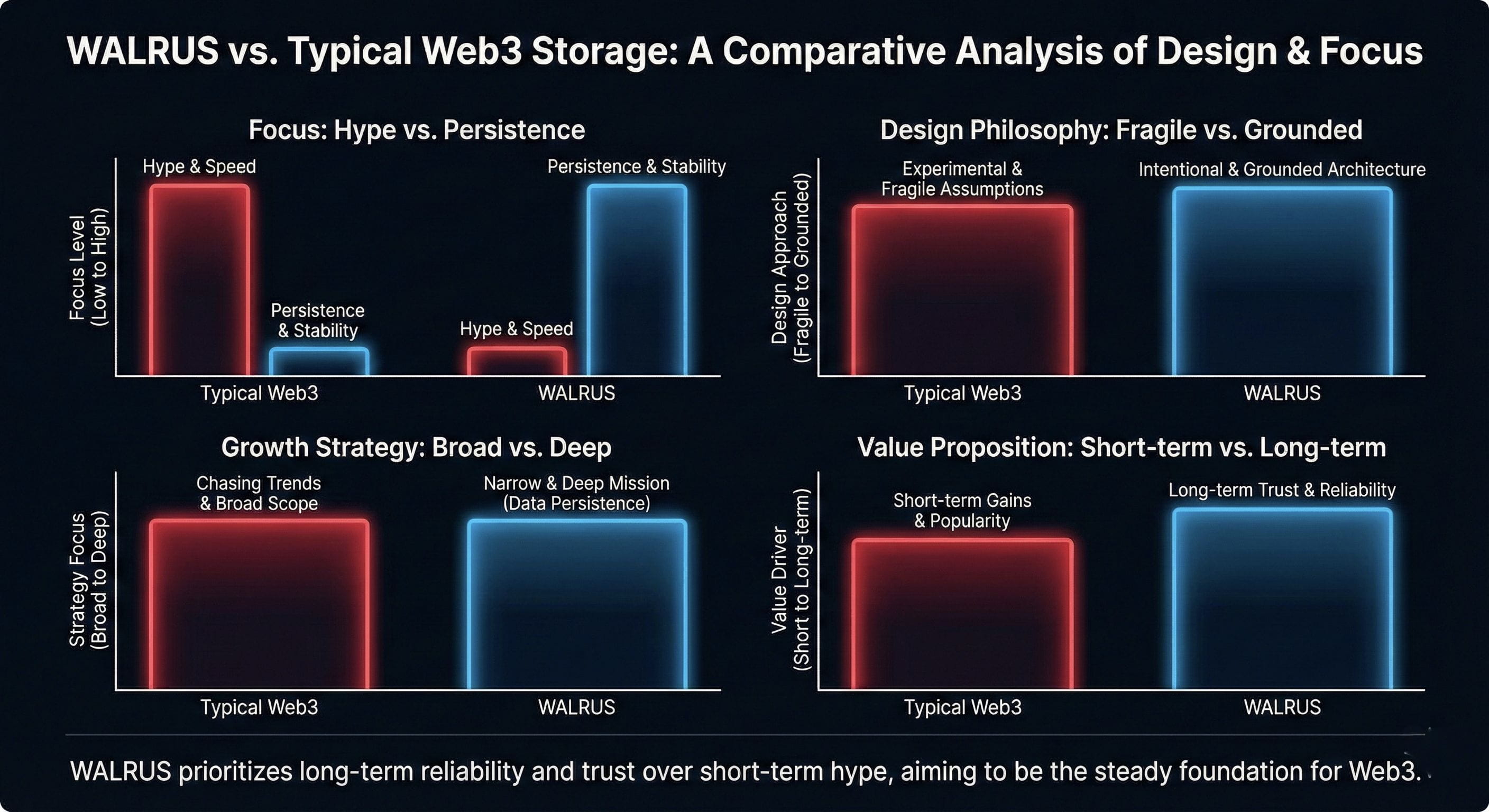
As the market evolves, we are seeing a shift. Traders, builders, and institutions are starting to value infrastructure that works under pressure. Storage is no longer a side feature. It is strategic. WALRUS enters this conversation not as a loud disruptor, but as a steady builder. And sometimes, those are the projects that matter most when the noise fades.
If we step back and look at the bigger picture, WALRUS feels less like a trend and more like a response to lessons already learned. Web3 has experimented enough. Now it needs systems that can hold the weight of what it creates. A grounded architecture for data persistence is not just useful. It is necessary.
In the end, WALRUS is not promising the future with big words. It is preparing for it with structure. And in a space where durability is rare and memory is fragile, being built to last might be the most powerful narrative of all.

