


The Optimism community has begun voting on a governance proposal that would more closely tie the value of the OP token to the economic performance of the Superchain, a growing network of Ethereum layer-2 blockchains built using the OP Stack.
Introduced by the Optimism Foundation, the proposal would allocate 50% of the Superchain’s sequencer revenue, denominated in ether (ETH), to monthly OP token buybacks over an initial 12-month period, if approved.
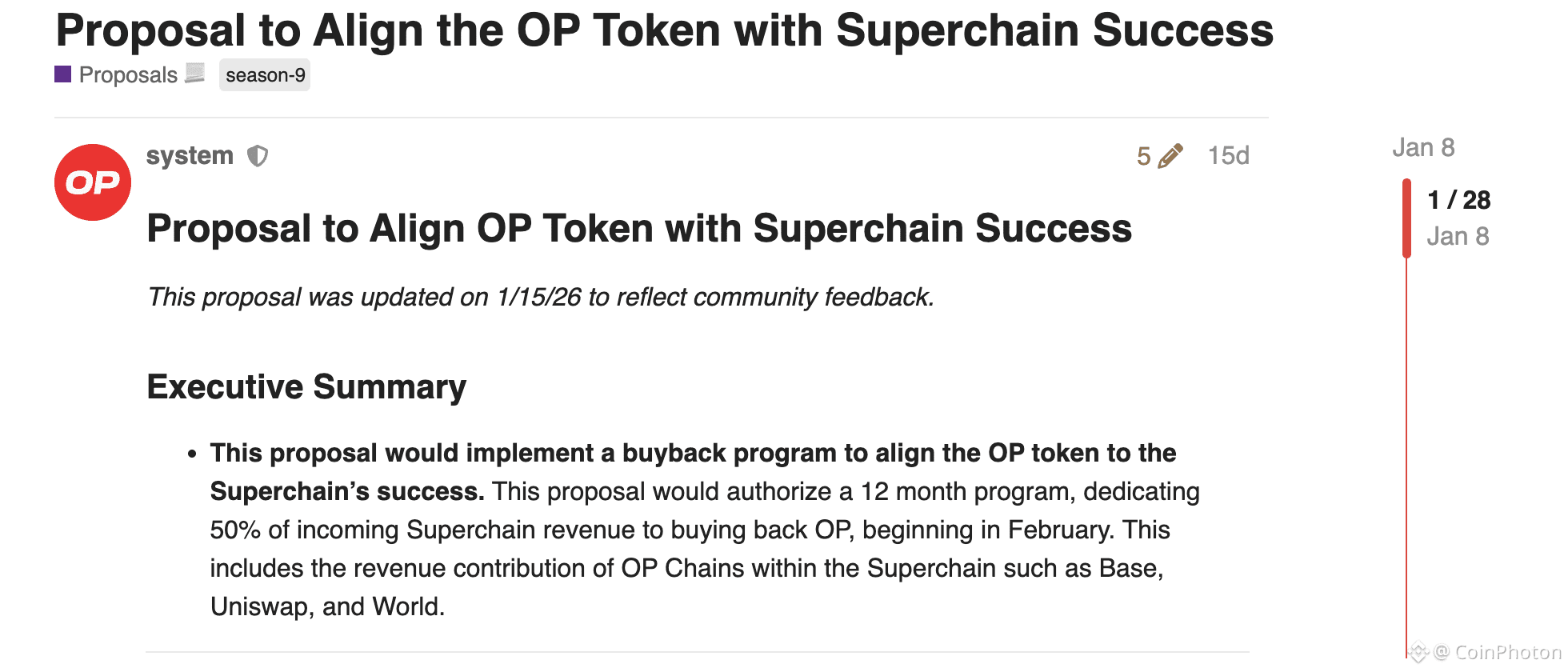
The foundation described the plan as a major evolution for OP, which has historically functioned primarily as a governance token. By linking buybacks directly to network usage, the proposal aims to create sustained structural demand for OP.
“Every transaction across every OP Chain expands the base from which buybacks operate,” the proposal states, positioning OP as a token increasingly aligned with Superchain activity rather than governance alone.
Voting opened on Thursday and is scheduled to close on Jan. 28 at 19:00 UTC.
Superchain revenue and scale
The Superchain is a collection of layer-2 networks that share a common technical stack and governance framework, including OP Mainnet, Base, Unichain, World Chain, Soneium, and Ink. Each participating chain contributes a portion of its sequencer revenue back to Optimism.
Over the past 12 months, the Superchain generated 5,868 ETH in sequencer revenue, all of which was directed to a governance-controlled treasury. As more networks join the Superchain, the overall revenue base is expected to expand.
Based on last year’s figures, allocating half of that revenue to buybacks would have resulted in roughly 2,700 ETH — equivalent to around $8 million at current prices — being used to purchase OP tokens.
How the buyback mechanism would work
Under the proposal, the foundation would conduct monthly ETH-to-OP conversions within a predefined window each month, without attempting to time the market. Buybacks could be paused if certain predefined conditions are not met.
Optimism Foundation plans to publish a public dashboard displaying trade data such as pricing, execution pacing, and balances. Purchased OP tokens would be held in the collective treasury alongside the remaining ETH revenue.
Initially, the buyback program would be operated by the foundation under fixed parameters designed to limit discretion. Over time, execution could transition fully on-chain, reducing the foundation’s operational role.
While the initial phase involves holding repurchased tokens in the treasury, the proposal outlines several potential future uses, including token burns, ecosystem funding, or distribution to participants involved in securing the network as interoperability and sequencer customization features are rolled out through 2026.

