

Financial markets are not open playgrounds. They operate inside legal frameworks, under strict compliance obligations, and with institutional risk constraints. Assets are issued through regulated entities. Trading venues must enforce eligibility rules. Settlement systems must guarantee confidentiality, auditability, and operational continuity.
Most blockchains were never designed under these assumptions. They emerged as general-purpose networks: public state, open participation, and application neutrality. This flexibility fueled innovation, but it also created a structural mismatch with how real financial systems function.
Dusk Foundation was created to close that gap.
Founded in 2018, Dusk is building Dusk Network as a Layer 1 blockchain specifically designed for regulated financial markets. Its mission is not to optimize retail experimentation or consumer DeFi, but to provide institutional-grade financial infrastructure: a network where compliant issuance, confidential trading, and programmable settlement can exist natively at protocol level.
At the core of Dusk Network is a modular architecture built around financial primitives rather than generic computation. Instead of collapsing execution, privacy, and settlement into a single layer, Dusk separates responsibilities. This design allows each layer to be optimized for regulatory alignment, operational resilience, and long-term market integration.
Settlement on Dusk is engineered to support institutional workflows. Assets are not treated as generic tokens, but as regulated instruments with defined lifecycles. Rules around issuance, holding conditions, transfer restrictions, and compliance logic are embedded directly into how assets behave on-chain. This enables markets where regulatory requirements are enforced structurally, not patched externally.
Execution on Dusk is delivered through DuskEVM, the network’s EVM-compatible application layer. DuskEVM allows developers and institutions to deploy standard Solidity smart contracts while inheriting Dusk’s financial-grade settlement environment. This removes friction for integration, while ensuring applications operate on top of infrastructure built for regulated markets rather than retrofitted to them.
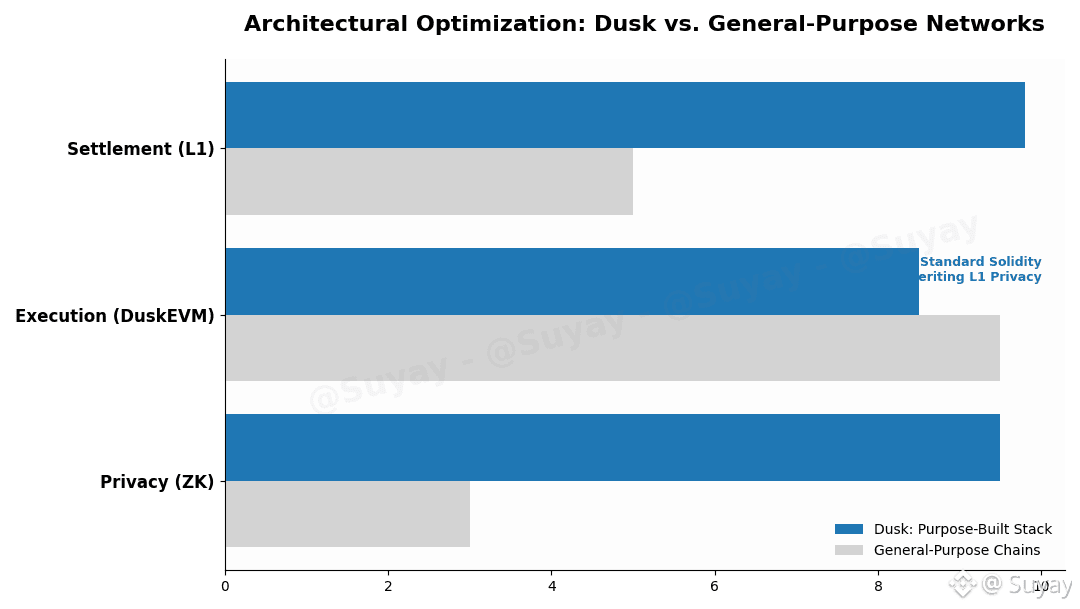
Privacy is addressed through Dusk’s cryptographic stack, designed specifically for compliant confidentiality. Financial markets require discretion, but also auditability. Positions, flows, and counterparty exposure cannot be globally transparent, yet regulators and authorized entities must retain oversight. Dusk enables this balance through zero-knowledge systems that allow transactions to remain confidential while preserving the ability to prove correctness and compliance.
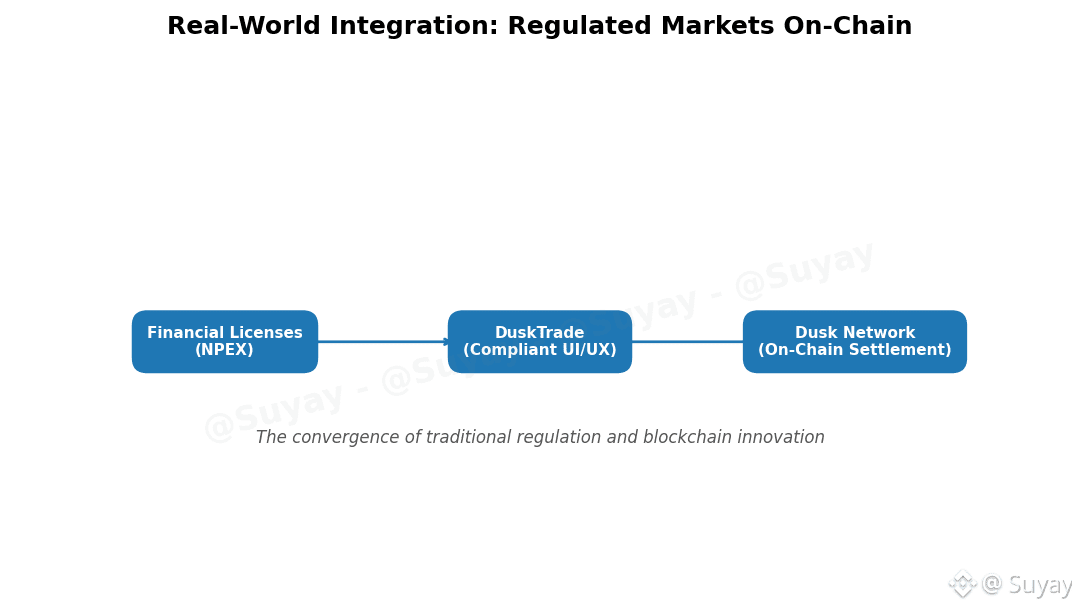
These architectural choices are not theoretical. They converge in Dusk’s growing real-world ecosystem. A central example is DuskTrade, developed in collaboration with NPEX, a regulated Dutch exchange holding multiple financial licenses. DuskTrade is designed as a compliant on-chain trading and investment platform, bringing regulated securities and institutional market activity directly onto Dusk’s settlement layer. It represents the practical expression of Dusk’s thesis: that on-chain markets must be built in coordination with regulation, not in opposition to it.
This is where Dusk diverges structurally from general-purpose blockchains. Most networks compete for applications, users, and liquidity. Their architectures optimize for openness, composability, and speed. Dusk optimizes for institutions, issuers, operators, and market infrastructure. Its design priorities reflect the realities of capital markets: confidentiality, enforceable asset logic, system stability, and regulatory compatibility.
The implication is significant. By embedding compliance, privacy, and asset structure directly into the protocol, Dusk enables markets that could not safely exist on transparent, application-first chains. Regulated issuance, confidential secondary trading, and programmable financial instruments become native capabilities rather than external engineering challenges.
Dusk is not attempting to replace the financial system with speculative primitives. It is building the on-chain foundations for how real financial markets can operate in a digital, programmable environment.
If blockchain adoption is to extend beyond experimentation into capital markets, it will require networks designed not only for innovation — but for institutions. Dusk Network is being built for that role.
