

Blockchain adoption in finance has stalled not because of technology, but because of structure. Financial markets are not open playgrounds. They are regulated systems shaped by law, confidentiality requirements, operational risk, and institutional accountability. Most blockchains were never designed for these conditions. They were built for openness, experimentation, and generic computation.
Dusk Foundation was created around a different assumption: if financial markets are to move on-chain, the infrastructure itself must be designed for them. Dusk Network is not positioning itself as a general-purpose platform. It is engineering a regulated financial stack where issuance, trading, settlement, and compliance can coexist at protocol level.
This distinction defines everything Dusk is building.
Financial markets are not applications
In traditional finance, infrastructure comes before products. Exchanges, clearing systems, custody frameworks, and regulatory processes exist long before individual instruments trade on top of them. These foundations determine what is possible.
Most blockchain ecosystems inverted this order. They launched applications first and attempted to retrofit financial requirements afterward. Compliance lives in interfaces. Privacy lives in external tooling. Settlement logic remains generic.
Dusk approaches the problem from the opposite direction. It starts from the conditions markets require: enforceable asset behavior, confidential yet auditable transactions, and operational environments compatible with regulated participants. Its Layer 1 is engineered around these constraints rather than attempting to work around them.
This is why Dusk does not describe itself as an app platform. It describes itself as financial infrastructure.
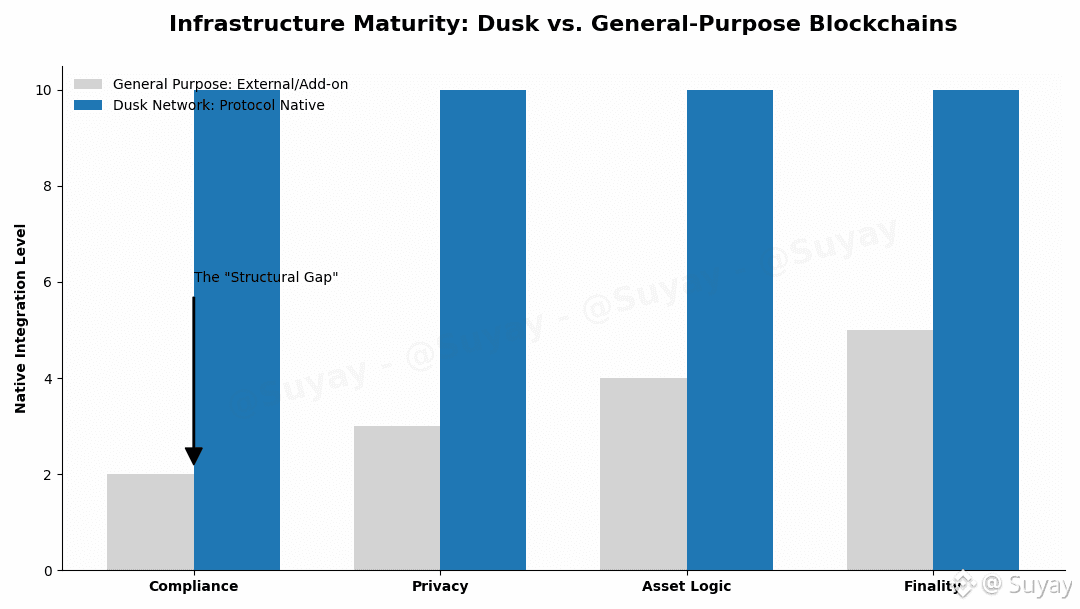
The modular financial stack
Dusk’s architecture reflects how real markets are structured.
At the base sits Dusk Network, responsible for settlement, confidentiality, and protocol-level financial guarantees. This layer is where compliance logic, cryptographic privacy, and asset constraints are anchored.
Above it operates DuskEVM, an Ethereum-compatible execution layer. Its role is not to compete with public chains, but to remove integration friction. Institutions and developers can deploy standard Solidity smart contracts while inheriting Dusk’s financial-grade settlement and confidentiality properties underneath.
On top of this stack, market applications can exist. The first major example is DuskTrade: a regulated trading and investment platform being built with NPEX, a licensed Dutch exchange. DuskTrade is not a showcase product. It is designed as an operational venue for tokenized securities, reflecting real issuance, trading, and settlement workflows.
Together, these layers form a coherent financial system rather than a collection of tools.
Privacy as a market requirement
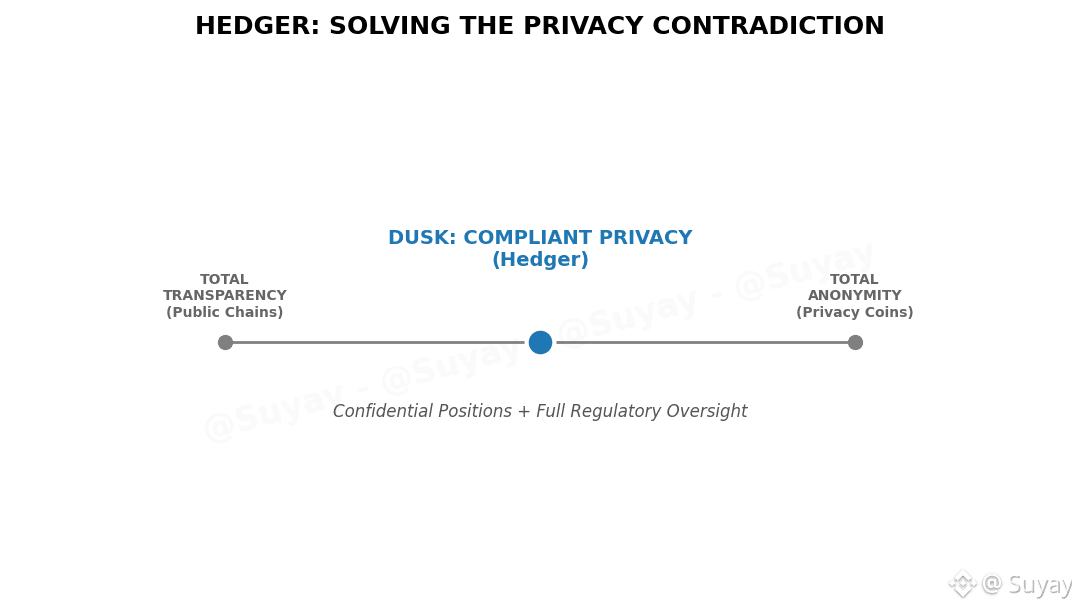
One of the central contradictions in blockchain finance is privacy. Public blockchains expose positions, flows, and participants by default. Financial markets cannot operate under those conditions.
Dusk resolves this through cryptographic design rather than obfuscation. Hedger enables confidential transactions on DuskEVM while preserving auditability and control. It is not anonymity. It is compliant privacy: a system where sensitive financial data can remain protected without removing oversight.
This capability is not an add-on. It is foundational. Institutions cannot adopt infrastructures that expose their books. Regulators cannot approve infrastructures that cannot be audited. Hedger exists to satisfy both simultaneously.
It reflects Dusk’s broader design philosophy: market requirements are embedded, not layered.
From experiments to capital markets
Dusk is not optimizing for retail experimentation or short-term activity. Its development trajectory aligns with how financial infrastructure actually evolves: slowly, structurally, and in direct relationship with regulated entities.
DuskTrade grounds the ecosystem in real market use. DuskEVM lowers the barrier for institutional participation. Hedger enables compliant privacy. And Dusk Network provides the settlement foundation that connects them.
This is not a DeFi narrative. It is a capital markets thesis.
If blockchain is to host real financial systems, it will not be through platforms built for general computation. It will be through infrastructures engineered for the legal, operational, and cryptographic realities markets depend on.
Dusk is being built for that role.
Conclusion
The question is no longer whether assets will move on-chain. The question is which infrastructures will be capable of hosting them without forcing finance to abandon its own rules.
Dusk Foundation is not adapting markets to blockchain. It is engineering blockchain for markets.
And that difference defines its mission.
