
Long-term holders are gradually exiting, and the market remains stable
Recently, a long-term holder of Solana (\u003ct-21/\u003e) tokens has begun to gradually exit, having unstaked over 98,000 SOL after holding for nearly two years. Initially, this portion of tokens was withdrawn when the Binance price was close to the cycle's peak and used for staking. Although the current exit price has significantly dropped compared to the peak, resulting in a loss of over 6.6 million dollars, the user has adopted a dollar-cost averaging (DCA) strategy instead of a one-time sell-off. This time-diversified exit method effectively avoids sudden market volatility caused by liquidation while also bringing sustained and moderate upward pressure.
Solana price consolidates within a range
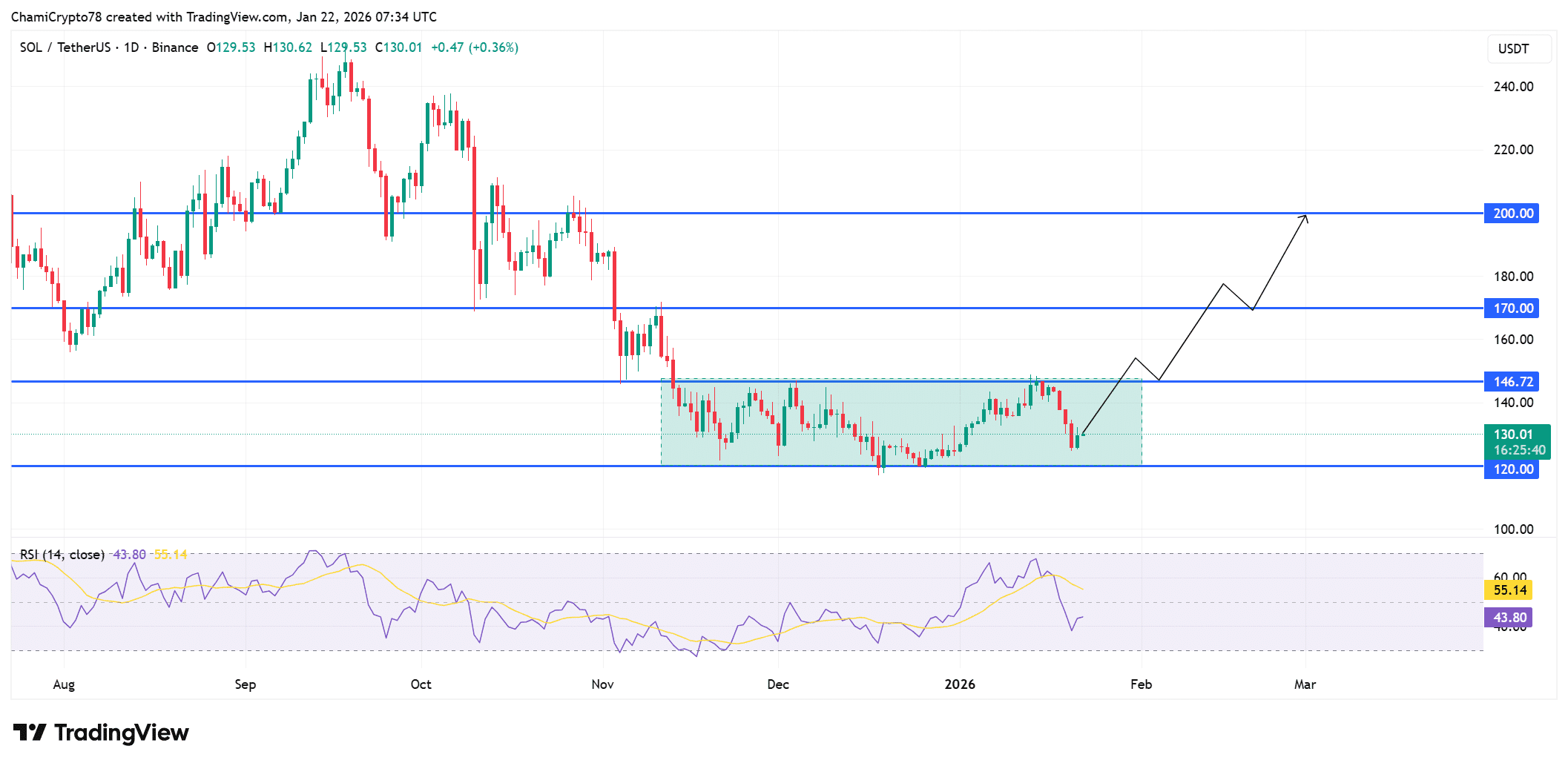
As of the time of writing, Solana's price is still fluctuating within a familiar range, with buyers consistently defending the support area of $120-125. Each time the price falls below this range, it quickly rebounds, preventing further declines. However, in the range of $146-150, attempts to rise repeatedly face obstacles, and each rebound loses momentum, forcing the price back to the midpoint of the range. Recently, the $135 area has become a short-term pivot, with prices oscillating between support and resistance, reflecting suppressed market volatility and an overall balanced price state, rather than a unilateral trend control.
Technical indicators show weakening momentum
From a technical perspective, the #solana daily RSI indicator has fallen from a high near 70 to about 43.8, indicating a weakening market momentum, but it has not yet issued an oversold signal. This means that selling power is not dominant, but the upward momentum of prices is also limited. The RSI indicator struggles to return to the midpoint of 50, indicating insufficient rebound momentum during the consolidation phase. When the price range contracts, the market reflects price compression rather than trend acceleration, overall showing weak momentum but robust structure.
Buyers absorb selling pressure, market remains stable
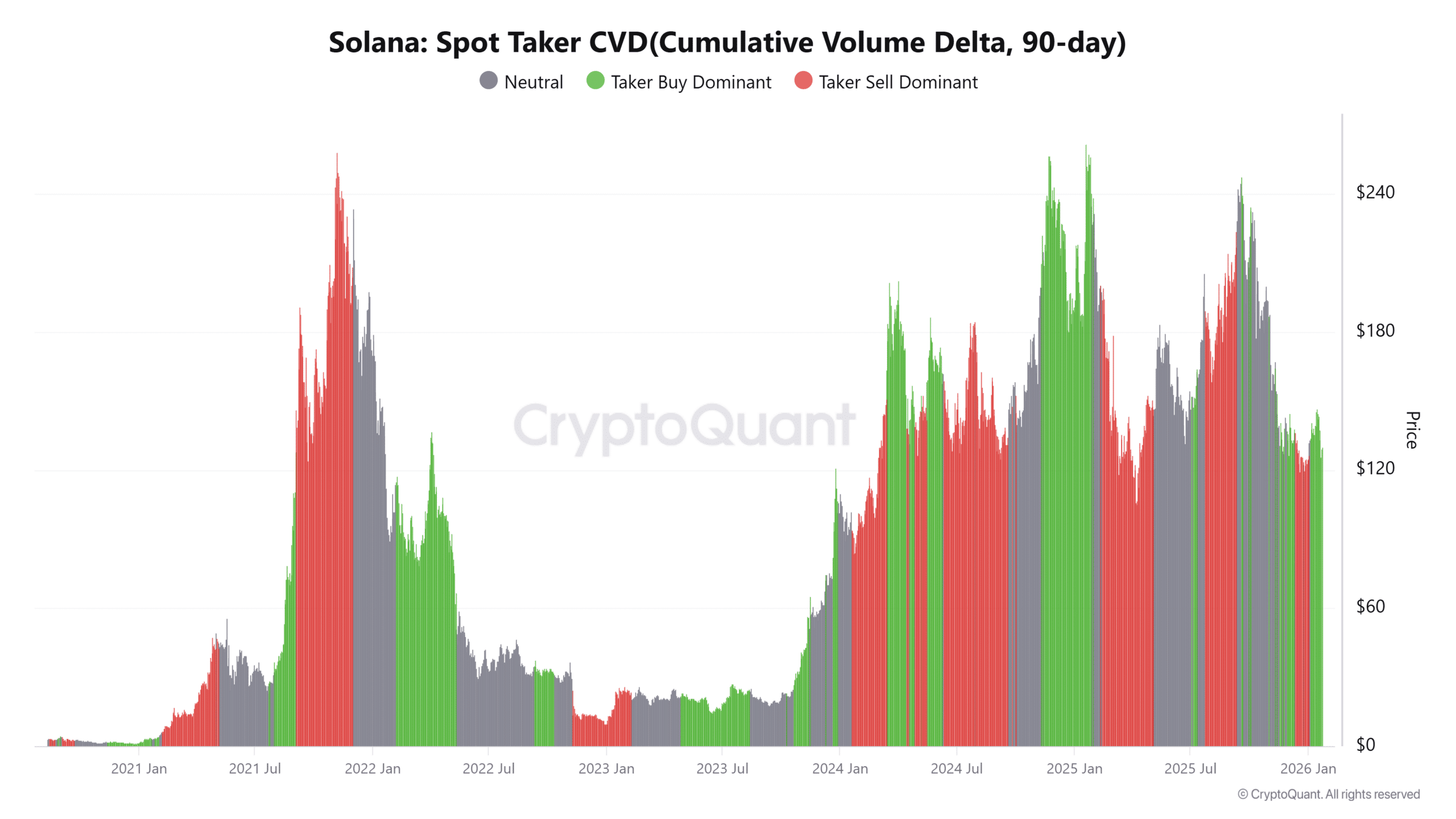
Despite large holders gradually selling off, spot trading data shows that cumulative trading volume (CVD) over a 90-day window remains dominated by buyers. Active buyers continue to enter near support levels, absorbing supply pressure, but prices have not risen further, indicating that the market is in a digestion phase rather than a chasing phase. The sustained dominance of buyers effectively reduces the likelihood of a significant price drop while stabilizing the range price, but merely absorbing selling pressure cannot drive a noticeable upward trend in the short term.
Top traders remain bullish
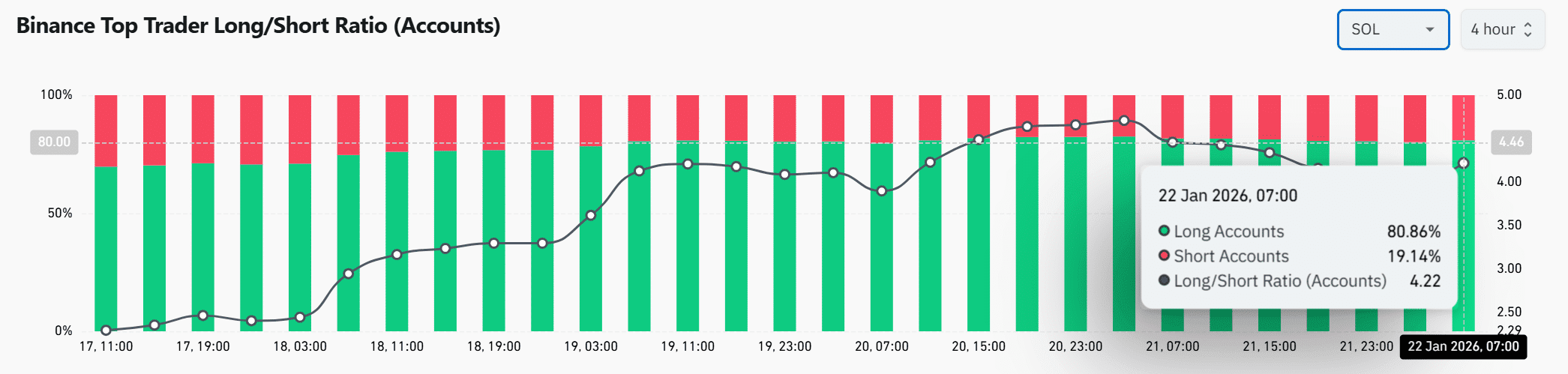
From the perspective of trader positions, Binance's top traders are still leaning towards bullish. As of the time of writing, over 80% of top accounts hold long positions, while short accounts only account for 19%, resulting in a long-to-short ratio of 4.22, indicating that bulls far outnumber bears. Nevertheless, the price remains within the consolidation range, without any breakthrough upward, suggesting strong market confidence, but the short-term price structure has not fully confirmed bullish expectations. Recently, the long-to-short ratio has slightly retreated, reflecting a mild digestion in the market rather than an aggressive risk-on sentiment.
Market balance has not been broken
Overall, Solana is currently in a long-term distribution absorption phase. Although there is some selling pressure, buyers are still actively defending key support levels, and the RSI indicator shows insufficient selling power, with top traders still holding a large number of long positions. Although prices lack expansion space, the market structure has not been damaged, and a clear balance state is evident. Only after a clear breakout from the consolidation range can bullish expectations be validated.
Summary
It can be said that Solana's current state is 'stability with tests.' Long-term selling pressure still exists, but due to buyers actively absorbing supply, the market has maintained range stability with limited volatility. Trader confidence remains high, but prices need to rise further to validate bullish expectations. Before breaking through key ranges, the market is still in a balanced state waiting for new directional signals.