
Imagine a world where trillion-dollar financial markets operate on-chain without sacrificing privacy or regulatory compliance – that's the reality Dusk is building right now. As someone who's been deep in the crypto trenches for years, spotting projects that bridge traditional finance with blockchain innovation, Dusk stands out for its no-nonsense approach to solving real problems. Founded back in 2018, this Layer-1 blockchain isn't chasing hype; it's engineering a foundation for regulated financial infrastructure that puts privacy and auditability at the core. With its modular architecture, Dusk enables institutional-grade applications, from compliant DeFi to tokenized real-world assets, all while ensuring transactions can be private yet verifiable. Let's dive into what makes this project a powerhouse for the next wave of on-chain finance.
At the heart of Dusk is its innovative technology stack, designed to eliminate the trade-offs that plague other chains. The DuskEVM, which hit mainnet in the second week of January 2026, brings full EVM compatibility to the table. This means developers can deploy standard Solidity smart contracts seamlessly, settling on Dusk's Layer-1 without the usual integration headaches. But here's where it gets clever: embedded within this is the Piecrust virtual machine, which compiles legal constraints directly into the code. Think securities laws or compliance rules automated at the microsecond level, enforcing rights and adjudication without needing intermediaries. This isn't just a patch; it's native compliance that rewrites how assets circulate, making Dusk a universal settlement layer for Web3 privacy. For instance, every smart contract call triggers zero-knowledge proofs, consuming the native DUSK token to power these operations, ensuring efficiency and deflationary pressure tied to actual network usage.
Privacy isn't an afterthought on Dusk – it's woven into the fabric using advanced cryptography like PLONK-based zk-SNARKs in the Phoenix transaction model. This allows for confidential transactions where sender, receiver, and amounts stay hidden, but cryptographic validity remains intact. The Citadel protocol takes it further, enabling selective disclosure: large funds can prove compliance to regulators without broadcasting positions globally. Combine this with homomorphic encryption in the Hedger module, now live in alpha, and you get privacy-preserving computations that are auditable on demand. It's a 'verifiable but not visible' system that protects data sovereignty while aligning with global regs like MiCA or MiFID II. In practice, this means tokenized assets – stocks, bonds, commodities – can be issued, managed, and settled on-chain with full lifecycle support, including transfer restrictions and corporate actions, all cryptographically enforced.
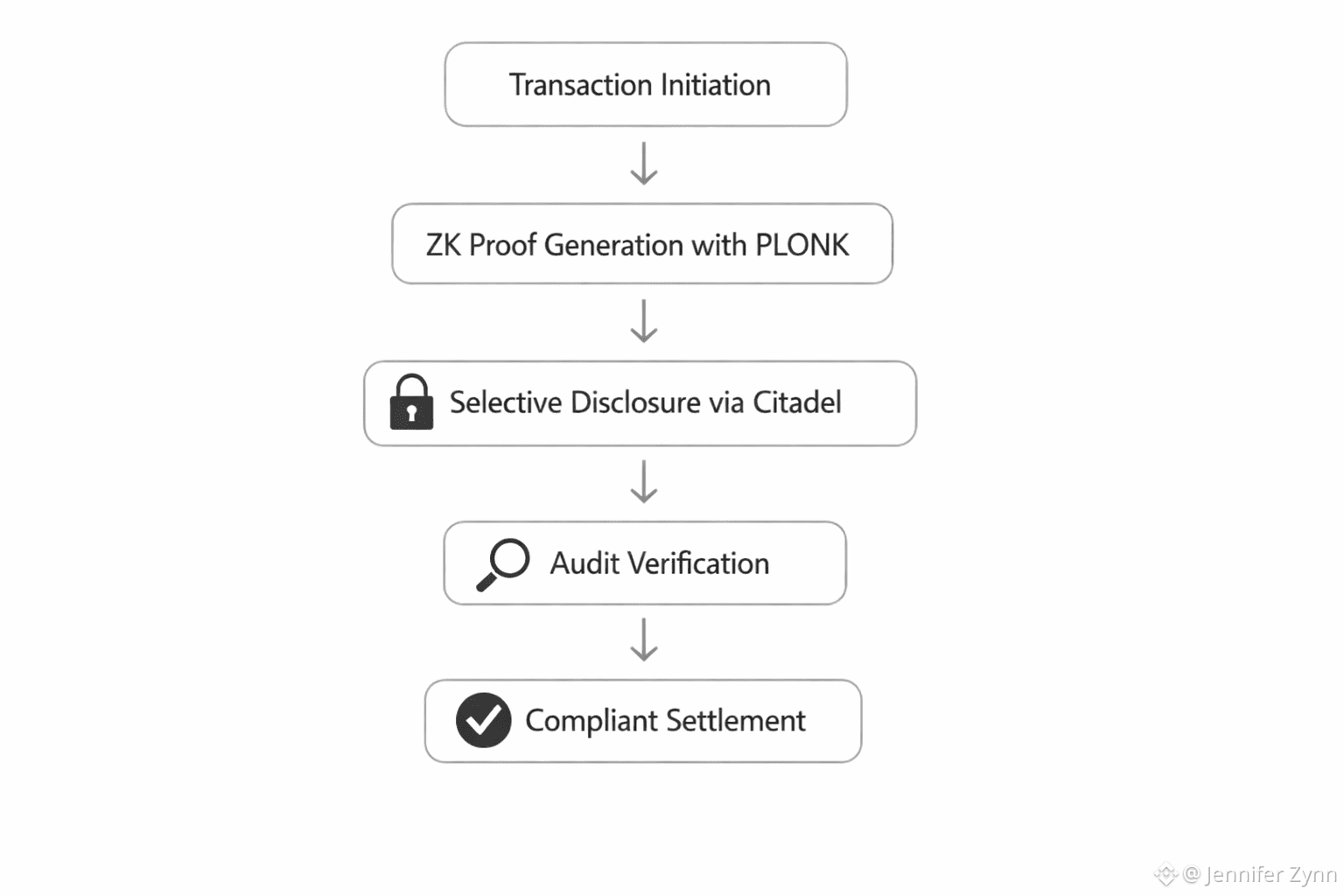
What sets Dusk apart in real-world applications is its focus on bridging fragmented markets. Take tokenized real-world assets (RWAs): Dusk facilitates their issuance and trading in a regulated environment, reducing liquidity fragmentation that costs institutions billions annually. Businesses can access financing and automate processes via smart contracts, outsourcing costly ops while maintaining self-custody. Institutions benefit from instant clearance and settlement, cutting out custodians and enabling automated compliance across borders. Users, whether in classic finance or crypto, gain unprecedented access to diverse assets from a single wallet, composing services across sectors without distinctions. A prime example is the integration of bulletin boards as a single source of truth, ensuring all parties operate from verifiable data without privacy leaks.
Partnerships underscore Dusk's institutional edge. The collaboration with NPEX, a regulated Dutch exchange holding MTF, Broker, and ECSP licenses, is bringing over €300 million in tokenized securities on-chain through platforms like DuskTrade. This isn't vaporware – it's real AUM moving to blockchain for compliant trading. Then there's the Chainlink integration, enabling cross-chain interoperability for RWAs via CCIP, Data Streams, and DataLink. Tokenized assets issued on DuskEVM can move securely between chains, becoming composable in broader DeFi ecosystems. Other key allies include Quantoz for the EURQ digital euro stablecoin, Cordialsys for compliant custody, and 21X as a DLT-TSS pioneer. These aren't just logos; they're licensed entities embedding Dusk's tech for production-grade solutions, like privacy-compliant payment rails and asset management.
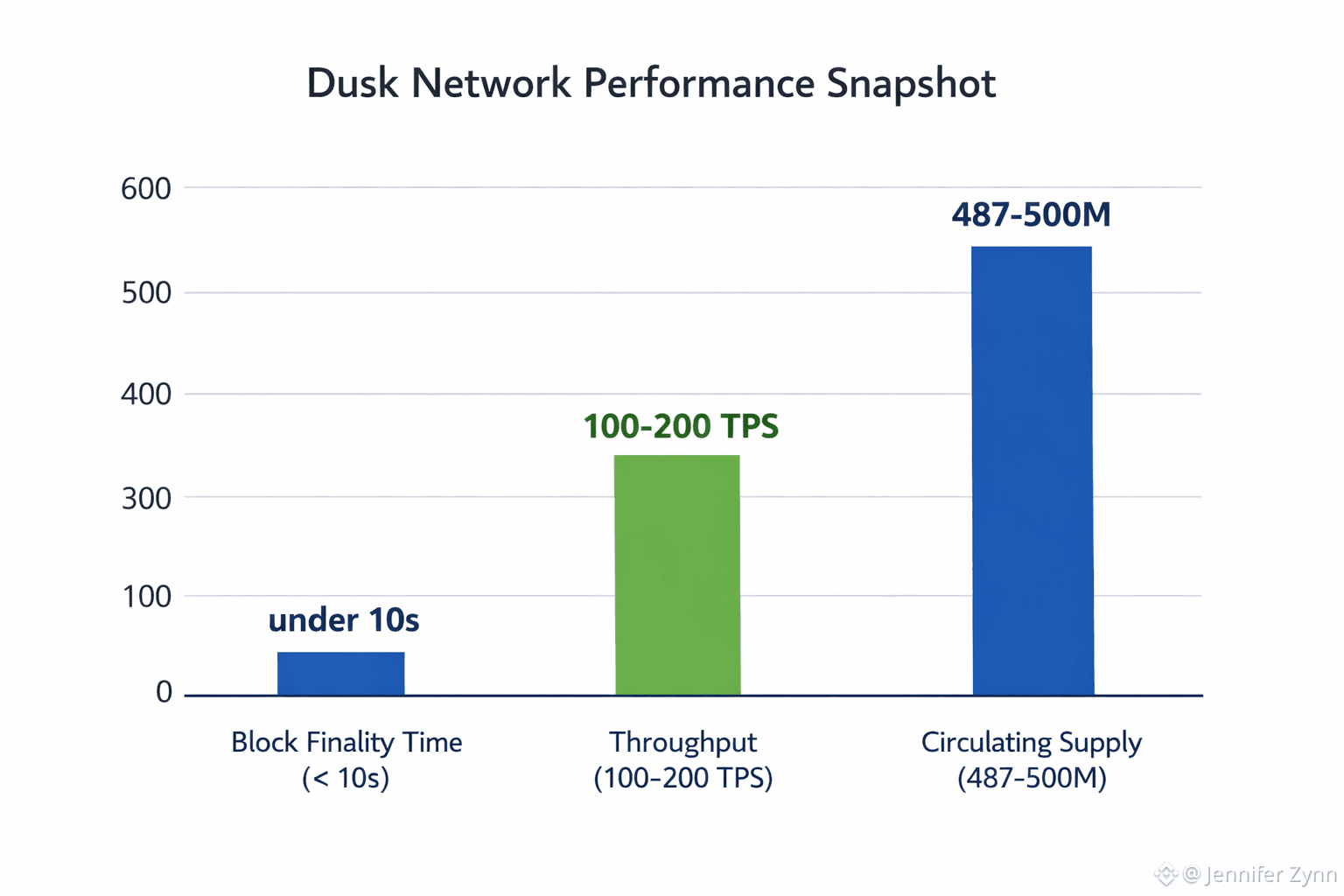
On the consensus front, Dusk's Segregated Byzantine Agreement delivers finality in under 10 seconds on average, with throughput hitting 100-200 TPS post-mainnet. This reliability supports high-stakes financial ops without the bottlenecks of slower chains. Staking mechanics further secure the network: validators propose blocks via a privacy-preserving Proof-of-Blind-Bid, tying incentives to honest behavior and providing Sybil resistance. With a circulating supply around 487-500 million out of a 1 billion max cap as of mid-January 2026, the system encourages long-term participation, where staked DUSK contributes to block production and governance through DAO processes.
Dusk's layered architecture – separating the native asset layer for staking and fees from the compute layer for contracts – ensures predictable economics and security. It avoids fragmentation by using DUSK as the sole token across the stack, creating a closed-loop that aligns network growth with real utility. For devs, this means building in a privacy-aware environment with familiar Ethereum tools, but optimized for regulated workflows like confidential liquidity models that prevent front-running in tokenized markets.
In a landscape cluttered with flashy narratives, Dusk delivers substance: a blockchain that's productizing profitable smart contracts for everyday finance. It's shifting from an institution-centric model to user-centric inclusion, where issuers tap global liquidity and everyone accesses markets on equal terms. If you're tracking projects that quietly solve the privacy-compliance paradox, Dusk is leading the charge with tech that's already in motion.
