


In crypto the first time you really understand governance risk is not when the chain is hacked or broken in an obvious way It is when nothing breaks nothing changes and yet you come to the slow realization that the project is locked in place The community still talks the token still trades the roadmap still exists But real decision making power has hardened into a small predictable shape
This quiet problem hides under the surface and is just as dangerous for traders and investors as a sudden technical failure This is the true governance risk that does not look like a crisis at first It looks like stability but it can turn into stagnation capture and long term fragility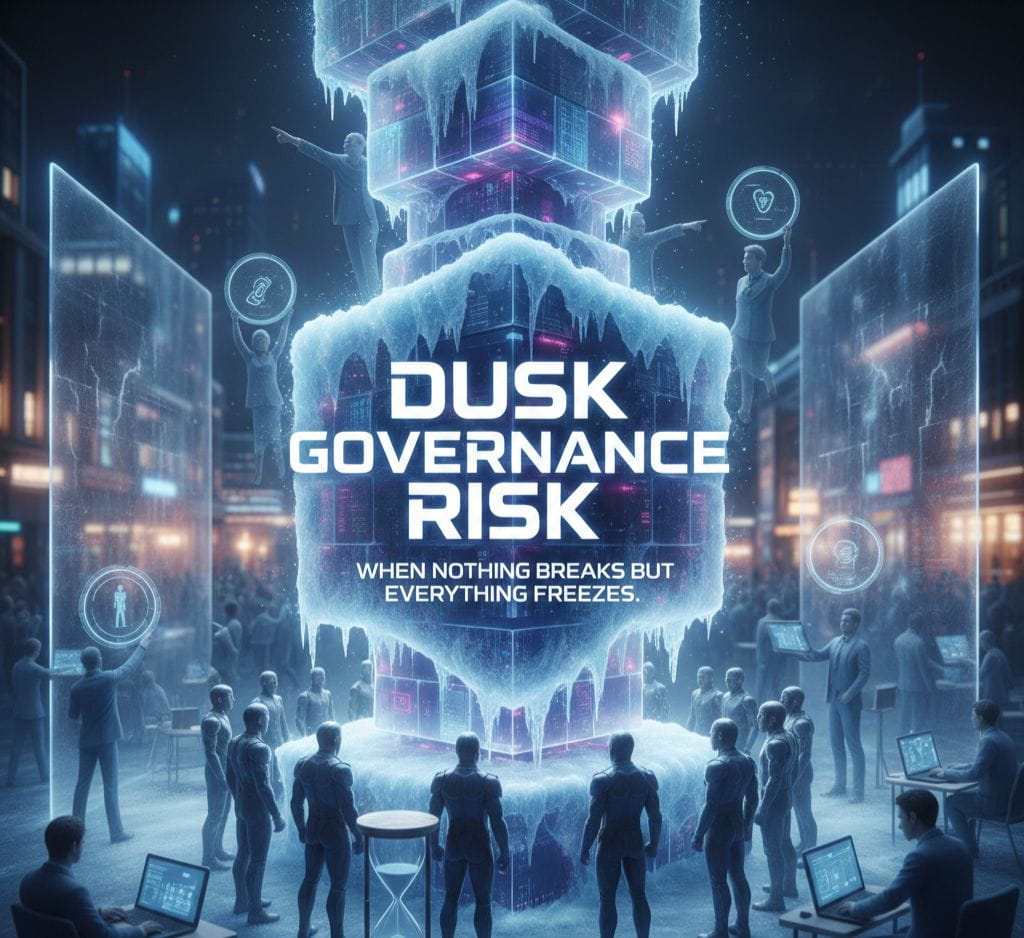
Dusk Network is a good example of this kind of risk because it promotes itself as infrastructure for regulated finance privacy and compliance It is not trying to be chaos It is trying to be reliable and predictable and that is exactly why investors want to believe the rules will stay steady and institutional grade But governance design will determine whether that trust becomes real credibility or slowly decays into a system that looks decentralized but behaves centralized
Dusk uses staking as a core part of how it works Staking is not just about earning rewards It directly supports network integrity and consensus participation Dusk documents explain that staking is a way to help secure the chain while earning rewards like in most Proof of Stake systems And like other PoS networks the token is at the center of everything Incentives consensus participation and broader system utility all flow through the token
Now this is where the hidden governance risk begins In practice staking systems often create a political class If voting power flows from stake then governance can evolve into something like a shareholder oligarchy This does not need corruption or dirty deals It happens naturally because capital tends to concentrate over time The most committed actors stake longer accumulate rewards build delegation networks become validators and end up with structural influence whether the community wants it or not
Many discussions about Dusk governance in public community content describe governance as stake weighted sometimes with proxy voting tools On the surface that sounds fair Larger long term participants take more responsibility But the same logic also means the average user steadily loses influence unless they actively delegate coordinate and stay politically engaged for years Most users dont Most people are busy Most token holders are not governance experts Many serious investors want exposure and predictable risk They do not want to vote every week Governance participation typically surges during drama and collapses during calm When that happens the system does not stop It just becomes easier to control
I have seen this pattern many times in crypto The first year feels democratic The second year feels procedural By the third year governance feels like a formality Proposals still happen but the outcome is known before the vote is finished It starts to feel like watching an election where the winner is decided by who shows up and you already know who shows up every time
This is what governance that never changes often means in real life Not that the protocol is stable But that the power map is stable For Dusk community materials also mention DAO processes and tools like off chain voting portals Whether governance is fully on chain or partially off chain is not the central point The point is that the social layer matters as much as the technical one The people who control proposal flow delegation habits and voting turnout effectively shape the chains long term direction
So what is the actual investor risk It is not simply whales vote That is obvious The deeper risk is that governance capture changes the chains future payoff distribution without needing a scandal A captured governance system can quietly shift reward structures to favor incumbents Set technical priorities that help validators not users Discourage controversial changes that are necessary for competitiveness And lock the chain into a safe but shrinking market niche
Chains that target regulated finance are especially exposed to this because regulations evolve Compliance standards change Reporting expectations shift What institutions demand now might be outdated in a few years If governance becomes politically frozen the chain can lose relevance without ever failing in a dramatic way The irony is that a chain can remain functional while becoming commercially obsolete
A simple example makes this clearer Imagine you are running a trading platform that wants to tokenize securities You adopt Dusk because privacy and auditability matter for institutional clients Years pass Regulators introduce new disclosure formats or require new verification standards The chain needs upgrades new primitives or changes to smart contract constraints But governance is dominated by a staking elite who earn nicely from the current setup and fear any change that might disrupt validator economics So the chain delays Debates drag on Proposals are watered down Institutions get impatient and move to a competitor Dusk did not break but the investment thesis quietly weakened
This is the hidden risk Governance rigidity does not show up in price charts early It shows up later as missed cycles lost integrations shrinking developer mindshare and eventually weak token demand If you are a trader you care because governance risk creates asymmetric event risk Markets do not price slow decay well The repricing happens suddenly often triggered by something small like a rejected upgrade a controversial parameter change or a governance drama that exposes how concentrated power really is
If you are a long term investor you care because governance quality is survival Token value is downstream of utility and utility is downstream of adaptation Chains that can not change do not stay safe They just stay still while the rest of the market moves The uncomfortable conclusion is this Decentralization is not a checkbox It is a living culture If Dusks governance continues to evolve in a way that balances stake based security with broad participation it strengthens the regulated finance infrastructure thesis But if governance slowly ossifies into permanent incumbency the chain may still look healthy on the surface while losing its ability to compete when it matters most
So the question every DUSK trader and investor should ask is simple If the next major upgrade depends on governance courage not code do you believe the system will choose the future or protect the past
